Food Policy Watch

FRESH Act 2026: What the Proposed FDA Reform Means for Your Food

A sweeping draft bill would reshape how the FDA regulates food ingredients. Here's what the FRESH Act proposes, who supports it, who opposes it, and what it means for shoppers.

May 7, 2026|10 min read
By Sanket Patel|Updated 2026-05-07|4 sources|Editorial standards
FRESH Act 2026: What the Proposed FDA Reform Means for Your Food

A draft bill introduced in Congress could reshape how the FDA oversees the ingredients in your food. Titled the FDA Review and Evaluation for Safe, Healthy, and Affordable Foods Act of 2026, or the FRESH Act, the legislation proposes sweeping changes to the way food chemicals enter the marketplace, are reviewed for safety, and are regulated across state lines. Introduced by Representative Kat Cammack (R-Florida), the bill was debated alongside 27 other food policy proposals during an April 29, 2026 hearing of the House Energy and Commerce Subcommittee on Health.

At the center of the debate is a system that most consumers have never heard of: the Generally Recognized as Safe pathway, or GRAS.

What Is GRAS and Why Does It Need Fixing?

What Is GRAS and Why Does It Need Fixing?

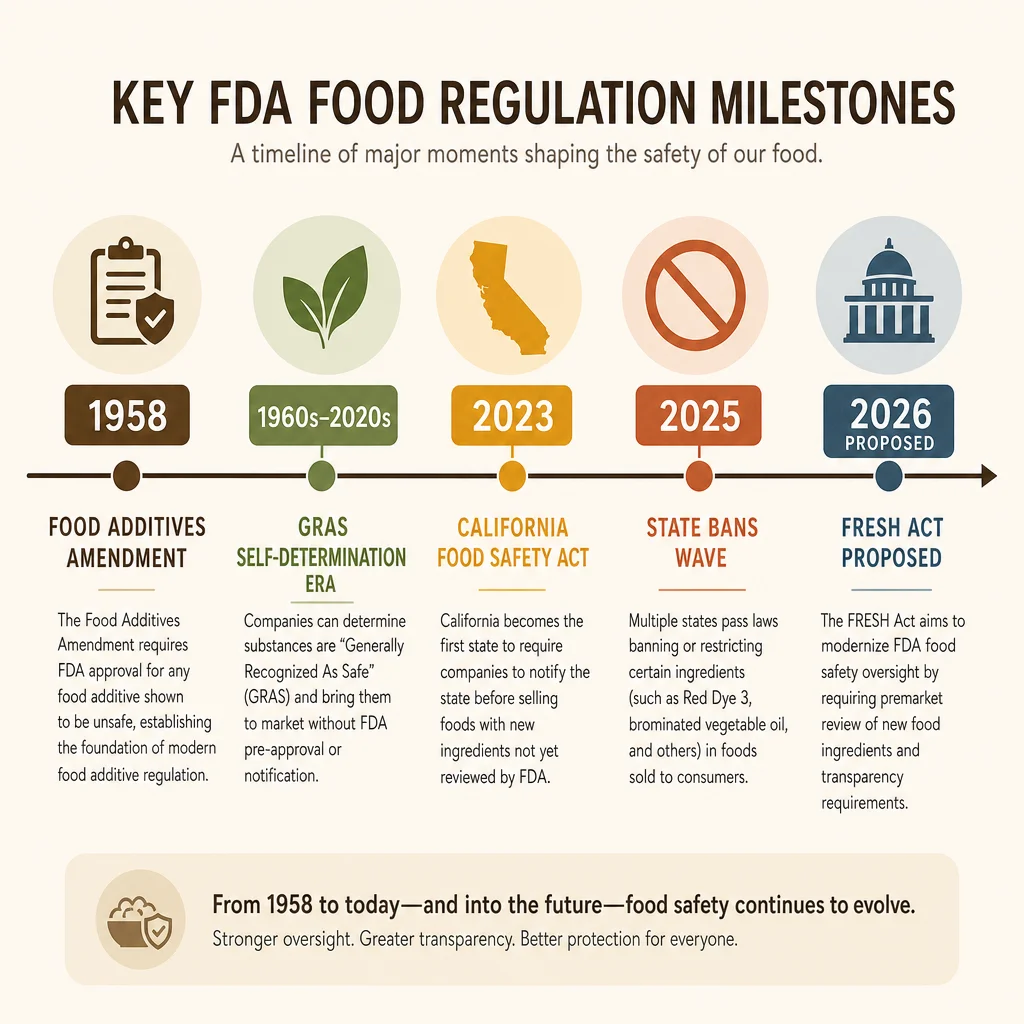
The GRAS designation dates back to the 1958 Food Additives Amendment. The idea was simple: substances with a long history of safe use in food, like salt, sugar, and vinegar, did not need to go through the same premarket approval process as novel synthetic chemicals. Over time, however, the GRAS loophole expanded far beyond its original intent.

Today, a food manufacturer can determine on its own that a new ingredient is GRAS, hire a panel of experts to review internal safety data, and introduce that ingredient into the food supply without ever notifying the FDA. The agency estimates that the average number of GRAS notices submitted voluntarily each year represents only a fraction of the substances actually entering the market through self-determination.

"The current GRAS loophole allows food companies to introduce new food substances without submitting safety data for FDA review," said Sarah Sorscher, Director of Regulatory Affairs at the Center for Science in the Public Interest (CSPI).

This is not a hypothetical problem. The FDA does not know how many GRAS substances are currently in the food supply. Some estimates place the number of chemicals in the US food system above 10,000, many of which have never been independently reviewed by the agency.

What the FRESH Act Would Change

The FRESH Act amends the Federal Food, Drug, and Cosmetic Act in three major ways.

Mandatory GRAS Notification

Currently, companies can voluntarily submit a GRAS notification to the FDA. The FRESH Act would make notification mandatory. Manufacturers would be prohibited from introducing any food containing a new GRAS substance unless a notification is on file with the FDA.

The bill requires manufacturers to submit detailed information including the substance's identity, manufacturing process, specifications, and a scientific summary supporting its safety. The FDA would have 90 days to review each submission. If the agency does not respond within that window, the notification becomes effective automatically.

Critics see the 90-day provision as a critical weakness. Melanie Benesh, EWG's Vice President for Government Affairs, warned that it would "allow new chemicals to be added to food if the FDA does not respond to a GRAS notice within 90 days." The concern is that an underfunded FDA may not have the resources to review submissions thoroughly within the timeframe.

A Public GRAS Registry

The FRESH Act would create a public registry of all GRAS determinations. Within 120 days of a GRAS notification taking effect, the FDA would be required to publish the full text of the submission, excluding properly claimed confidential business information. Crucially, the bill specifies that "pivotal safety data" cannot be claimed as confidential.

For consumers, this means greater visibility into what chemicals are in their food and what safety data exists to support their use. Currently, there is no single public resource where you can look up whether a food ingredient has been reviewed for safety.

A New Category: "Common Food Ingredients"

One of the more controversial provisions creates a new statutory category called "common food ingredients." These are defined as ingredients that were "ordinarily consumed as food or available to purchase as an independent article of food on or before January 1, 1958." The list explicitly includes fruits, vegetables, legumes, nuts, seeds, algae, meat, poultry, fish, grain ingredients, milk, honey, and traditional bacterial cultures, along with any substances derived from them.

These ingredients would be excluded from regulation as food additives, effectively creating a broad categorical exemption from premarket clearance. While the intention may be to prevent common foods from being regulated like synthetic chemicals, critics worry the "derived from" language could create new loopholes.
The State Preemption Fight

The State Preemption Fight

Perhaps the most contentious provision in the FRESH Act is federal preemption of state food safety laws. The bill would establish a national standard governing the use, sale, labeling, and marketing of food substances, overriding any state-level requirements or prohibitions.

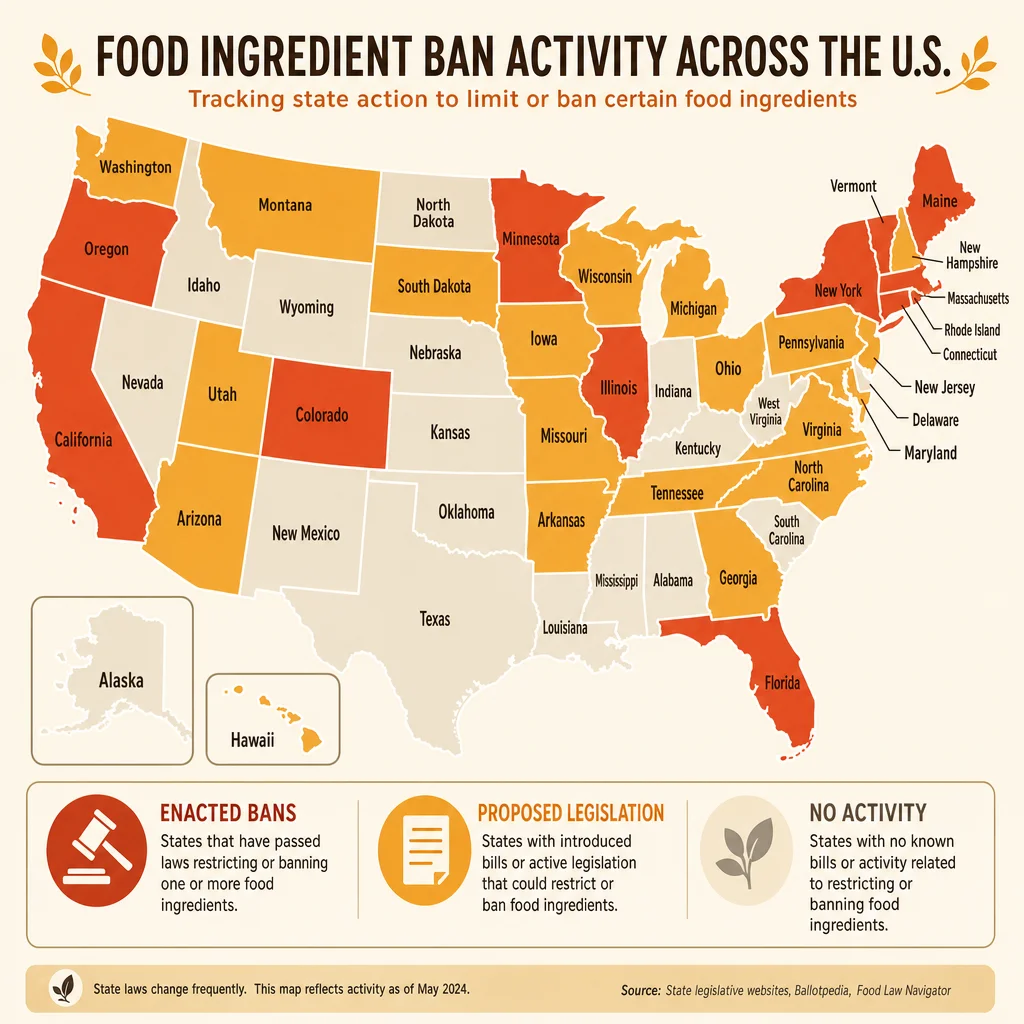
This is significant because states have been moving faster than the federal government on food chemical regulation. In 2023, California passed the California Food Safety Act, which bans four chemical food additives (brominated vegetable oil, potassium bromate, propylparaben, and Red Dye No. 3) starting in 2027. Other states have since introduced their own bills targeting synthetic dyes in school foods, PFAS in food packaging, and additional additives.

The EWG maintains an interactive map tracking which states have enacted or proposed food chemical regulations. More than a dozen states have active legislation targeting specific ingredients.

"This extreme preemption language will hurt consumers but serves as a major win for big food companies," Ms. Sorscher said, citing the industry-backed lobbyist group Americans for Ingredient Transparency.

The bill does include an exception: state requirements adopted by public initiative or referendum before September 1, 1997 would not be preempted. But for most modern state food safety laws, including California's landmark ban, the FRESH Act would override them.

Who Supports the Bill?

The FRESH Act aligns closely with the policy priorities of Americans for Ingredient Transparency (AFIT), a coalition formed in October 2025 by major consumer packaged goods companies including Coca-Cola, PepsiCo, General Mills, and NestlΓ©. AFIT advocates for "one, uniform, consumer-friendly standard" for ingredient regulation centered on FDA authority.

The industry argument is straightforward: a patchwork of 50 different state ingredient regulations creates confusion for consumers and compliance burdens for manufacturers. A single national standard, the argument goes, would provide consistency and clarity.

AFIT frames its priorities around GRAS reform, national labeling standards, and federal preemption. Their website describes the current state-by-state approach as an invitation to "regulatory division."

Who Opposes It?

On the other side, consumer advocacy groups including CSPI, the Environmental Working Group, and Children's Health Defense have strongly opposed the bill.

EWG titled its response statement "FRESH and Affordable Foods Act is rotten to the core," listing ten specific ways the bill would weaken food safety oversight. Their chief complaints: the bill would retroactively approve all existing GRAS substances, allow industry-funded expert panels (specifically naming the Flavor Extract Manufacturers Association, or FEMA) to conduct safety reviews, and block states from enacting stronger protections than the federal government provides.

"[The FRESH Act] would gut rules on the information companies must provide to FDA when submitting a notice that a food chemical is generally recognized as safe," EWG wrote.

The Alliance for Natural Health USA took a different angle, arguing that while reform is needed, converting GRAS into a quasi pre-market approval system could "reduce access, stifle innovation, and consolidate control over the food supply." Their concern is that smaller producers of natural ingredients could be priced out of the market by burdensome notification requirements.

Why This Matters Right Now

The FRESH Act arrives at a moment of unusual intensity in American food policy. The Make America Healthy Again (MAHA) movement has placed food ingredients, synthetic dyes, and ultra-processed foods at the center of political conversation. States are actively passing their own ingredient bans. And consumers are increasingly reading labels, downloading ingredient scanner apps, and demanding transparency.

The April 29, 2026 hearing before the House Energy and Commerce Subcommittee on Health considered 28 FDA food policy bills, reflecting a Congress that is unusually focused on food regulation. The FRESH Act is one of the most comprehensive among them.

What happens next is uncertain. The bill has not yet been formally introduced as numbered legislation; it remains a discussion draft. Its path through Congress would require committee markup, floor votes in both chambers, and presidential signature. That timeline is measured in months or years, not days.

In the meantime, the debate itself is valuable. It exposes the tension between uniform national standards and state-level innovation, between industry's desire for predictability and consumer advocates' demand for stronger safeguards. Whatever the outcome of this specific bill, GRAS reform is no longer a niche regulatory topic. It is now front and center in the public conversation about what is in our food.

What Consumers Can Do

While Congress debates, consumers are not powerless. Reading ingredient labels remains the most direct way to know what you are eating. Learning to recognize additives that are banned in other countries but still permitted in the US is a practical skill. And tools that help decode food labels can bridge the gap between regulatory complexity and everyday shopping decisions.

Using IngrediCheck, you can scan food products and instantly see which additives and allergens they contain, including substances that face regulatory scrutiny in jurisdictions around the world. While lawmakers consider the future of food chemical oversight, you can make informed choices about what goes into your cart today.

Next Label Check

Follow the scanner, hub, and ingredient paths connected to this guide

Get the app for clearer label decisions.

Scan labels, see what fits your food notes, and read the why in plain English.

IngrediCheck app