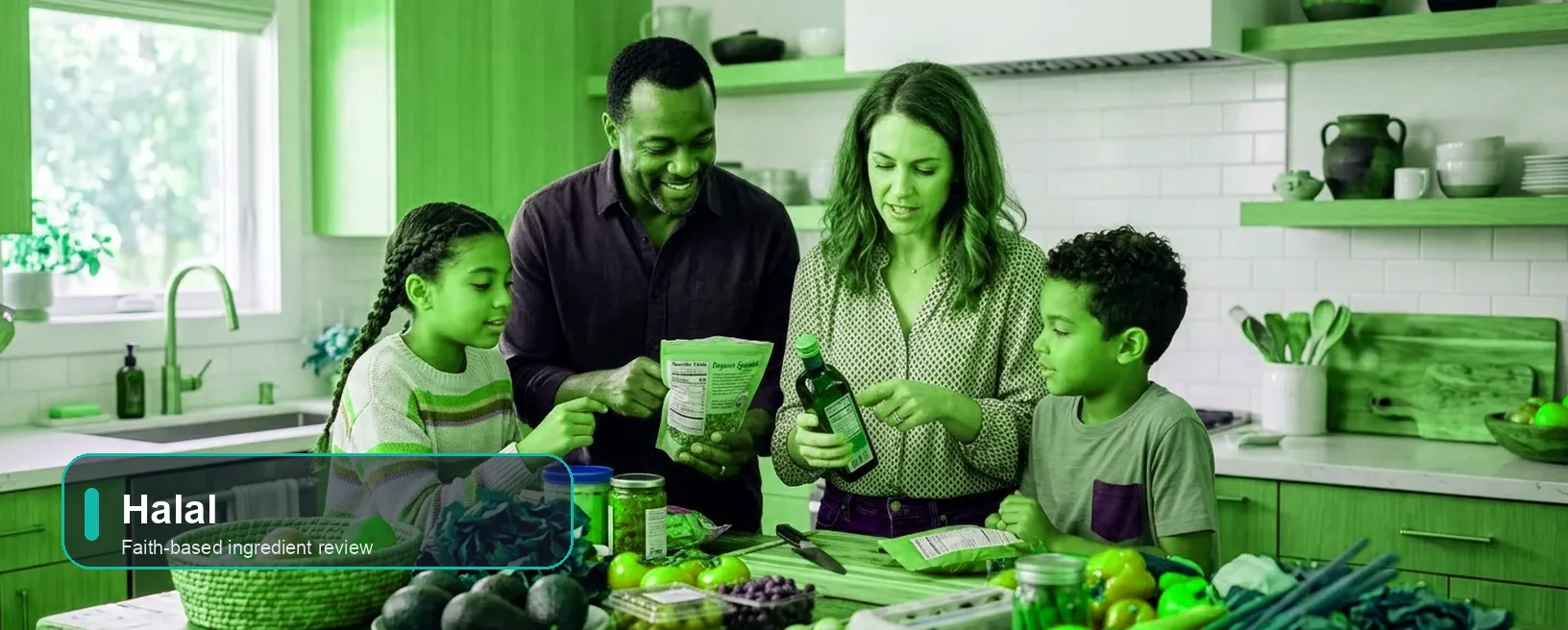
Halal shopping gets harder the moment you leave obvious foods and start dealing with packaged ones. A protein bar, gummy candy, soup base, dessert topping, or supplement can look ordinary while still raising real questions about gelatin, glycerin, enzymes, flavors, alcohol, or other source-dependent ingredients.
A halal food scanner app is useful when it speeds up that first pass on the label. The honest goal is not to turn a scan into a religious ruling. It is to help you catch obvious problems faster, surface ambiguous ingredients sooner, and save your time for the products that actually need certification or deeper review.
This article is for informational purposes only and is not a religious ruling. If your household follows a particular scholar, madhhab, or certifier, continue to follow that guidance and use label scanning as a support tool rather than a substitute.
One of the most useful points in IFANCA's guidance on halal and haram lists is that ingredient lists can help consumers understand labels and make informed halal choices, but fixed lists of specific products are less reliable because formulas can change and a product sold in one region may differ from the version sold somewhere else.
That is the real packaged-food problem. Whole foods are usually simple. Processed foods are not.
Even when the FDA's ingredient-list rules give you the main ingredients in descending order by weight, the halal question is often still:
- Is this ingredient clearly acceptable, clearly not acceptable, or source-dependent?
- Is this a product I can rule out immediately, or one that needs certification review?
- Is this brand familiar, but this specific product or region different?
That is why halal grocery shopping often becomes a label-interpretation job, not just a shopping job.
The Real Friction Is Source-Dependent Ingredients
IFANCA's Shopper's Guide is useful because it separates ingredients into things to avoid and things to investigate further. Its avoid list includes ingredients such as gelatin, hydrolyzed animal protein, lard, pork, shortening, and ethyl alcohol. Its investigate further list includes exactly the kinds of ingredients that slow shoppers down in real aisles:
- artificial and natural flavorings
- enzymes
- glycerin
- mono- and diglycerides
- polysorbates
- stearic acid
- whey
That tells you something important: the hardest halal packaged-food decisions are often not about an obvious pork ingredient. They are about ingredients whose source is not obvious from the label.
This is where a scanner becomes helpful. A good tool should not just look for one or two forbidden words. It should help translate ingredient panels into fine, not for this household, or needs a closer look.
Certification Matters Because Halal Review Goes Beyond the Printed Label
This is the core limitation every honest halal tech product has to admit.
IFANCA says in its FAQ on halal and haram lists that it supervises facilities, examines and approves ingredients, and allows approved products to carry the Crescent-M symbol. In IFANCA's own consumer materials, the organization also tells shoppers to look for the Crescent-M logo on the label or verify the certification in its product listing, and reminds consumers that not every product from a company is necessarily halal-certified.
That distinction matters because a certifier is evaluating things the ingredient panel does not fully reveal:
- the source of ambiguous ingredients
- how the product was made
- whether contamination controls were acceptable
- whether packaging and logistics still met the certification standard
In other words, a scanner and a certifier solve different problems. The scanner helps with ingredient triage. The certifier settles the product-specific halal status more reliably.
How IngrediCheck Fits This Use Case
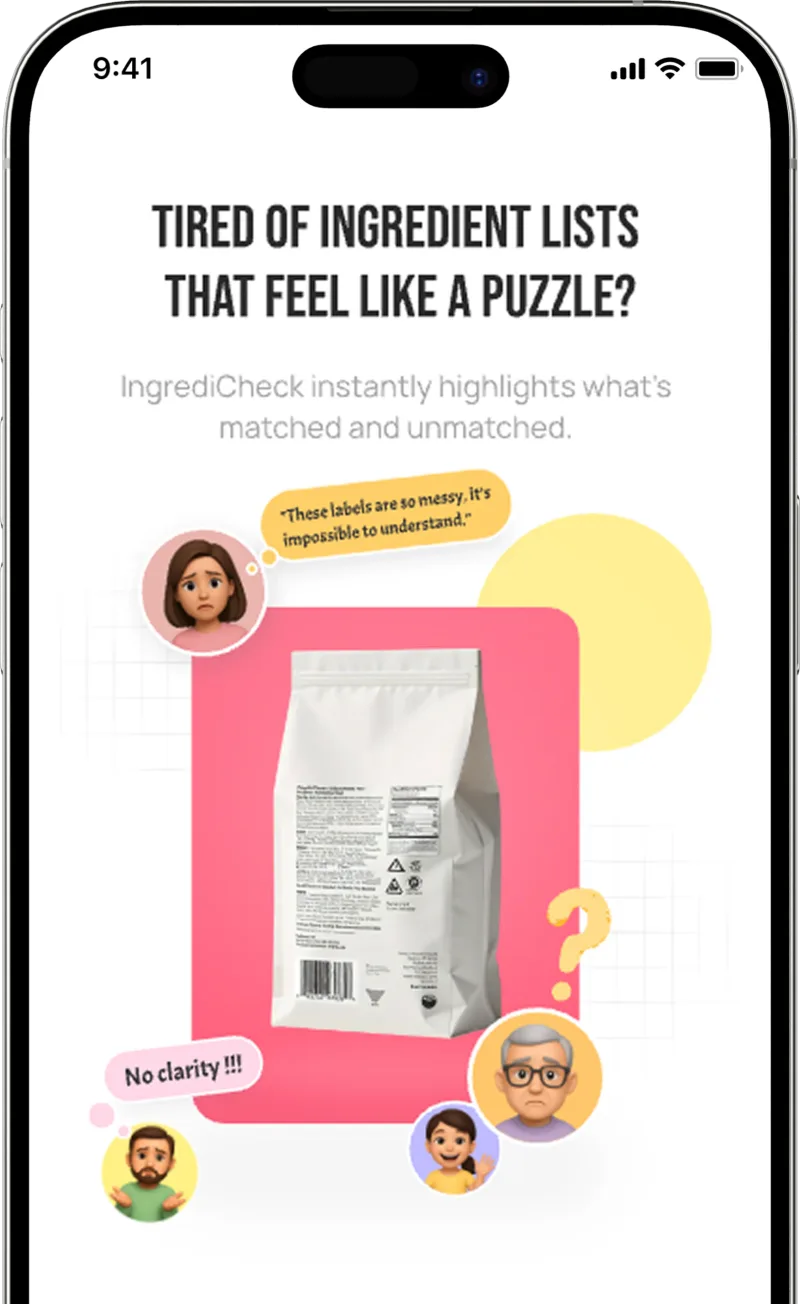
IngrediCheck is strongest here when it is used as a first-pass label-review tool against your own saved rules.
That means you can save rules like:
avoid pork, lard, and ethyl alcoholflag gelatin, glycerin, and mono- and diglycerides for reviewtreat flavors and enzymes as needs-review ingredients
Then you can scan the barcode or ingredient label and see whether the product matches those saved rules, with the reason spelled out clearly.
That is a useful workflow because it helps you rule out obvious conflicts quickly and spend your attention on the products that actually need a logo check, a certifier lookup, or a second review.
For a shorter workflow with certification limits kept explicit, use the halal ingredient checker page. If you want the broader product context, compare this page with the general ingredient checker app guide, the parallel kosher scanner app guide, and the full ingredient checker and food scanner guides hub.