Label Reading Guides

How to Read Food Labels Abroad When You Don't Speak the Language

Use a practical supermarket workflow to find the ingredient list, capture the complete package, interpret unfamiliar label conventions, and verify a packaged food abroad.

Jul 27, 2026|10 min read
By Sanket Patel|Updated 2026-07-27|8 sources|Editorial standards
How to Read Food Labels Abroad When You Don't Speak the Language

You are holding a packaged snack in a supermarket abroad. The brand looks familiar, but the ingredient panel is not in a language you read confidently. The barcode may return nothing useful. Bold words catch your eye, yet you do not know whether they mark allergens, headings, or marketing.

The safest practical response is not to translate one promising phrase and decide. Read the package as a structured document: identify the current product, capture every relevant panel, translate unfamiliar text, compare the available information with your own food rules, and verify the result against the physical package.

If you want to compare a foreign package with saved allergies, diets, and avoid rules, the travel food label checker supports that personalized part of the workflow. It can recognize some non-English labels and provide an English suitability explanation, but it does not consistently turn every ingredient list into a complete English transcript.

The Five-Step Aisle Workflow

The Five-Step Aisle Workflow

Use the same order every time. A repeatable process makes it less likely that a warning on another panel, a wrapped line, or a different local formula will be missed.

  1. Confirm the exact package. Check the product name, flavor, size, market, and any variant wording.
  2. Find every decision panel. Locate the ingredient list, allergen statement, precautionary warning, certification marks, and relevant preparation instructions.
  3. Capture the complete text. Photograph the panels in clear light, using overlapping images when the text wraps.
  4. Translate and compare. Use literal translation for unfamiliar words, then compare the available label information with the Food Notes or written rules that matter to you.
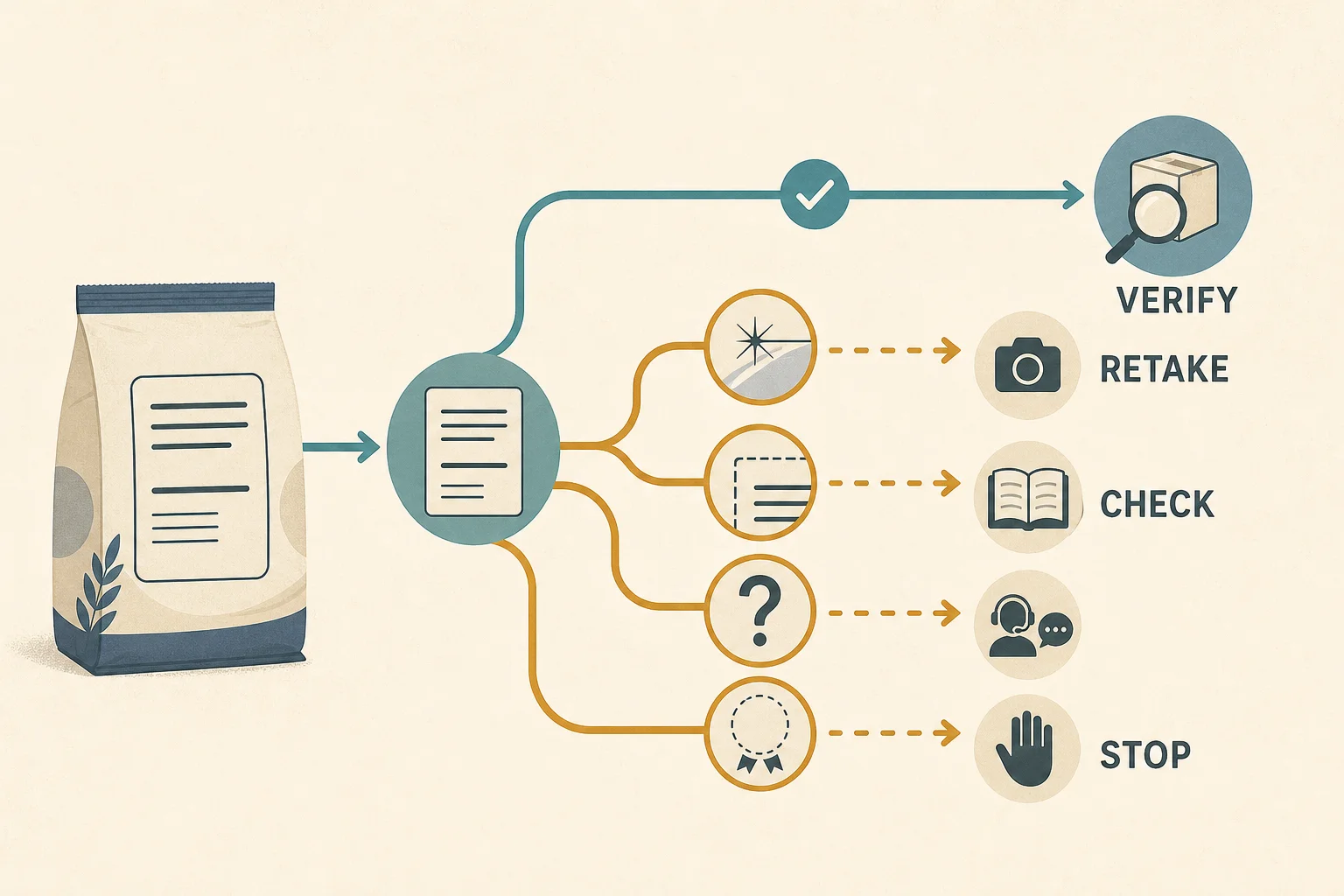
  5. Verify before buying. Match the output back to the package. Treat missing text, ambiguous sources, and unfamiliar warnings as reasons to stop or investigate.

This workflow separates two questions that are easy to confuse. “What does this text say?” is a translation question. “Does this declared information fit my rules?” is a personal checking question. A useful shopping process answers both without pretending that either answer proves safety.

Step 1: Confirm You Have the Right Product

Do not begin with the assumption that a familiar brand has the same formula everywhere. Recipes, pack sizes, suppliers, warnings, and certification can differ by country or change over time.

Start with visible identifiers:

  • exact product and flavor name
  • pack size and format
  • country or market information
  • manufacturer or importer
  • certification marks
  • date and lot information when relevant

An online image from home is supporting context, not the decision label. The package in your hand is the current evidence. This matters even when the front design looks nearly identical to the product you usually buy.

For diagnosed allergies, use the rule recommended by the FDA's consumer label guidance: read the label rather than relying on familiarity with the product. Outside the United States, the required allergen names and presentation may differ, but the habit of checking the current package still holds.

Step 2: Find the Complete Decision Surface

The front of a package is designed to sell. The decision usually lives on the back, side, base, lid, or a label placed over the original packaging.

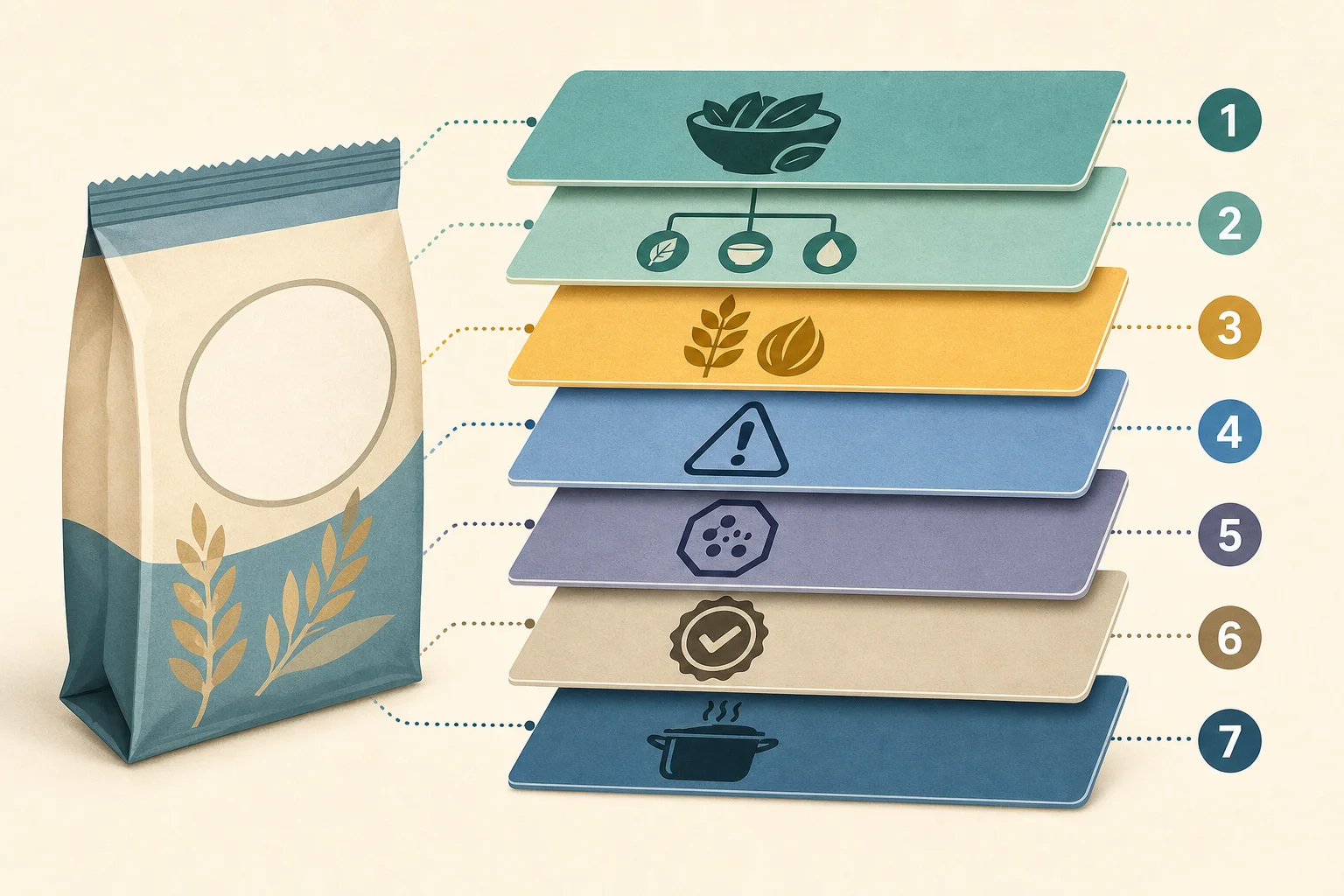
Look for five kinds of information:

Ingredient list

The ingredient list is usually a dense block introduced by the local equivalent of “ingredients.” It may list components in descending order by weight, but the exact legal rules depend on the market. Use a translator to locate the heading if necessary.

Sub-ingredients

Compound ingredients can contain their own components inside parentheses or after punctuation. A sauce, seasoning blend, filling, coating, or flavor system may hide the detail that matters to your rule. Capture the full nested list.

Allergen declaration

Some systems emphasize regulated allergens within the ingredient list. Others use a separate “Contains” statement or allow more than one presentation. Do not assume bold text means the same thing everywhere.

Precautionary language

Statements such as “may contain,” “made in a facility,” or “shared equipment” address possible unintended presence rather than a direct ingredient. The UK Food Standards Agency's precautionary-label guidance explains that this wording is voluntary and should follow a cross-contamination risk assessment. Your own response should follow the allergy plan appropriate to you.

Certification and preparation details

A certification mark, dilution instruction, cooking step, or “add milk” direction may change the practical decision. Translation can help you understand these elements, but verify the actual mark and issuing body rather than relying on a translated logo description.

Step 3: Photograph the Label So Nothing Is Missing

Step 3: Photograph the Label So Nothing Is Missing

The quality of the input sets the ceiling for every later step. A sharp photo of half the label is still incomplete.

Before taking a picture:

  • wipe condensation from chilled packaging
  • move away from direct glare
  • flatten flexible packaging where possible
  • hold the camera parallel to the text
  • fill the frame without cutting off edges
  • use a second image when the panel wraps
  • include the ingredient heading and the end of the list
  • capture nearby allergen and precautionary statements

Review each image before leaving the panel. Zoom in and make sure letters are legible. If a fold covers one line or a reflection erases several words, retake it.

The existing food-scanning OCR guide explains why curved, reflective, and tiny text is difficult for automated capture. The practical lesson is simple: make uncertainty visible instead of forcing a result from poor input.

Step 4: Translate the Label Without Losing Its Structure

Translation works better when you preserve the document around the words.

Start with the ingredient heading and complete ingredient block. Then translate the allergen statement and warnings separately. This keeps direct ingredients, precautionary language, and front-of-pack claims from being blended into one paragraph.

When using a camera translator:

  1. Select the source and target languages when known.
  2. Translate the whole panel before isolating individual words.
  3. Keep punctuation, parentheses, numbers, and codes visible.
  4. Compare the translation with the source image line by line.
  5. Search uncertain terms separately rather than accepting the first guess.

Small or stylized text can reduce image-translation accuracy. A label with tiny type, vertical writing, a glossy curve, or several languages may need multiple photos. Translation also does not resolve every code. An E number or INS number may remain unchanged because it is already an identifier. Use the E-number glossary for that lookup.

Ingredient aliases need a different reference. The ingredient label-name glossary helps connect unfamiliar terms with common label families, but a glossary still cannot reveal a private supplier, an undeclared processing aid, or the biological source of an ambiguous additive.

Step 5: Compare With Your Rules and Verify

Once you can review the available information, apply the rules that matter to the actual traveler.

A household may need separate checks:

  • milk and sesame allergy for one person
  • vegetarian rules with source-dependent additives for another
  • gluten-related label review for a third
  • a preference to avoid specific colors or sweeteners

Do not collapse those into one universal score. The same package may conflict with one profile and not another.

IngrediCheck uses saved Food Notes and separate profiles to organize that comparison. A result can be Matched, Unmatched, or Uncertain. “Matched” means the available analyzed information did not conflict with the saved notes. It does not mean the food is guaranteed safe, the label is complete, or cross-contact is absent.

Before buying:

  • identify the ingredient or rule behind the result
  • compare it with the source package
  • check every warning panel
  • verify certification when the decision depends on it
  • contact the manufacturer when an ingredient source is private
  • do not buy when critical text remains missing or ambiguous

Why Home-Country Label Habits Can Mislead You

Food labeling is not globally uniform. The European Commission says mandatory information for prepacked food must appear in a language easily understood by consumers in the market where the food is sold. That does not guarantee it will be English or another language you know.

The European Union requires specified allergens to be emphasized in the ingredient list. U.S. rules identify major allergen food sources through specified ingredient wording or a “Contains” statement. Other countries recognize different allergen lists or use different presentation rules.

A review of international food-allergen labeling laws documents differences in regulated allergens and label presentation across markets. The practical consequence is not that foreign labels are unreliable. It is that the visual shortcut learned at home may not travel with you.

Build a destination-specific mini-reference before departure:

  • local word for ingredients
  • local words for your critical allergens or avoided foods
  • recognized precautionary phrases
  • the destination's regulated allergen list
  • common additive-code system
  • certification bodies relevant to your rules

A Pre-Trip Checklist You Can Save

Before leaving:

  • update Food Notes for every traveler
  • remove vague rules and add critical aliases
  • download language resources supported by your translation tool
  • save the local ingredient and allergen terms you cannot afford to miss
  • research destination labeling rules
  • pack an allergy translation card when communication is needed
  • carry medication and the action plan prescribed for you
  • keep a backup snack for times when no package can be verified
  • plan for weak connectivity

The CDC Yellow Book advises travelers with food allergies to research country-specific labeling rules, local ingredients, and available travel resources before departure. An app supports that preparation. It does not replace medication, an emergency plan, or direct communication with food businesses.

Bottom Line

To read a food label abroad, treat the package as evidence rather than a block of text to translate once. Confirm the exact product, capture every decision panel, preserve the label's structure, compare the information with your personal rules, and verify the output against the current package.

IngrediCheck can support that repeatable supermarket workflow by reviewing available label information against saved Food Notes and explaining what matched, conflicted, or remained uncertain. Keep the package, applicable certification, manufacturer information, and clinician-approved plan in the final decision.

Frequently Asked Questions

How do I find the ingredient list on a foreign food package?

Look for a dense list introduced by the local word for ingredients, then inspect nearby panels for bold text, contains statements, warnings, and sub-ingredients. A translation tool can help identify the heading, but verify the complete package.

Can I rely on bold words to identify allergens abroad?

No. Some markets require specified allergens to be emphasized, but recognized allergen lists and formatting rules differ. Learn the destination's rules and inspect the ingredient list, allergen statement, and precautionary wording together.

Should I translate the front or the ingredient panel first?

Start with the ingredient and warning panels because they contain the declared information most relevant to a packaged-food decision. Translate front-of-pack claims only as supporting context.

What if the ingredient panel wraps around the package?

Take overlapping photos so every line, fold, seam, and warning is visible. Keep the package until you have compared the output with the original text and retake any section affected by glare or blur.

Does a translated label prove a food is safe?

No. Translation can be incomplete or wrong, labels follow local rules, and undeclared cross-contact cannot be detected from text. Follow the current package, applicable certification, manufacturer information, and your clinician-approved plan.

Next Label Check

Follow the scanner, hub, and ingredient paths connected to this guide

Get the app for clearer label decisions.

Scan labels, see what fits your food notes, and read the why in plain English.

IngrediCheck app