Label Reading Guides

Is the 'Contains' Statement Enough? How to Check Food Labels for Allergens

A Contains statement is useful, but it is not your complete shopping checklist. Learn what FDA rules require, what the summary leaves unanswered, and how to check the full label.

Sep 14, 2026|11 min read
By Sanket Patel|Updated 2026-10-14|3 sources|Editorial standards
Is the 'Contains' Statement Enough? How to Check Food Labels for Allergens

You turn over a snack packet and look for the familiar line: Contains: Milk, Soy. Neither is on your avoid list. Can you put the packet in the cart without reading anything else?

Not necessarily. The statement answers a specific legal question, not every question you might have about the food. And some properly labeled products have no separate Contains statement at all.

The practical answer is to read the full ingredient information, check any allergen declaration, and review precautionary warnings separately. An ingredient-checking app can help you compare that information with your own needs, but neither the summary nor an app result proves a food is safe for you.

This guide focuses on FDA-regulated packaged foods sold in the United States. It draws on FDA's consumer guidance, its January 2025 allergen-labeling guidance, the underlying law, and food-labeling regulations. Other countries and other U.S. regulators have different rules.

What a Contains Statement Actually Tells You

What a Contains Statement Actually Tells You

The U.S. recognizes nine major food-allergen categories: milk, egg, fish, crustacean shellfish, tree nuts, peanuts, wheat, soybeans and sesame. Sesame labeling became mandatory on January 1, 2023.

For foods within the law's scope, the allergen's food source must be identified when it is used as an ingredient, including ingredients containing its protein. The specific tree nut or fish or crustacean species also matters: almond, cod and shrimp communicate more than the umbrella words nuts or seafood.

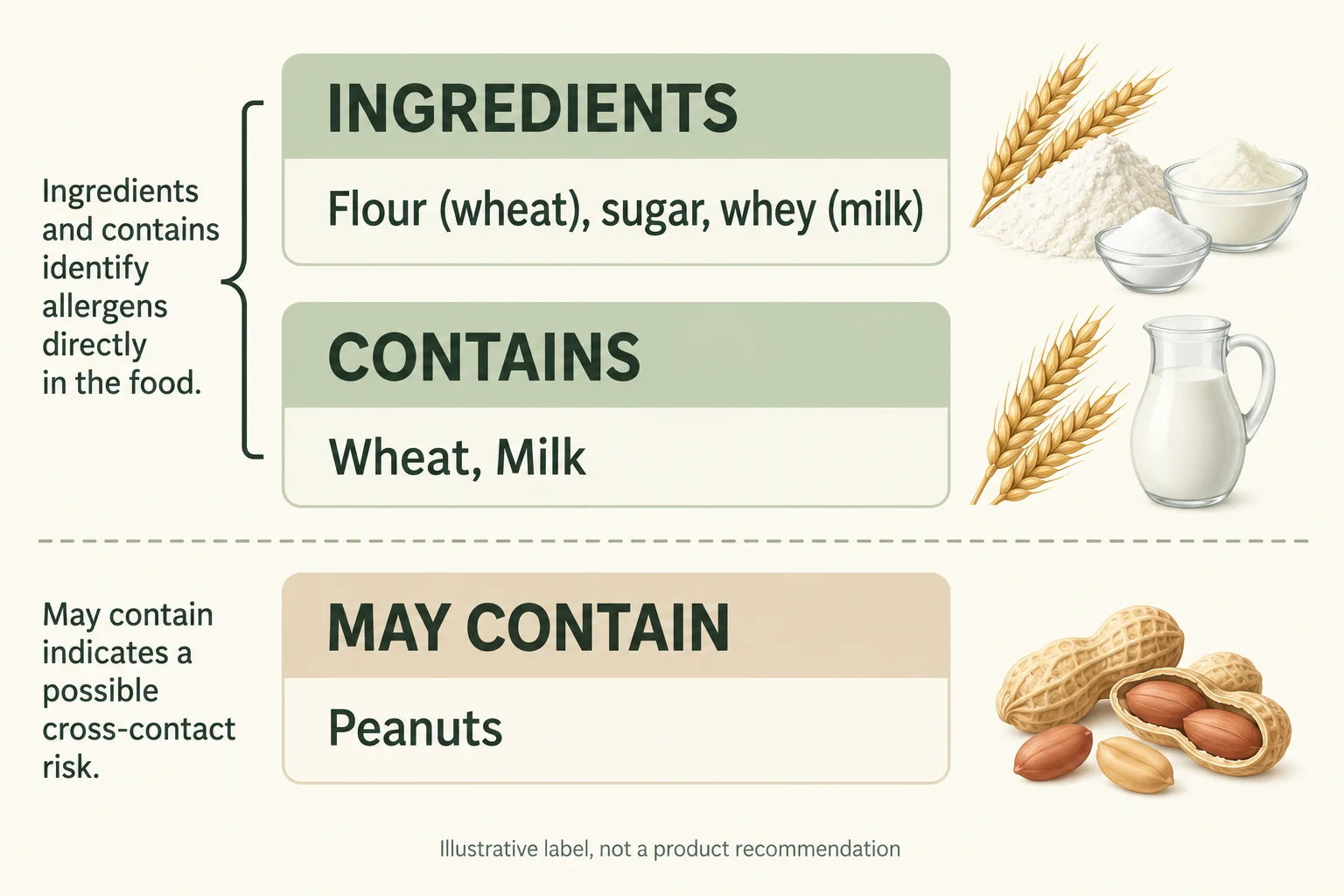
The FDA's consumer explanation describes two routes to disclosure:

  • In the ingredient information: a recognizable source name, such as buttermilk, or clarification such as whey (milk) and lecithin (soy).
  • In a separate statement: Contains: Milk, Soy, immediately after or next to the ingredient list.

If a manufacturer chooses the second route, the statement must identify all major food allergens used as ingredients, not just the ones the company feels like emphasizing. A compliant Contains statement is useful evidence. It is not a decorative or selectively edited warning.

The limitation is its scope. It summarizes the regulated major allergens in the recipe; it is not a complete ingredient inventory, a screen for every possible allergy, or a report on factory cross-contact.

Why No Contains Line Does Not Mean Allergen-Free

Consider this hypothetical ingredient list, not a real product recommendation:

Ingredients: Rice flour, sugar, whey (milk), sunflower oil, salt.

Even without a separate Contains line, whey (milk) identifies milk. Looking only for a summary box would miss information that is already plainly on the package.

FDA explicitly warns shoppers that not all allergen-containing products have a Contains statement. Its advice is to read all ingredient information. That is the strongest reason to build a full-label habit: you should not depend on a layout feature the manufacturer is not always required to use.

There are also special presentation rules for single-ingredient foods and certain package formats. A single-ingredient product can identify its allergen through the product name. The FDA's Edition 5 guidance, particularly sections D.1 through D.3, explains those situations. Not finding a conventional ingredient panel on a plainly identified single-ingredient food is different from finding incomplete information on a complex snack.

Three Questions the Summary Cannot Answer for Everyone

1. Does this meet a gluten-free requirement?

Wheat allergy and celiac disease are different concerns. Wheat is a major allergen; gluten is not a separate category in the FDA's nine-allergen list. Barley and rye therefore do not trigger the wheat disclosure simply because they contain gluten.

Imagine another illustrative label:

Ingredients: Rice, sugar, barley malt extract, whey (milk), soy lecithin, salt. Contains: Milk, Soy.

For a shopper checking the Contains line for wheat, the barley malt extract is the important information elsewhere in the ingredients. The example does not require a dishonest summary to create a problem. It shows that an accurate major-allergen summary and a complete gluten check are different tasks.

The FDA's gluten-free rule Q&A explains the separate requirements for a gluten-free claim, including ingredient restrictions and unavoidable gluten below 20 parts per million. A compliant gluten-free food can, in certain circumstances, use specially processed wheat-derived ingredients and still require wheat allergen disclosure. Neither wheat-free nor gluten-free is a universal substitute for the other.

Use the gluten-free label-checking workflow for that broader question. Ingredient review alone does not measure gluten concentration or verify manufacturing controls.

2. What if my allergy is not one of the nine?

People can be allergic to foods outside the major categories. Mustard, celery and molluscan shellfish, such as clams and oysters, are examples that do not receive the same U.S. major-allergen declaration treatment.

A sauce could list mustard by name in its ingredients without including it in the statutory Contains statement. Someone avoiding mustard therefore needs more than a quick scan for the major-allergen summary.

There is a further limit: reading every word still may not resolve every ingredient source. Under 21 CFR 101.22, qualifying spices and flavors can use collective names. The spice definition includes mustard flour and celery seed. Ordinary celery and celery powder have different naming requirements; they should not simply be treated as unnamed spices.

For someone with a mustard allergy, an unresolved spices entry may require a manufacturer question. An app can help organize the review, but it cannot reconstruct an undisclosed spice formula.

3. Does the food fit the rest of my household's needs?

An allergen summary does not establish vegetarian suitability, a religious certification or the absence of an ingredient someone avoids for another reason. A person checking milk allergy for one family member and a vegetarian preference for another is asking two different questions.

Gelatin, for example, is not its own category in the nine-major-allergen summary. Its presence can still matter to a vegetarian shopper. The full ingredient list helps connect the package to the actual checklist, rather than expecting one short statement to do every job.

Keep those needs distinct. A preference mismatch is not the same as an allergic risk, and neither should be reduced to a generic good-food or bad-food score.

Prepared ingredients can contain other ingredients: chocolate chips inside a cookie, a seasoning on crackers, or sauce inside a ready meal. 21 CFR 101.4 permits component ingredients to be declared parenthetically or incorporated individually into the overall ingredient statement.

Follow those details when reading. A quick glance at the first few ingredients is not a substitute for reviewing the whole declaration. Our compound-ingredient guide explains the nesting conventions in more depth.

However, do not conclude that a manufacturer can lawfully hide milk, peanut or another major-allergen protein by calling it natural flavor, spices or a processing aid. FDA's Edition 5 guidance, sections B.4 and D.8, explains that major-allergen source disclosure still applies in those situations. A small quantity is not a general exemption either.

Some specific exemptions do exist. Highly refined oils, for example, have a statutory exemption from major-allergen labeling; that is different from all oils being exempt or the ingredient itself disappearing from the list. See our refined-oil labeling guide for the distinction. Do not turn a legal exemption into a personal safety conclusion.

The honest message is not that major-allergen declarations are worthless. It is that the full list provides context, and an unresolved term deserves a question rather than a guess.

Contains and May Contain Answer Different Questions

Contains identifies major allergens used as ingredients. May contain, shared-equipment and shared-facility wording address possible unintended cross-contact. One is not a weaker version of the other.

Precautionary allergen statements are voluntary in the U.S. Their absence does not establish that a facility or product is free of cross-contact. Nor should you treat different phrases as a dependable ranking of exposure risk.

Voluntary does not mean anything goes. FDA says advisory statements must be truthful and not misleading, and they cannot replace proper manufacturing practices. Applicable preventive-control requirements separately address allergen cross-contact and labeling controls.

For the deeper explanation, use our may-contain and shared-facility guide. Here, the practical point is simple: read the warning separately instead of assuming the ingredients or Contains line answers the cross-contact question.

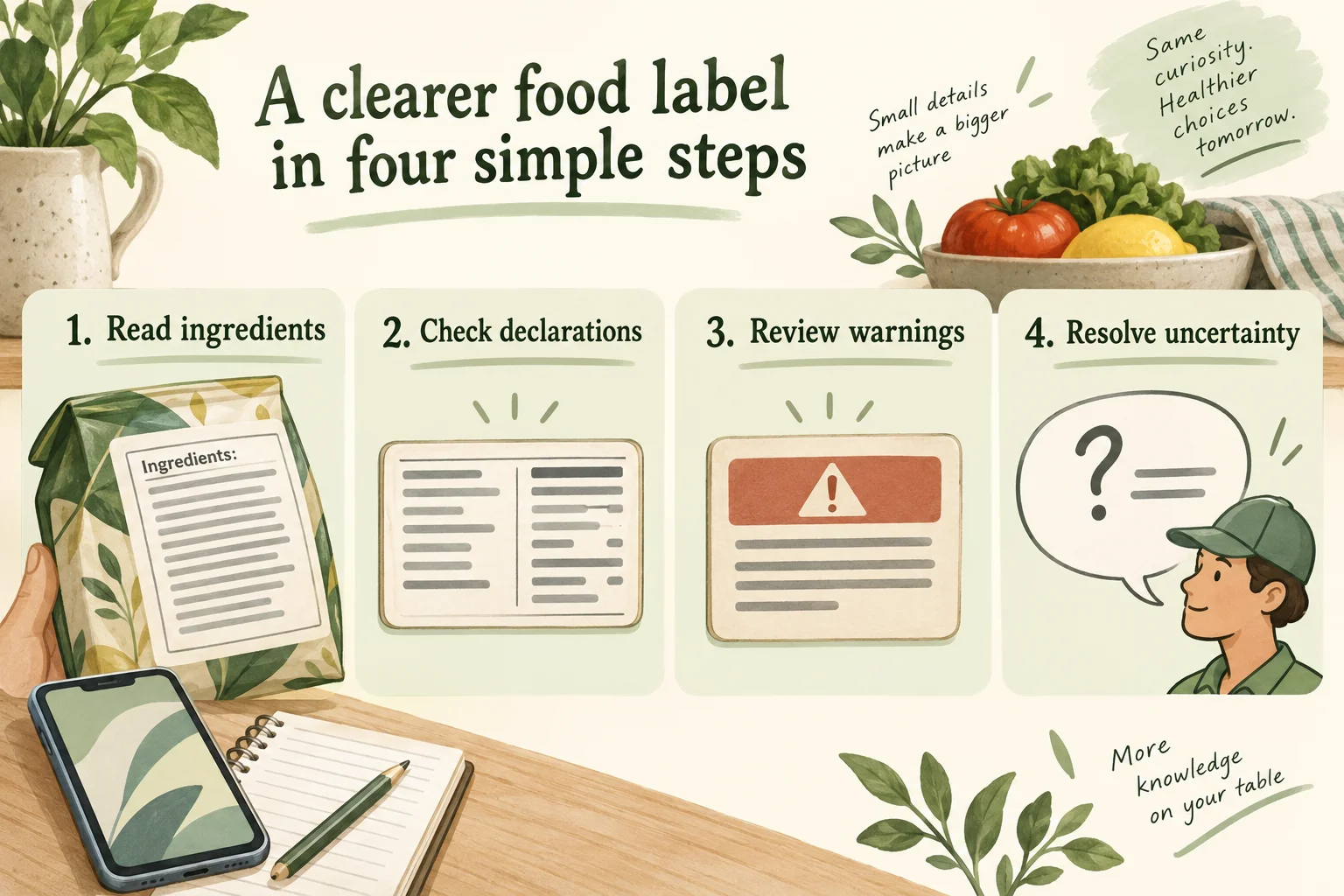
A Four-Step Check Before the Food Goes in Your Cart

A Four-Step Check Before the Food Goes in Your Cart

Step 1: Read the current ingredient information

Read from beginning to end, including parentheses and low-percentage ingredients. Match what is written to the specific foods and ingredients you need to avoid. Do this for the actual flavor, size and market you are buying, not a similar product.

FARE's label-reading guidance recommends checking every purchase because ingredients and manufacturing processes can change. A familiar brand or a previously successful purchase is not evidence that today's package is unchanged.

Step 2: Check the allergen declaration

Look for source names within the ingredients and any separate Contains statement. Do not expect every allergen to be in bold on a U.S. label. Look for the actual name and any relevant species or nut type.

Keep the country and regulatory scope in mind. This guide's FDA framework covers relevant packaged foods sold in the U.S., including imports; it is not the exact rulebook for USDA-regulated products, every alcoholic drink or a restaurant meal. Unpackaged food may require staff or manufacturer information that a package cannot supply.

Step 3: Review warnings and relevant claims separately

Read precautionary statements. If your decision also depends on a gluten-free claim or another certification, check that evidence too. Do not let a reassuring front-of-pack phrase override a conflicting ingredient, and do not turn an absent warning into a guarantee.

Step 4: Resolve uncertainty before choosing

If a source is unclear, a label is unreadable or information conflicts, pause. Contact the manufacturer with the exact product name, market, package details and ingredient term. Ask a targeted question about the ingredient or cross-contact controls, rather than only asking whether the product is safe.

For an established food allergy, keep following the avoidance and cross-contact advice in your care plan. A shopping aid does not change those boundaries.

Where IngrediCheck Makes the Full-Label Habit Easier

The work is not just spotting one familiar word. It is remembering your particular checklist each time you compare a cereal, sauce or snack, especially when different people in the household have different needs.

That is where IngrediCheck fits. Save allergies, dietary preferences and ingredients to avoid in your Food Notes, then scan a barcode or photograph the ingredient label. The app checks the available information against those saved notes and explains a Matched, Unmatched or Uncertain result. You can also start with the food-allergy checker to explore the ingredient-checking approach in your browser.

Review the explanation and compare it with the package in your hand. Barcode records can be incomplete or out of date; a clear photo can provide current label information, but automated reading and interpretation can still make mistakes. If the package and result disagree, do not let a Matched result overrule the label or an unresolved source question.

The app does not test food for allergen protein, detect undeclared contamination, verify a factory's controls or measure gluten. Matched means no conflict was identified in the available information, not that the food has been proven safe. Read precautionary warnings yourself and get manufacturer clarification when needed.

IngrediCheck is free to download, with a first scan free during onboarding. Further scanning and personalized analysis require Pro; see the app for current plans and terms. You can review the product facts before trying it.

Keep Your Checklist With You

The Contains statement is useful, but it is not your complete shopping checklist. Read the full ingredient information, review the allergen declaration and warnings, and keep unresolved questions unresolved until you have better evidence.

You do not have to rebuild your personal checklist for every package. Download the app, save your Food Notes and try your first ingredient check with IngrediCheck. Bring the label, your needs and the explanation together before you decide what goes in the cart.

Frequently Asked Questions

Is a separate Contains statement required on every food label?

No. For FDA-regulated packaged foods, a manufacturer can satisfy major-allergen disclosure through source-identifying ingredient names, including parentheses such as whey (milk), instead of a separate Contains statement. Special rules also apply to single-ingredient foods and some package formats.

If a Contains statement is used, must it list every major allergen?

It must identify all major food allergens used as ingredients, including relevant sub-ingredients. It is not a complete list of every food someone can be allergic to and does not establish that cross-contact is absent.

Can natural flavors hide milk or peanuts legally?

A generic flavor name does not remove the requirement to disclose a major allergen when the flavor ingredient contains its protein. Different rules can leave a non-major allergen's source unresolved, and violations or undeclared cross-contact can still occur.

Can an ingredient-checking app tell whether a food is allergy-safe?

No app result guarantees safety. IngrediCheck helps compare available ingredient information with saved Food Notes, but product data and automated interpretation can be incomplete or wrong. Review the package, warnings and uncertainty, and ask the manufacturer when needed.

Next Label Check

Follow the scanner, hub, and ingredient paths connected to this guide

Get the app for clearer label decisions.

Scan labels, see what fits your food notes, and read the why in plain English.

IngrediCheck app