Ingredient FAQs

L-Cysteine: Is This Common Dough Conditioner Vegan?

L-cysteine can be produced from animal keratin or microbial fermentation. Learn why E920 appears in bread and how to verify its source.

Jul 19, 2026|8 min read
By Sanket Patel|Updated 2026-07-19|4 sources|Editorial standards
L-Cysteine: Is This Common Dough Conditioner Vegan?

Quick answer: L-cysteine is not automatically vegan. The amino acid itself can be obtained from keratin-rich animal materials or produced through microbial fermentation. Both routes can yield an ingredient labeled "L-cysteine" or "E920," so the package may not reveal the source. Vegan certification, an explicit fermentation-derived statement, or current manufacturer confirmation is needed to resolve the ambiguity.

L-cysteine has acquired a dramatic reputation because older and some continuing production routes recover it from keratin, a protein found in hair and feathers. That history is real, but it is not the whole modern market. Fermentation-based production exists, and the chemistry of the purified amino acid does not announce which route was used.

The practical label-reading question is not whether every loaf contains feathers. It is whether a particular dough conditioner was made using animal-derived raw materials, and whether the manufacturer can document a non-animal alternative.

What L-Cysteine Does in Dough

What L-Cysteine Does in Dough

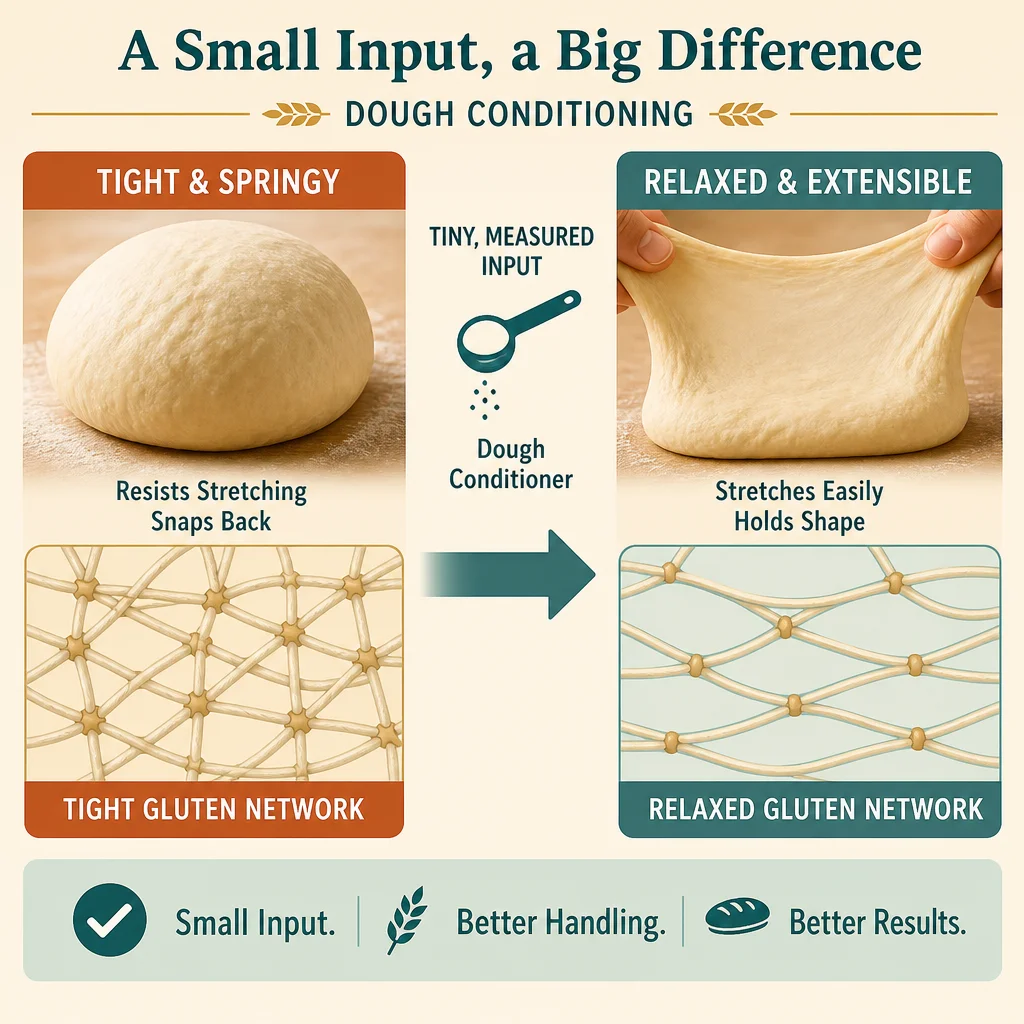
L-cysteine is a sulfur-containing amino acid. In bread production, its chemistry can weaken certain bonds within gluten proteins. That makes dough more extensible and easier to process at industrial speed.

Depending on the formula and process, a dough relaxer can help:

  • reduce mixing time
  • make dough easier to stretch or sheet
  • improve machinability in high-speed lines
  • reduce shrink-back after shaping
  • create more consistent portions
  • support production of buns, rolls, bagels, pizza bases, and other yeast-leavened goods

The US regulation at 21 CFR 184.1271 permits L-cysteine to supply up to 0.009 part per 100 parts of flour in yeast-leavened baked goods and baking mixes for the specified dough-strengthener use. The amount is small, but dietary suitability depends on source rather than quantity.

In European additive terminology, L-cysteine is associated with E920. A related form may appear as L-cysteine hydrochloride or L-cysteine hydrochloride monohydrate in technical documentation.

Three Ways L-Cysteine Can Be Produced

Keratin hydrolysis

Keratin is rich in cystine, which can be converted into cysteine through chemical processing. Industrial raw materials have historically included human hair and poultry feathers. Other keratin-rich animal materials can serve similar technical purposes.

An ingredient produced from feathers or another animal tissue is not vegan. Many vegetarians also reject it because the material comes from the animal-processing supply chain. Purification changes the chemical mixture, but not the origin that matters to these dietary standards.

Microbial fermentation

Microorganisms can be cultivated to produce L-cysteine in a controlled fermentation process. The amino acid is then separated and purified. When the fermentation medium, processing aids, and downstream materials also meet non-animal specifications, the resulting ingredient can be suitable for vegan products.

The word "fermented" alone is not a complete certification. Fermentation nutrients, antifoaming agents, carriers, or other processing inputs can still require review. A credible vegan certification evaluates the production specification rather than relying only on the headline method.

Synthetic or combined routes

Chemical and hybrid manufacturing routes may also be possible. "Synthetic" does not necessarily mean vegan, because a synthesis can begin with animal-derived feedstock or use animal-derived process materials. Conversely, a highly technical fermentation process can be compatible with vegan standards.

The useful question is always about documented inputs, not whether the process sounds natural.

Why the Label Usually Cannot Tell You

"L-cysteine" is the common ingredient identity. "E920" is an additive identity. Neither term is a source declaration.

A package may use any of these forms:

  • L-cysteine
  • L cysteine
  • cysteine
  • E920
  • flour treatment agent: E920
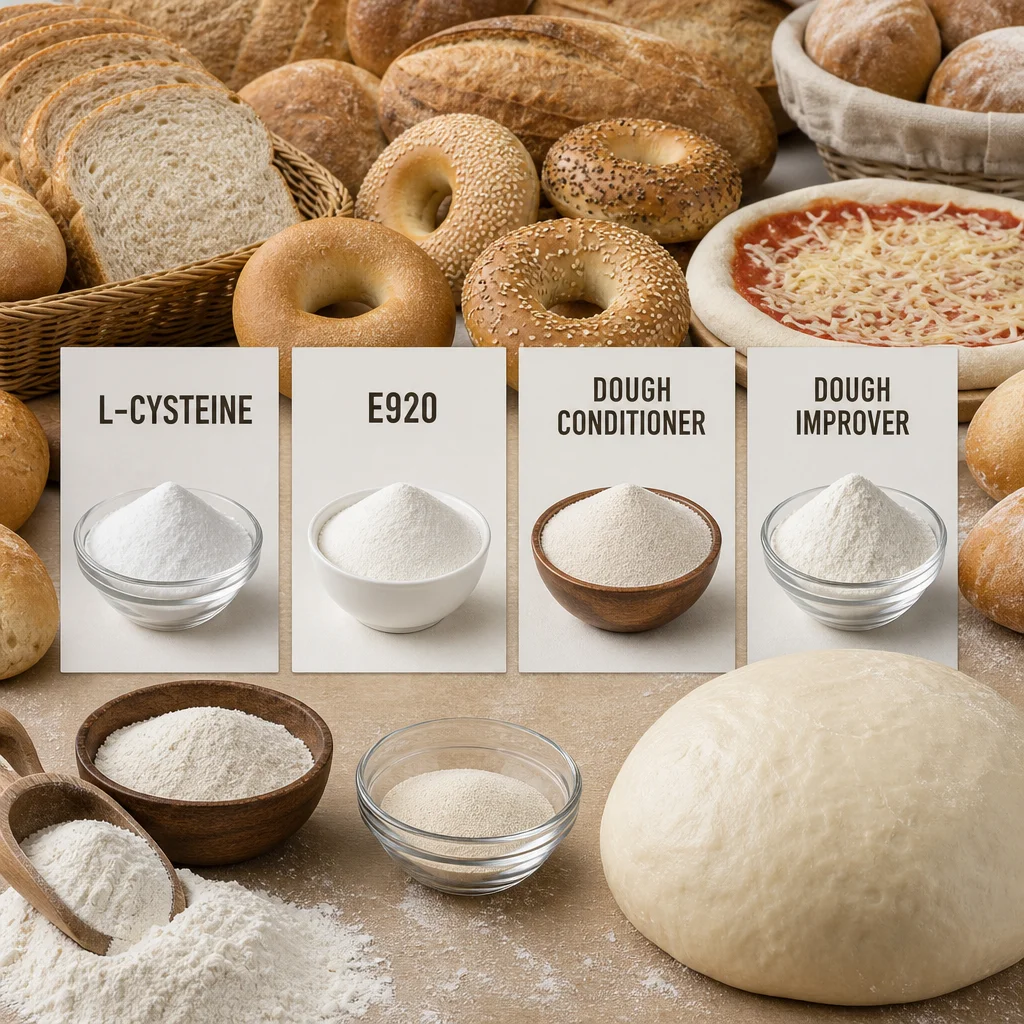
  • dough conditioner
  • dough improver
  • L-cysteine hydrochloride
  • L-cysteine hydrochloride monohydrate

The broader phrases "dough conditioner" and "dough improver" can refer to many substances, not only L-cysteine. Enzymes, ascorbic acid, emulsifiers, and other processing aids may perform related or opposite dough functions.

Some bakery inputs can also be supplied to a restaurant, bakery, or food-service operator as part of a premix. A customer-facing menu will rarely list each component. Even a packaged food label may not reveal every processing aid when an applicable exemption applies.

This is why a viral list claiming that a particular restaurant "uses duck feathers" can age badly. The supplier, production method, market, and formula may have changed. Verify the current product rather than repeating an old sourcing answer indefinitely.

Products Worth Checking

Products Worth Checking

L-cysteine is most relevant to yeast-leavened and mechanically processed dough systems. Check:

  • packaged sandwich bread and rolls
  • burger and hot-dog buns
  • bagels and English muffins
  • pizza crusts and flatbreads
  • bakery mixes
  • frozen dough
  • croissants and laminated bakery products
  • food-service bread products
  • dough conditioners sold to commercial bakers

Its absence from an ingredient list does not prove every processing input was vegan. Other source-dependent bakery ingredients include mono- and diglycerides, enzymes, shortening, natural flavors, vitamin D, whey, casein, egg wash, and release agents.

L-Cysteine Is Not the Same as Cystine or Cysteamine

Similar names can cause unnecessary confusion.

  • L-cysteine is the amino acid used in the food application discussed here.
  • Cystine consists of two cysteine molecules linked by a disulfide bond and appears naturally in proteins.
  • N-acetyl-L-cysteine, often shortened to NAC, is a related compound used in medical and supplement contexts.
  • Cysteamine is a different sulfur-containing compound.

A general warning about one should not automatically be transferred to all the others. For vegan sourcing, evaluate the exact ingredient and its production method.

How to Verify L-Cysteine

1. Prefer a recognized vegan certification

Certification is the simplest product-level evidence because it should cover the finished recipe and relevant processing aids, not only the printed ingredient names. Verify the mark applies to the exact regional product.

2. Look for explicit fermentation language

An official manufacturer statement that L-cysteine is "produced by microbial fermentation" or "non-animal-derived" is more useful than "clean label" or "natural." For strict use, confirm the statement applies to all suppliers used for the current product.

3. Ask about the complete specification

Use a specific question:

Is every source of L-cysteine or E920 used in this product produced without human hair, poultry feathers, other animal keratin, or animal-derived fermentation and processing materials?

Ask whether alternate approved suppliers follow the same rule. A company can have a plant-based primary supplier and an animal-derived backup unless its purchasing specification prohibits that substitution.

A useful answer should distinguish the finished amino acid from its raw material. Statements such as "no animal protein remains" or "the ingredient is chemically identical" do not resolve vegan sourcing. Ask whether the purchasing specification excludes animal keratin at the manufacturing stage. If the company will not disclose a supplier, it may still be able to confirm that every qualified supply meets a non-animal or certified-vegan specification.

Premix suppliers also matter in practice. A bakery may buy a complete dough improver rather than L-cysteine directly, so the bakery's customer-service team may need to obtain the documented answer from its ingredient vendor.

That vendor confirmation should cover every approved production site and substitute supply, not only the sample originally reviewed.

4. Check restaurant information carefully

Restaurant allergen and ingredient guides may differ by country and can lag behind supplier changes. Record the date and market of any customer-service answer.

5. Do not use allergen labels as a proxy

Feather-derived L-cysteine does not turn "Contains" statements into vegan declarations. Major-allergen rules address specified allergenic proteins. They do not require a label to identify every animal-derived source relevant to an ethical diet.

Common Questions

Is all L-cysteine made from human hair?

No. Human hair is part of the ingredient's manufacturing history, but poultry-feather and fermentation-based routes also exist. A sweeping claim about every current supply is inaccurate.

Is feather-derived L-cysteine vegetarian?

Standards differ, but many vegetarians reject an ingredient recovered from animal material, especially from a slaughter-related supply chain. Product-level vegetarian certification is stronger evidence than personal assumptions about trace amounts.

Can organic bread contain L-cysteine?

Organic production standards and permitted-input rules vary by jurisdiction and product. "Organic" should not be treated as a universal vegan claim. Read the ingredient list and certification relevant to the dietary question.

Does baking destroy the source issue?

Heat may change or consume some functional material during processing, but vegan suitability is based on what was used to make the food, not whether the original protein remains intact after baking.

IngrediCheck can detect L-cysteine, E920, and related dough-conditioner terms while flagging them as source-dependent rather than pretending the label proves an origin it does not reveal. Use the vegan ingredient checker or vegetarian ingredient checker to review the complete product, then verify the current L-cysteine specification with its manufacturer.

Next Label Check

Follow the scanner, hub, and ingredient paths connected to this guide

Get the app for clearer label decisions.

Scan labels, see what fits your food notes, and read the why in plain English.

IngrediCheck app