Ingredient Deep Dives

What Are Natural Flavors? The Vague Label Term, Decoded

'Natural flavors' appears on thousands of products, yet the term reveals almost nothing about what is inside. Here is what it legally means, and what it hides from allergy sufferers, vegans, and everyone else.

Jun 15, 2026|10 min read
By Sanket Patel|Updated 2026-06-15|3 sources|Editorial standards
What Are Natural Flavors? The Vague Label Term, Decoded

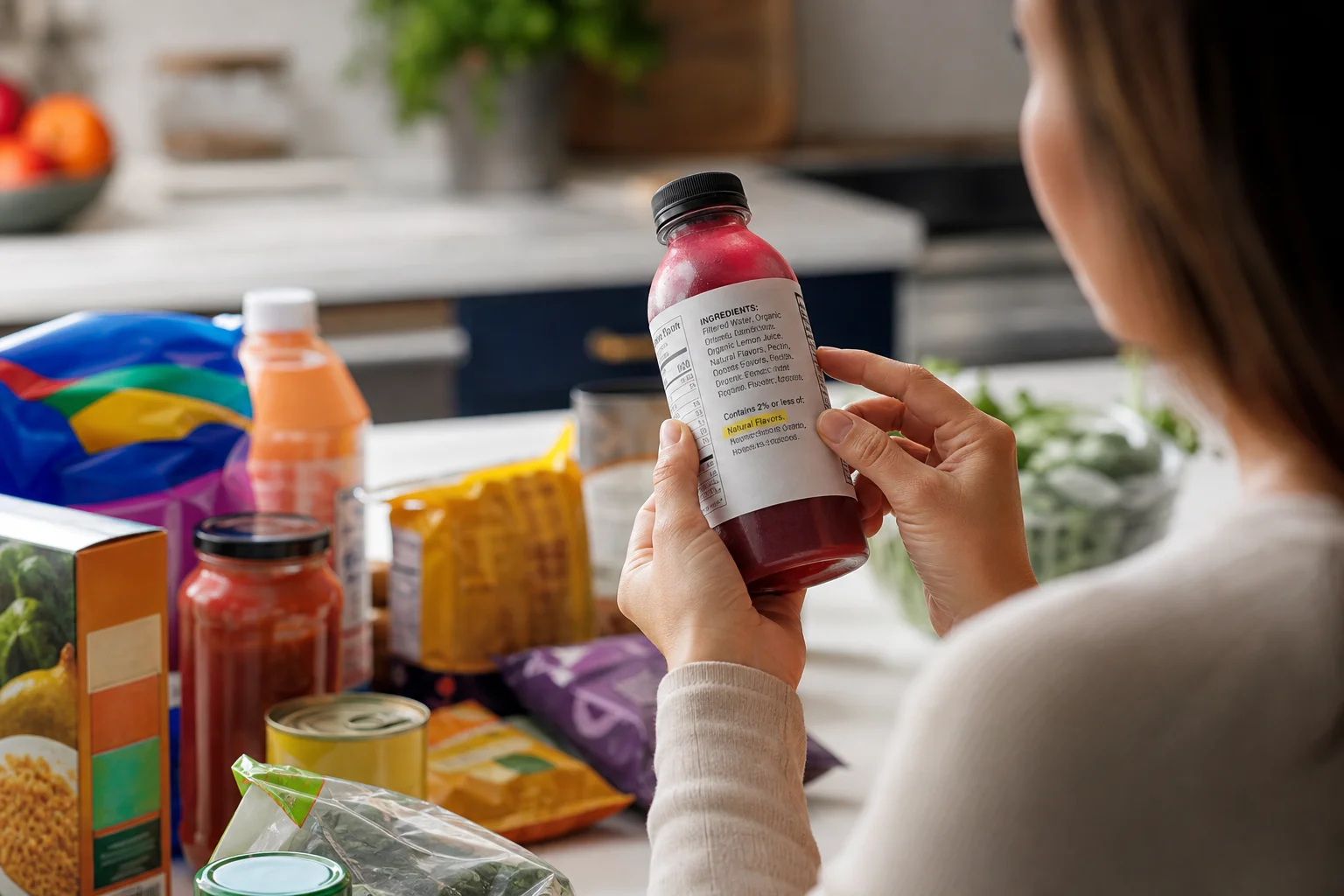
Flip over almost any packaged food and you will find it. Sparkling water, granola bars, yogurt, potato chips, plant-based milk, even so-called clean-label products list "natural flavors" somewhere near the bottom of the ingredients. It sounds wholesome. It sounds like the opposite of the scary artificial stuff. Yet it is one of the least informative phrases on the entire label, a single term that can stand in for a blend of dozens of chemicals whose identities you are not allowed to see.

So what does "natural flavors" actually mean? The short answer is that it tells you where a flavoring started, and almost nothing else. Not what is in it, not how processed it is, not whether it came from a plant or an animal, and not whether it is safe for your allergies or your diet. Here is the full picture, and how to read around the vagueness.
The Legal Definition Is Broader Than You Think

In the United States, "natural flavor" is not a marketing word. It is a legally defined term, and the definition is sprawling. According to the U.S. Food and Drug Administration's rule at 21 CFR 101.22, a natural flavor is the essential oil, oleoresin, essence, extractive, protein hydrolysate, distillate, or any product of roasting, heating, or enzymolysis that contains flavoring constituents derived from a long list of sources. That list includes spices, fruit and fruit juice, vegetables, edible yeast, herbs, bark, buds, roots, leaves, meat, seafood, poultry, eggs, dairy products, and fermentation products, so long as the substance's significant function in food is flavoring rather than nutrition.

Read that carefully, because the definition hinges on two things: the source material and the purpose. It says the flavor has to come from something that was once a plant or animal, and its job has to be flavoring rather than feeding you. What the definition does not mention is just as important. It says nothing about how many chemicals are involved, nothing about how heavily processed they are, and nothing about how the flavor is delivered into the food.

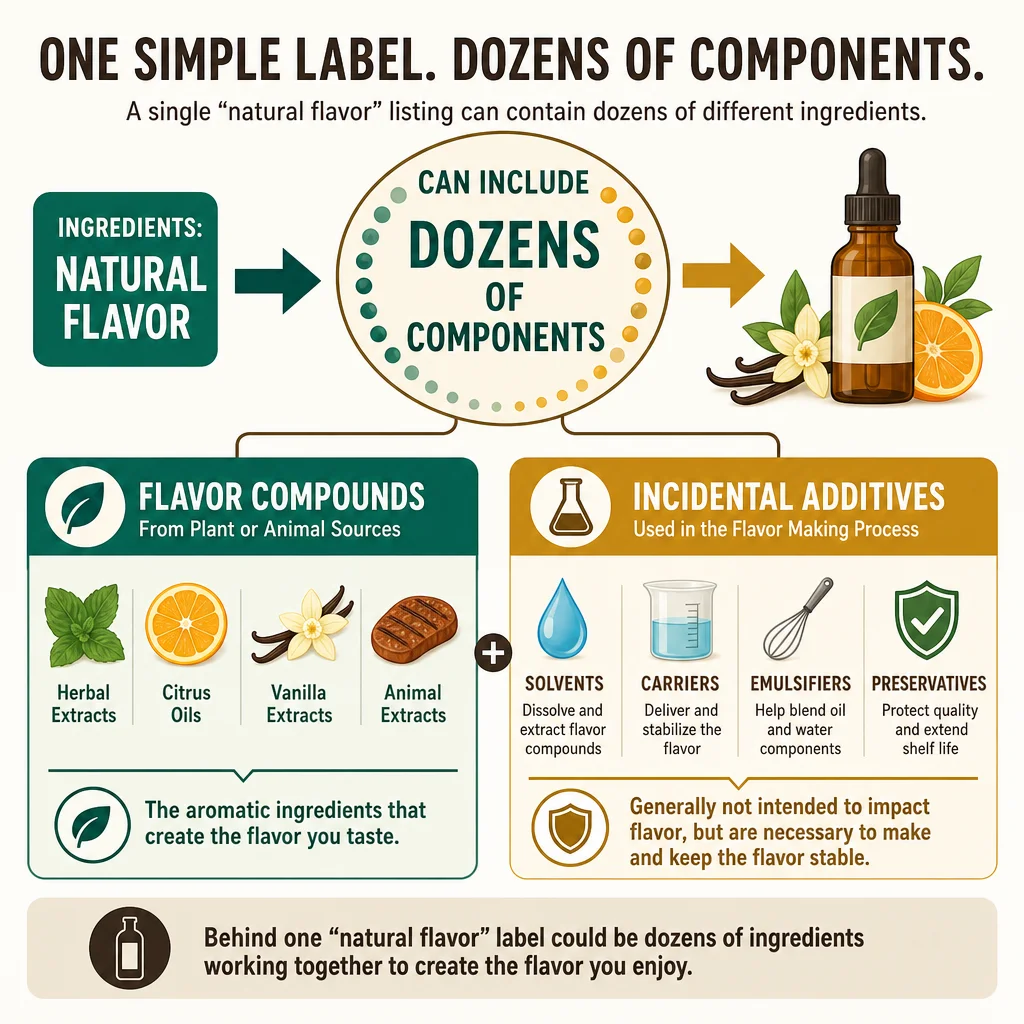
That silence is where the confusion lives. A "natural flavor" can be a single extract, or it can be a carefully engineered mixture assembled by specialists. As the University of Wisconsin-Madison's Department of Nutritional Sciences explains, flavors are often not one chemical but a combination, and flavorists may use several natural chemicals to build a single taste. The two words on your label can represent a recipe more complicated than the rest of the ingredient list combined.

What Hides Inside Those Two Words

Here is the part most shoppers never learn. A natural flavor is not just the flavor molecule. To make that molecule usable, manufacturers blend in supporting ingredients: solvents to dissolve it, carriers to distribute it, emulsifiers to keep it mixed, and preservatives to keep it stable. As Healthline notes, natural flavors can include a range of chemicals such as enhancers, preservatives, and emulsifiers alongside the actual flavoring.

Many of these helpers never appear on the label at all. Under the FDA's exemptions in 21 CFR 101.100, substances that act only as processing aids or "incidental additives," present at insignificant levels with no functional effect in the finished food, do not have to be listed separately. So the solvent used to extract a flavor, or a carrier that rides along with it, can legally disappear into the phrase "natural flavors" without a trace on the ingredient panel.

This is not a loophole in the sense of something illegal. It is how the system was designed. The result, though, is that "natural flavors" is a container term. It bundles the star ingredient together with a supporting cast you will never see named.

"Natural" Describes the Origin, Not the Health

"Natural" Describes the Origin, Not the Health

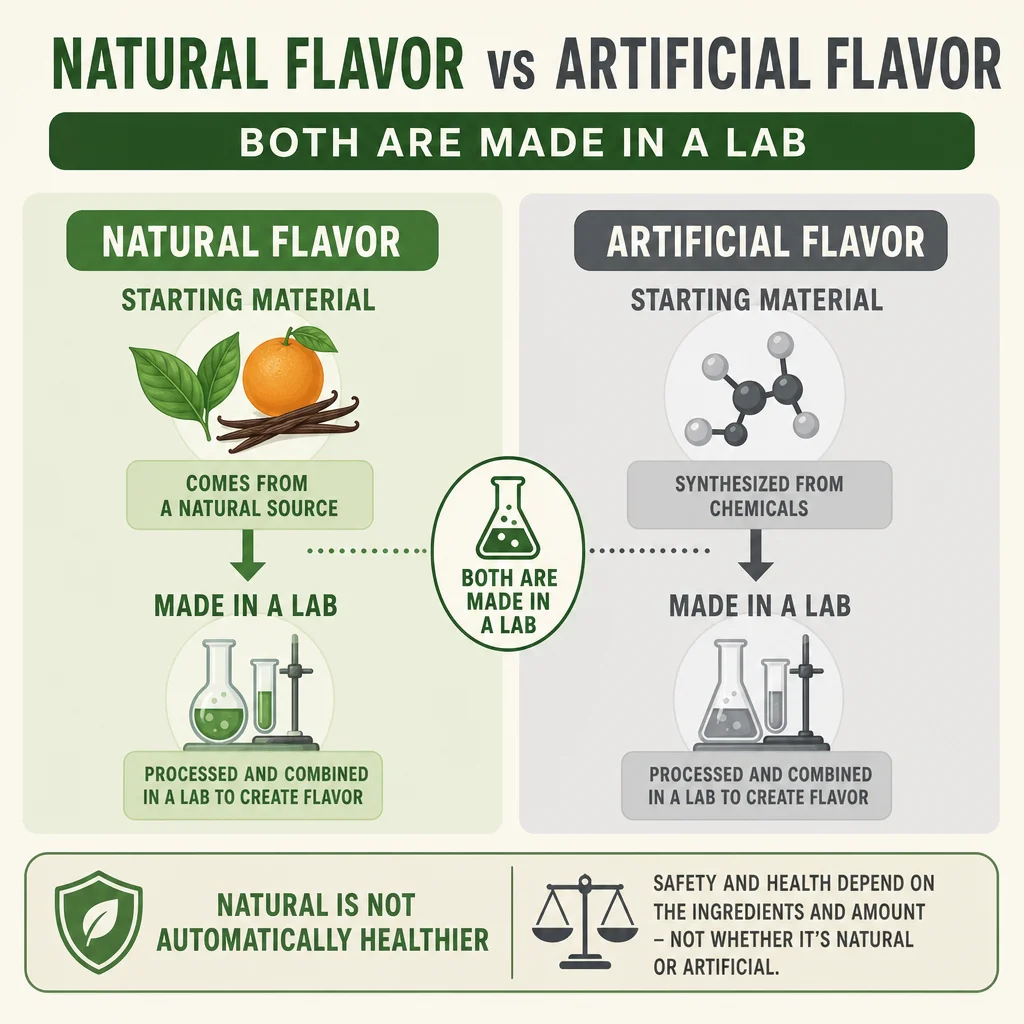
The single biggest misconception is that natural flavors are healthier than artificial ones. Chemically, that assumption often falls apart. The flavor molecule in a natural flavoring can be the exact same molecule as the one in the artificial version. The only difference is where the starting material came from.

The food scientist Gary Reineccius put it memorably in Scientific American: the distinction between natural and artificial flavors comes from the source of what are often identical chemicals, and it is a bit like saying that an apple sold at a gas station is artificial while one sold from a fruit stand is natural. The apple is the same apple. In flavor chemistry, the compound is frequently the same compound.

A natural flavor gets its raw material from a plant or animal source and is then processed, often extensively, by trained flavorists in a lab. An artificial flavor starts from a synthesized chemical, typically not derived from food, and is built by the same kind of specialists. Both are made in laboratories. Neither label tells you anything about safety or nutrition. "Natural" is a statement about ancestry, not about wholesomeness.

The Real Problem: Allergens and Diets in the Dark

For most people, the vagueness of "natural flavors" is a curiosity. For people with food allergies, or who keep vegan, vegetarian, kosher, or halal diets, it can be a genuine blind spot.

Start with allergens. Under the U.S. Food Allergen Labeling and Consumer Protection Act, the major food allergens must be declared on the label even when they are part of a flavoring. Those groups are milk, eggs, fish, crustacean shellfish, tree nuts, peanuts, wheat, and soybeans, with sesame added as the ninth major allergen under the FASTER Act. So if a natural flavor contains one of these, the law requires it to be named.

The gap is everything outside that list. Flavorings can be declared as a class rather than spelled out ingredient by ingredient, and non-major allergens receive no such protection. Someone allergic to celery, mustard, or a specific spice can find no answer on the label, because those do not trigger mandatory disclosure. Trace amounts and cross-contact material tucked inside a flavor blend can also slip past.

Then there is the question of source species. Because a natural flavor can be derived from an animal just as easily as a plant, the term is silent on whether a product is vegan or vegetarian. Healthline points out plainly that natural flavors can come from plant or animal sources, and the label gives no species detail. A dairy-derived flavor, an egg-based one, or an animal fat carrier can hide behind the same two words that a fruit extract uses. For anyone keeping kosher or halal, the lack of source information is a similar dead end.

The Beaver Myth and the La Croix Lawsuit

No discussion of natural flavors is complete without the internet's favorite claim: that your vanilla comes from beaver glands. The ingredient in question is castoreum, a secretion from beavers that was historically used as a flavoring. The claim that it is lurking in your vanilla ice cream is, however, mostly a myth. As Snopes and Smithsonian Magazine have documented, castoreum use today is exceedingly rare. Total annual U.S. consumption amounts to a few hundred pounds, a rounding error next to the millions of pounds of real vanilla used each year. Harvesting it is difficult and expensive, so it has essentially vanished from the food supply. The story survives because it is a perfect illustration of the deeper anxiety: if a beaver secretion could once be a "natural flavor," what else could be?

The transparency worry is real enough that it has reached the courts. In 2018, a class-action lawsuit accused the sparkling water brand La Croix of using synthetic ingredients despite its all-natural claims. The suit generated headlines, but it is best understood as a consumer-perception dispute rather than a finding of wrongdoing. The plaintiff ultimately retracted the allegations and the case was dropped in 2020, as the trade press reported. What the episode really exposed was how little the phrase "natural" reassures a skeptical public when the details stay hidden.

Why It Stays Secret, and How Europe Does It Differently

If the term is so frustrating, why do companies cling to it? The main reason is trade secrets. Flavor formulas are guarded like recipes for a reason. The Center for Science in the Public Interest has argued that flavor and food companies treat their blends as closely held secrets to stop competitors from copying them. Listing every component would hand rivals the formula. Vagueness is a feature, not an oversight.

The European Union takes a stricter line on at least one point. Under Regulation (EC) No 1334/2008, the word "natural" can only describe a flavoring tied to a named source if the flavoring component was obtained exclusively, or at least 95 percent by weight, from that source material. The remaining small fraction must also come from natural sources and only for rounding out the flavor. When those conditions are met, the label must read "natural X flavouring," pointing the shopper back to the actual source. The U.S. system has no equivalent minimum-percentage rule and does not require naming the source at all. A European "natural strawberry flavouring" has to be almost entirely strawberry. An American "natural flavor" does not even have to tell you it is strawberry.

How to Read Around the Vagueness

You cannot force a label to reveal what it is allowed to hide, but you can shop smarter.

First, treat "natural flavor," "natural [X] flavor," "flavoring," and "flavor" as the same category. All fall under the same regulatory umbrella, and none of them tells you the specific chemicals, the source species, or the solvents and carriers involved. The word "natural" in front changes nothing about how much you can actually see. For a wider view of the label terms that reveal less than they promise, our ingredient safety guides break down the words worth a second look.

Second, do not read "natural" as "safe," "vegan," or "allergen-free." If a product must be free of a major allergen, the law has your back, because that allergen has to be declared even inside a flavor. For anything else, a non-major allergen, a specific spice, an animal-derived source, kosher or halal status, the label alone will not answer the question.

Third, when the answer matters, go to the source. Because manufacturers are not required to disclose flavor details on the package, the most reliable move for allergy sufferers, vegans, and religious-diet followers is to contact the company directly and ask what the flavor is derived from and what carries it. Northwell Health's consumer guidance and dietitian-reviewed advice both recommend exactly this step.

The deeper lesson is that a short ingredient list is not the same as a transparent one. Two innocent-looking words can stand in for a great deal you cannot see. Using IngrediCheck, you can scan a product and instantly flag when "natural flavors" and other catch-all terms appear, check them against your own allergen list and dietary preferences, and cut through vague labeling so you can decide with clear eyes whether a product belongs in your cart.

Next Label Check

Follow the scanner, hub, and ingredient paths connected to this guide

Get the app for clearer label decisions.

Scan labels, see what fits your food notes, and read the why in plain English.

IngrediCheck app