Texas SB 25: The 44-Ingredient Food Warning Law, Explained

Texas signed a law in June 2025 requiring warning labels on 44 food ingredients, including Red 40, BHA, titanium dioxide, and potassium bromate. A federal court blocked enforcement in February 2026. Here's what the law says, who is fighting it, and what it means for shoppers.

May 27, 2026|10 min read
By Sanket Patel|Updated 2026-05-27|9 sources|Editorial standards
Texas SB 25: The 44-Ingredient Food Warning Law, Explained

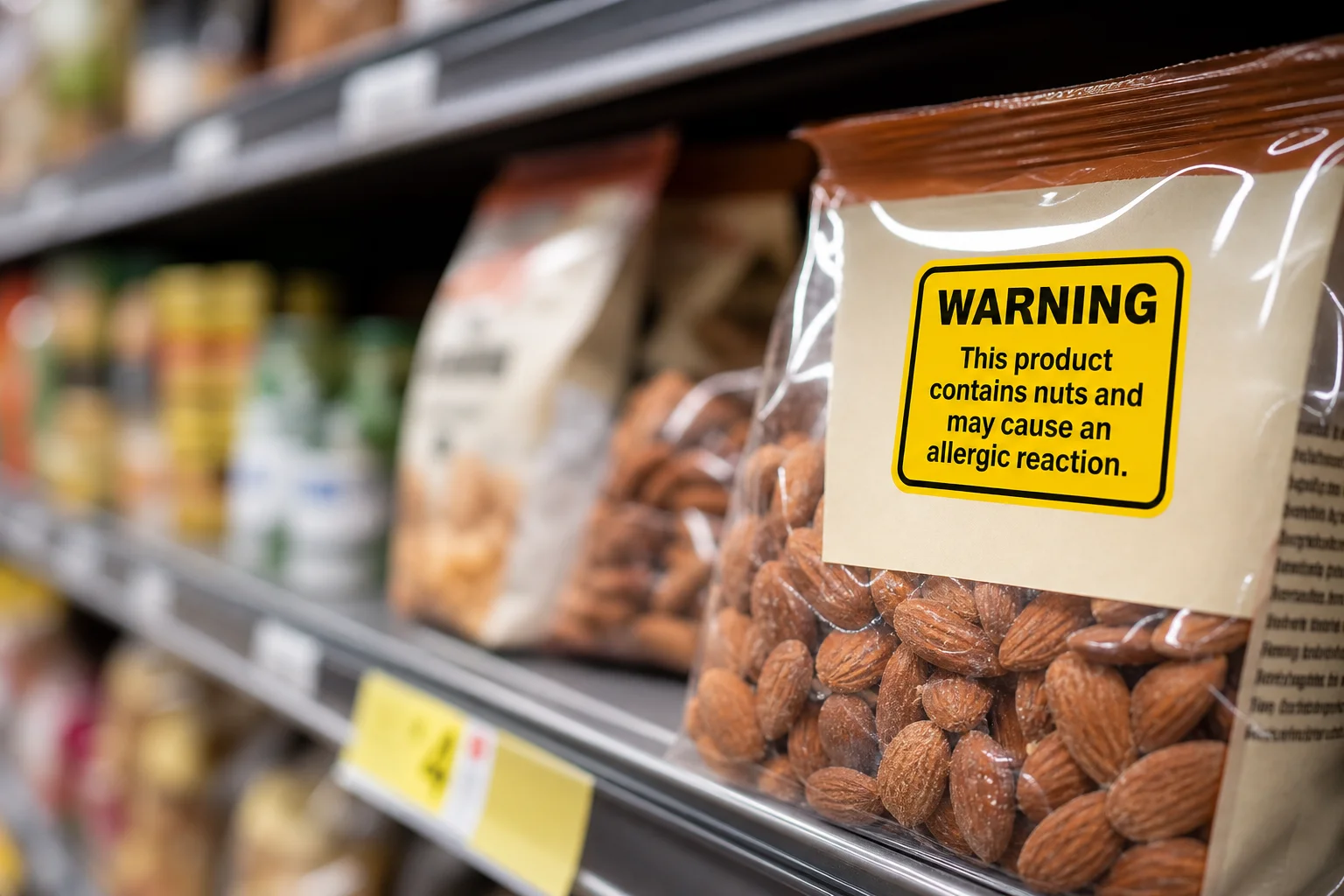
On June 22, 2025, Texas Governor Greg Abbott signed Senate Bill 25, the "Make Texas Healthy Again Act," into law. It requires warning labels on packaged food sold in Texas if the product contains any of 44 named ingredients. Red 40, Yellow 5, BHA, titanium dioxide, potassium bromate, and azodicarbonamide are among them.

Eight months later, a federal court blocked enforcement of the labeling requirement. Industry trade groups had sued, arguing the law compels speech and conflicts with federal food regulation. As of May 2026, the case is on appeal in the Fifth Circuit and the warning label requirement remains suspended.

The story of Texas SB 25 is, in miniature, the story of where US food policy stands in 2026: an unprecedented wave of state-level action on food ingredients, a food industry fighting back through the courts, and consumers caught in the middle trying to figure out what any of it means for what they buy.
What SB 25 Actually Requires

The law does not ban any of the 44 ingredients. It requires a warning label on any retail packaged food that contains one or more of them. The mandated text reads:

"WARNING: This product contains an ingredient that is not recommended for human consumption by the appropriate authority in Australia, Canada, the European Union, or the United Kingdom."

The label must be conspicuous, clearly legible, and prominently placed. It applies to food labels developed or copyrighted on or after January 1, 2027. Online retailers satisfy the requirement by posting a photo of the warning panel. Civil penalties for noncompliance run up to $50,000 per day per distinct product.

The law was sponsored by Republican State Senator Lois Kolkhorst, with RFK Jr., then HHS Secretary, calling Kolkhorst to urge passage and attending the signing ceremony. It passed with bipartisan support.

The 44 Ingredients

The 44 Ingredients

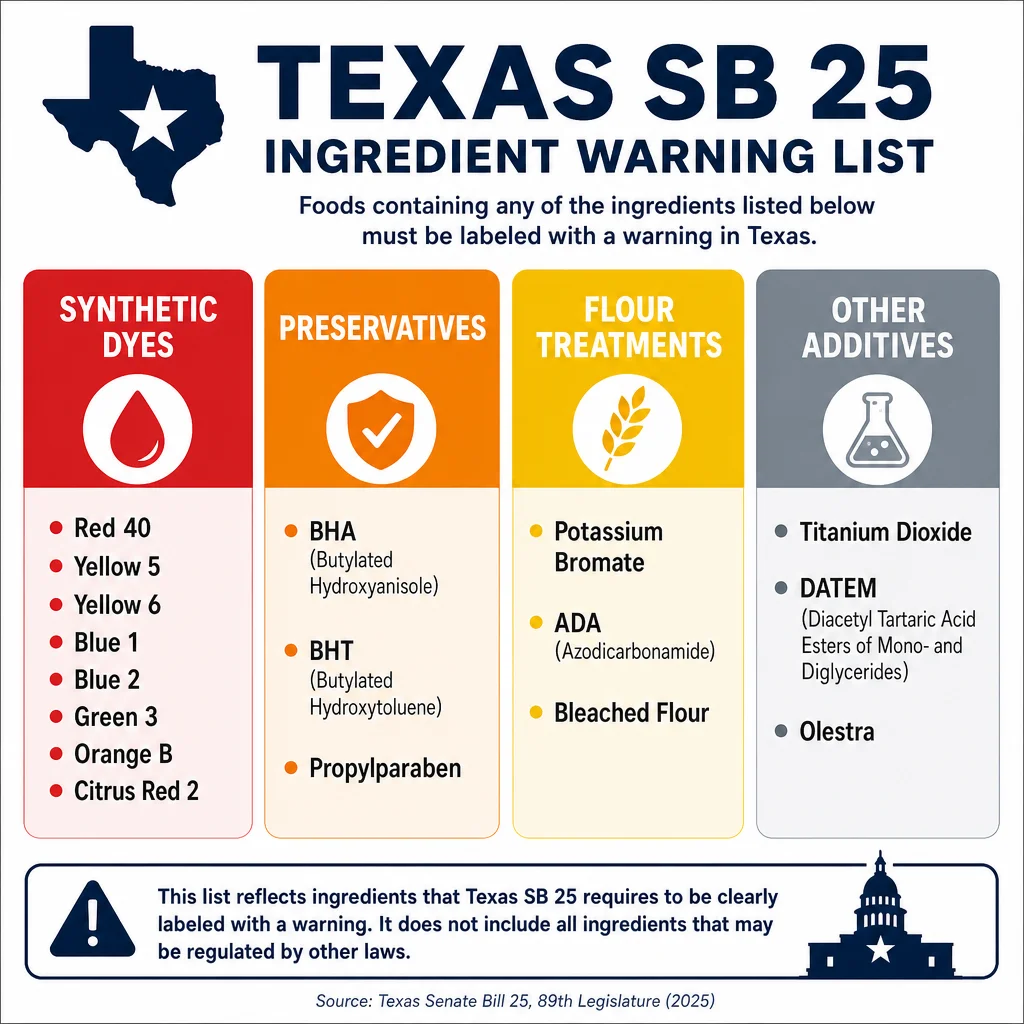
The complete list, drawn from the bill text and published by Holland & Knight, covers a range from well-known synthetic dyes to additives most consumers have never heard of:

Synthetic dyes: Red 40, Red 3, Red 4, Yellow 5, Yellow 6, Blue 1, Blue 2, Green 3, Citrus Red 2, Certified food colors as a category

Preservatives and antioxidants: BHA (butylated hydroxyanisole), BHT (butylated hydroxytoluene), Propylparaben, Thiodipropionic acid

Flour treatments: Potassium bromate, Calcium bromate, Bromated flour, Bleached flour, Potassium iodate, Azodicarbonamide

Emulsifiers and processing aids: DATEM (diacetyl tartaric and fatty acid esters of mono- and diglycerides), Acetylated esters of mono- and diglycerides, Lactylated fatty acid esters of glycerol and propylene glycol, Dioctyl sodium sulfosuccinate, Sodium lauryl sulfate, Sodium stearyl fumarate, Stearyl tartrate

Other additives: Titanium dioxide, Canthaxanthin, Diacetyl, Olestra, Interesterified palm oil, Interesterified soybean oil, Partially hydrogenated oil, Synthetic trans fatty acid, Morpholine, Propylene oxide, Potassium aluminum sulfate, Sodium aluminum sulfate, Ficin, Lye

Industrial chemicals not typically found in food: Anisole, Toluene, Dimethylamylamine (DMAA)

That last group is worth noting. Toluene, propylene oxide, and DMAA are not food ingredients in any normal sense. Their inclusion on the list has been cited by food law analysts as evidence that the list was assembled without a systematic review of what is actually used in food.

Why the Warning Text Is Contested

The industry's primary factual objection to the law, and a concern echoed by the court, is that the mandated warning language is not accurate.

The label states that the ingredient "is not recommended for human consumption" by foreign authorities in Australia, Canada, the EU, or the UK. That description does not accurately characterise how those authorities actually treat most of the 44 substances. BHT, Blue 1, and DATEM, for example, are permitted in the EU under certain conditions. The foreign regulators have not issued blanket declarations that these substances are "not recommended for human consumption."

A detailed comparison by FoodChain ID, published in June 2025, found material discrepancies between the SB 25 warning text and the actual regulatory positions of EU, UK, and Australian food authorities for a significant portion of the 44 ingredients.

This matters legally. The court found that a government-scripted warning must be factually accurate, and a label that mischaracterises foreign regulatory positions fails that test.

The Lawsuit: Blocked in Court

On December 5, 2025, four food industry associations filed suit in the Western District of Texas: the American Beverage Association, Consumer Brands Association, National Confectioners Association, and FMI-The Food Industry Association.

They raised two arguments. First, the law compels speech in violation of the First Amendment by forcing companies to carry a government-written message about their products. Second, it conflicts with federal food law, since the FDA already regulates all 44 listed ingredients and state labeling requirements that conflict with federal standards are preempted.

On February 11, 2026, the federal court granted a preliminary injunction. The judge found that the plaintiffs were likely to succeed on the merits of the First Amendment claim. Under the standard applied to commercial speech regulations, the state must show the warning directly and materially advances a substantial government interest. The court found that the state had not met this burden, partly because Texas could pursue other means of informing consumers (such as its own public education campaigns) without compelling private companies to carry a specific message on product packaging.

Texas AG Ken Paxton appealed. The case is now before the Fifth Circuit, where it remained pending as of May 2026. The January 1, 2027 enforcement date remains on the books, but whether enforcement can begin depends on the outcome of the appeal.

The GRAS Exemption That Could Narrow the Law Significantly

When the Texas Department of State Health Services finalised its implementing rule on February 20, 2026, the preamble included a statement that food law analysts flagged immediately:

"DSHS has also determined ingredients considered generally recognized as safe or determined to be safe by the FDA or USDA are not subject to the rule requirements."

This single sentence may have substantially narrowed the law's real-world impact. Most of the 44 listed ingredients are FDA-authorised food additives or colour additives. If they are GRAS-exempt from the rule, the warning requirement would apply only to ingredients that are not authorized in the US, which are already excluded from food products under existing federal law.

The practical result, if the GRAS exemption stands, is that SB 25's warning label would be required for almost nothing that is currently used in food sold in Texas.

Hogan Lovells, Davis Wright Tremaine, and other food law firms analysing the rule in March 2026 described the GRAS exemption as a significant limitation on the scope of what the law actually covers.

Texas vs. California: Two Different Approaches

Texas vs. California: Two Different Approaches

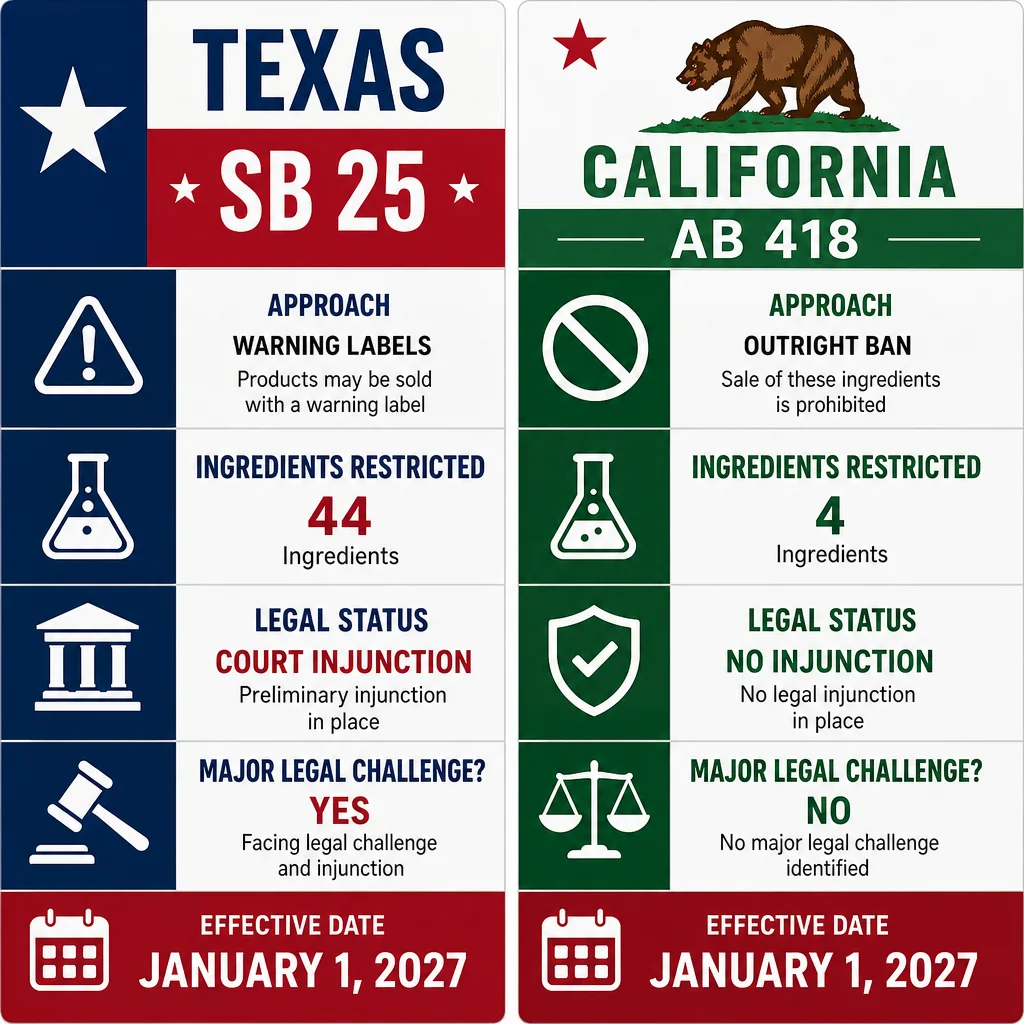
Texas SB 25 and California AB 418 (the California Food Safety Act, signed October 2023) represent two distinct legislative strategies for addressing food additives at the state level.

California's law bans four additives outright: BVO (brominated vegetable oil), potassium bromate, propylparaben, and Red Dye No. 3. Any food containing these ingredients cannot be manufactured or sold in California starting January 1, 2027. California also passed a separate school food law in 2024 banning six synthetic dyes from K-12 meals, effective December 2027.

Texas chose warning labels rather than bans, covering 44 ingredients rather than four. The broader list and the labeling approach rather than outright prohibition reflect both a different political philosophy and a different strategic calculation: a warning label requirement might be easier to defend legally and harder for industry to argue causes immediate harm.

As of May 2026, California's ban faces no major legal challenge. Texas's warning label requirement is blocked. The comparison suggests that the outright ban model, applied to a focused list of specific ingredients, may be more legally durable than a broad warning label requirement applied to a large list where the scientific and regulatory basis varies across ingredients.

The Broader State Wave

Texas and California are two examples from a much larger legislative movement. In 2025, more than 30 states introduced nearly 120 pieces of food additive legislation. As of early 2026, more than 25 states have legislation pending or enacted that would restrict or require labeling of synthetic food dyes alone.

States that have enacted food additive laws through early 2026 include Virginia (dye ban from school meals, effective July 2025), West Virginia (nine-substance statewide ban, currently facing its own injunction), Texas (SB 314, a separate law banning 16 additives from school meals, effective 2026-27), Utah (dye and preservative ban from school meals), and Louisiana (SB 14, a warning label law similar to Texas SB 25, signed and not yet legally challenged). The state bans overview has a broader breakdown of where each state stands.

At the federal level, the FDA has added BHA to its formal post-market chemical review list and is advancing the same review process for the petroleum-based FD&C dyes. But as the FDA's February 2026 synthetic dye enforcement guidance showed, the agency has also made moves that consumer advocates viewed as a step back from stricter action. The gap between federal pace and state legislative momentum remains wide.

What This Means for Consumers Right Now

On the ground, for a shopper in Texas in May 2026, SB 25 means nothing yet. The warning label is blocked by a court order. Products containing any of the 44 ingredients are sold without labels.

What is changing, independent of whether SB 25 ever takes effect, is that the political and commercial pressure on food manufacturers has accelerated voluntary reformulation. Kraft Heinz, Tyson Foods, Nestlé, PepsiCo, and Hershey are among the companies that have announced plans to remove petroleum-based dyes or other listed ingredients ahead of regulatory deadlines, driven by a combination of FDA industry pledges, state legislative pressure, and shifting consumer expectations.

If SB 25 ultimately survives the Fifth Circuit appeal and takes effect in 2027, the ingredients most likely to require a warning label are those that are not FDA-authorized at all, meaning they are already not present in US-market food. The GRAS exemption interpretation, if confirmed, could leave the warning requirement as a largely symbolic gesture.

If the court strikes it down entirely, the impact is also minimal in practical terms. The reformulation wave is already happening.

For consumers who want to know right now which of these 44 ingredients appear in the products they buy, the answer is not a warning label. It is the ingredient list on the back of the package.

IngrediCheck lets you scan any packaged food and flag any of the SB 25 ingredients, whether or not a warning label is required. The 44 are all declarable ingredients; if they appear in a product, they appear on the ingredient list. That is where you find the facts, regardless of what Texas's courts eventually decide.

Next Label Check

Follow the scanner, hub, and ingredient paths connected to this guide

Get the app for clearer label decisions.

Scan labels, see what fits your food notes, and read the why in plain English.

IngrediCheck app