FDA's 'No Artificial Colors' Has a New Meaning in 2026

In February 2026, the FDA issued guidance that allows products containing non-certified color additives — including titanium dioxide, which is banned in the EU — to carry a 'no artificial colors' claim. Here's what changed, what it means, and how to read past the label.

May 26, 2026|9 min read
By Sanket Patel|Updated 2026-05-26|6 sources|Editorial standards
FDA's 'No Artificial Colors' Has a New Meaning in 2026

If you have been picking products labeled "no artificial colors" off grocery shelves because you want to avoid synthetic dyes, the label still helps — mostly. But after a February 2026 FDA guidance letter, it no longer tells the whole story.

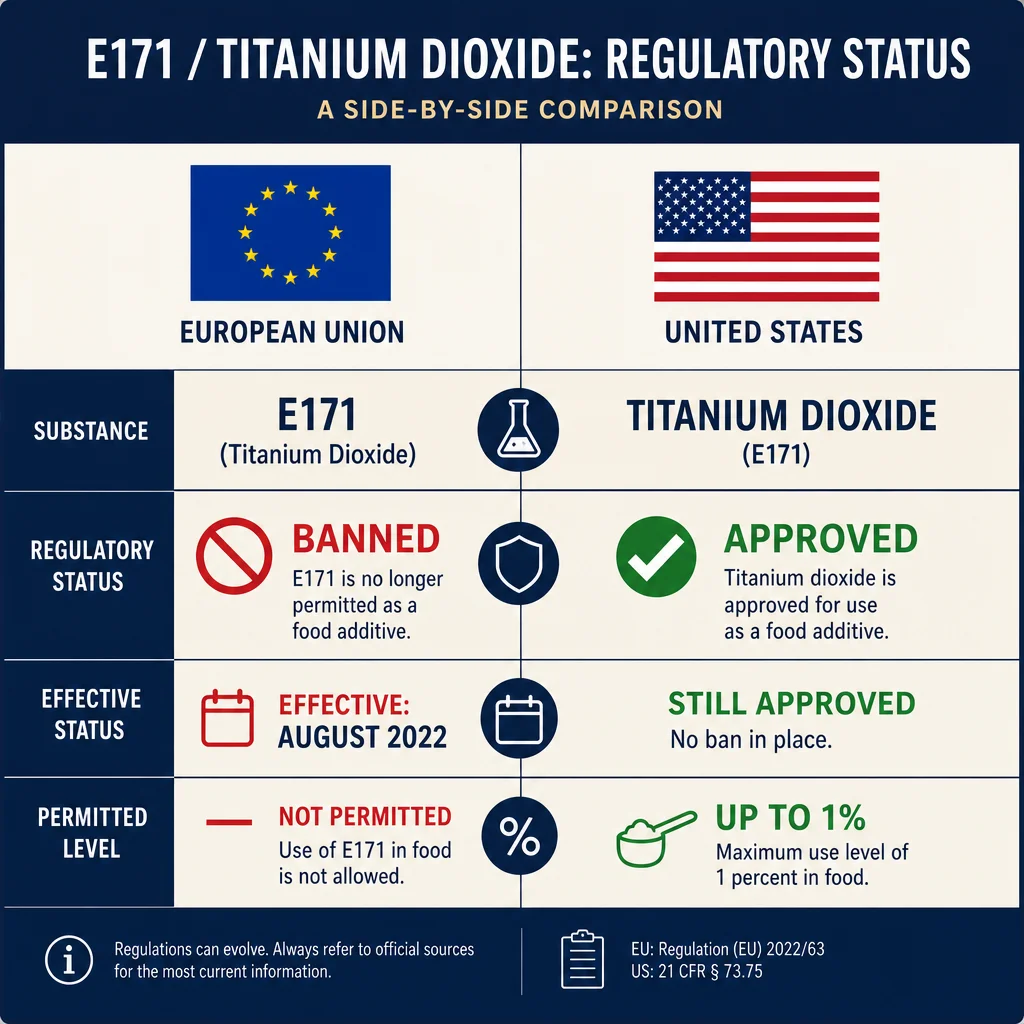
A product can now carry a "no artificial colors" claim and still contain titanium dioxide: a white mineral colorant that the European Union banned from all food in August 2022 after its food safety authority concluded that genotoxicity could not be excluded.

Understanding what changed — and what it means for the products you buy — requires a look at how the FDA defines "artificial color" in the first place, and why that definition has always been more complicated than the front-of-pack claim suggests.

Two Categories of Color Additives

Two Categories of Color Additives

US food labeling law divides approved color additives into two categories, and the distinction matters for this story.

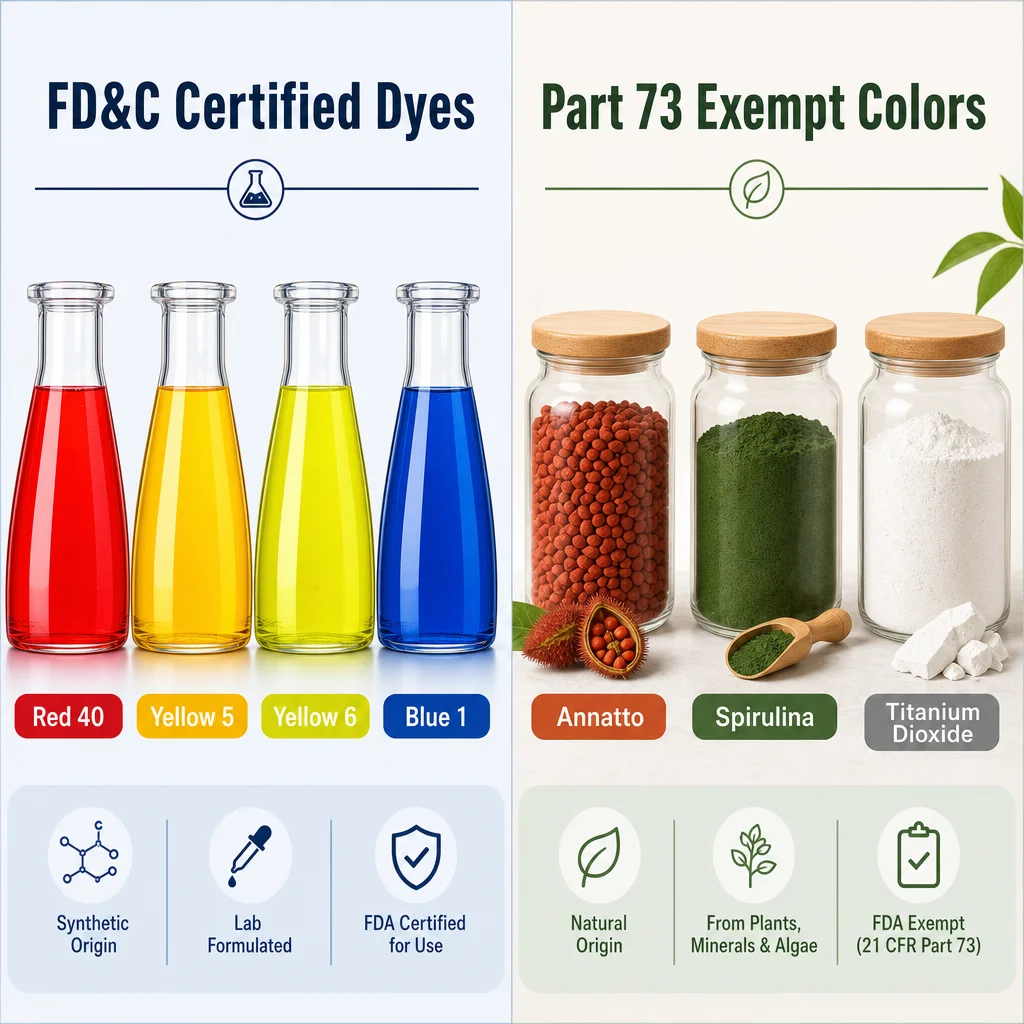
The first category is certified colors — synthetic dyes made from petroleum-derived chemicals, certified by the FDA on a batch-by-batch basis. These are the FD&C colors: Red 40, Yellow 5, Yellow 6, Blue 1, Blue 2, Green 3, Red 3. Their names are familiar because they appear on ingredient lists by their certified names or FD&C numbers. They are what most consumers picture when they hear "artificial food coloring."

The second category is colors exempt from certification — color additives that are approved for use in food but whose safety was evaluated through a color additive petition process rather than batch certification. These are listed in 21 CFR Part 73. They include annatto, beta-carotene, spirulina extract, beet powder, grape skin extract, turmeric — and titanium dioxide.

Under the existing regulatory definition at 21 CFR 101.22(a)(4), both categories qualify as "color additives." And under the broader definition at 21 CFR 70.3(f), a color additive is any substance that imparts color to food, whether made by synthesis or derived from a natural source. Technically, a product containing spirulina extract or beta-carotene — substances most consumers would describe as "natural" — could be cited by FDA for a misleading "no artificial colors" claim, because those substances are officially color additives.

What the February 2026 Guidance Changed

On February 5, 2026, the FDA sent a letter to food manufacturers describing a new enforcement discretion posture. The agency said it would generally refrain from taking action against "no artificial colors" claims when a product:

  • Contains no FD&C-certified (synthetic) colors
  • Uses only approved, non-certified Part 73 color additives

The specific claim forms now considered acceptable under this posture: "Made without artificial food colors," "No artificial color," "No artificial coloring," and variations with "added" inserted.

The intent, as framed by FDA, was to support the shift away from petroleum-based synthetic dyes. This aligns with the MAHA policy agenda — the Make America Healthy Again initiative that has pushed FDA to accelerate its review of food chemicals. By clarifying that "no artificial colors" means "no FD&C synthetic dyes," FDA wanted to give manufacturers a clearer path to make that claim as they reformulate away from Red 40 and Yellow 5.

What the guidance also did, without explicitly intending it as the headline, was create regulatory space for products containing titanium dioxide to carry the "no artificial colors" label.

The underlying definitions in 21 CFR 101.22(a)(4) and 70.3(f) were not changed. This is enforcement discretion, not a rule change. The FDA could, in theory, reverse course or narrow the interpretation. But as written, and as applied, the February 2026 letter means titanium dioxide products can now use that label.

Consumer Reports flagged the concern explicitly in a February 9, 2026 analysis, noting that the policy "could make food labels like 'no artificial colors' misleading" for consumers who associate the claim with a broader category of ingredient avoidance.

Why Titanium Dioxide Matters

Why Titanium Dioxide Matters

Titanium dioxide is not a dye. It does not impart a vivid color in the way Red 40 or Yellow 5 does. It is a white mineral — synthetically prepared titanium dioxide, as specified in its FDA regulatory listing at 21 CFR 73.575 — that functions as a whitening and brightening agent in food. It makes candy coating opaque and bright white. It creates the stark white appearance of powdered donuts, frosting, and certain coffee creamers.

The FDA has approved titanium dioxide for use at up to 1 percent by weight of food since 1966. It has not been placed on the agency's current formal post-market chemical review list, which as of May 2026 is focused on BHA, BHT, azodicarbonamide, and the petroleum-based FD&C dyes.

The EU reached a different conclusion. In May 2021, the European Food Safety Authority (EFSA) published a reassessment of titanium dioxide as a food additive and concluded it could no longer be considered safe. The critical finding:

"Taking into account all available scientific studies and data, the Panel concluded that titanium dioxide can no longer be considered safe as a food additive. A critical element in reaching this conclusion is that we could not exclude genotoxicity concerns after consumption of titanium dioxide particles."

The concern centered on nanoparticles. Up to 50 percent of the particles in food-grade titanium dioxide fall below 100 nanometers in size — the nano range. At that scale, the particles behave differently than bulk material. They are absorbed, even at low levels, and can accumulate in body tissues. EFSA found that genotoxicity — the ability to damage DNA — could not be ruled out at the levels found in consumer food products.

The European Commission acted on that opinion. Commission Regulation (EU) 2022/63, published January 18, 2022, removed titanium dioxide from the EU's authorized food additive list. Products with E171 were allowed to be sold through August 7, 2022, after which the ingredient became banned from food sold in the EU.

The EU and the US are now on divergent regulatory paths for the same ingredient.

Which Foods Contain Titanium Dioxide

Which Foods Contain Titanium Dioxide

Titanium dioxide is not as ubiquitous in the US food supply as the petroleum-based dyes, but it is common enough that consumers who want to avoid it need to read labels actively. The Center for Science in the Public Interest identified the following food categories in its October 2025 analysis:

  • White-coated candies and confections (white jelly beans, white candy coating, some seasonal candy)
  • Frosting and cake decorations
  • Chewing gum (white sticks, stick gum)
  • Powdered donuts
  • Coffee creamers
  • Certain salad dressings and sauces (particularly white or cream-based varieties)
  • Dairy products (some white yogurt coatings, cream cheese products)
  • Marshmallows
  • Vanilla ice cream coatings and white chocolate coatings

Mars and Wrigley removed titanium dioxide from Skittles by June 2025 as part of a broader voluntary reformulation program. The company committed to removing synthetic dyes from M&Ms and additional products through 2026. Voluntary removal has been happening across the industry, but it is not universal.

On an ingredient list, titanium dioxide appears as "titanium dioxide" — there is no synonym or hidden name to watch for. It is always declared by that name when used as a color additive. The E number is E171 (used in EU-market products before the ban, and still visible on older imported products or labeling databases).

State-Level Response and What Comes Next

No US state has enacted a blanket food-wide ban on titanium dioxide as of May 2026. Florida introduced HB 641, which would prohibit titanium dioxide (among other additives including BHA, BHT, potassium bromate, and FD&C dyes) in public school food. The bill is pending as of May 2026.

The MAHA policy agenda has generally focused its energy on petroleum-based FD&C dyes — the FDA's plan to phase out Red 40, Yellow 5, Yellow 6, and others by end of 2026 has commanded most of the public attention. Titanium dioxide occupies a secondary position in those discussions, which is partly why the February 2026 enforcement discretion letter's implications for titanium dioxide did not generate as much immediate coverage as the dye phase-out itself.

The Environmental Working Group and CSPI have both maintained active campaigns around titanium dioxide. CSPI has a citizen petition before FDA requesting revocation of the color additive authorization, though FDA has not acted on it. EWG's state-by-state regulatory tracker tracks titanium dioxide separately from the FD&C dyes.

Reading Past the Label

The practical implication for consumers is straightforward: "no artificial colors" on a product package now signals that the product contains no FD&C synthetic dyes. That is still useful information. It does not, however, tell you whether the product contains titanium dioxide.

To know whether titanium dioxide is present, you need to read the ingredient list, not the front-of-pack claim. Titanium dioxide is always explicitly declared when used as a color additive — it will appear on the ingredients panel by name. A "no artificial colors" front-of-pack banner does not substitute for checking.

This is precisely the problem with front-of-pack claims that exceed their regulatory scope: they create a sense of assurance that the full ingredient list does not always support. The claim has not become false — it accurately communicates the absence of FD&C-certified dyes — but for consumers who read it more broadly, the gap between what the label says and what it means has widened.

IngrediCheck lets you scan any product and flag titanium dioxide — along with any other ingredient you want to track — regardless of what the front of the package says. The ingredient list is where the actual contents of a product are disclosed, and that is where IngrediCheck does its work.

Next Label Check

Follow the scanner, hub, and ingredient paths connected to this guide

Get the app for clearer label decisions.

Scan labels, see what fits your food notes, and read the why in plain English.

IngrediCheck app