What Does 'Contains 2% or Less' Mean on an Ingredient List?

The phrase "contains 2% or less of" means that every ingredient grouped after it makes up no more than 2% of the finished food by weight. It does not mean the whole group adds up to 2%, and it does not reveal the exact amount of any one ingredient.

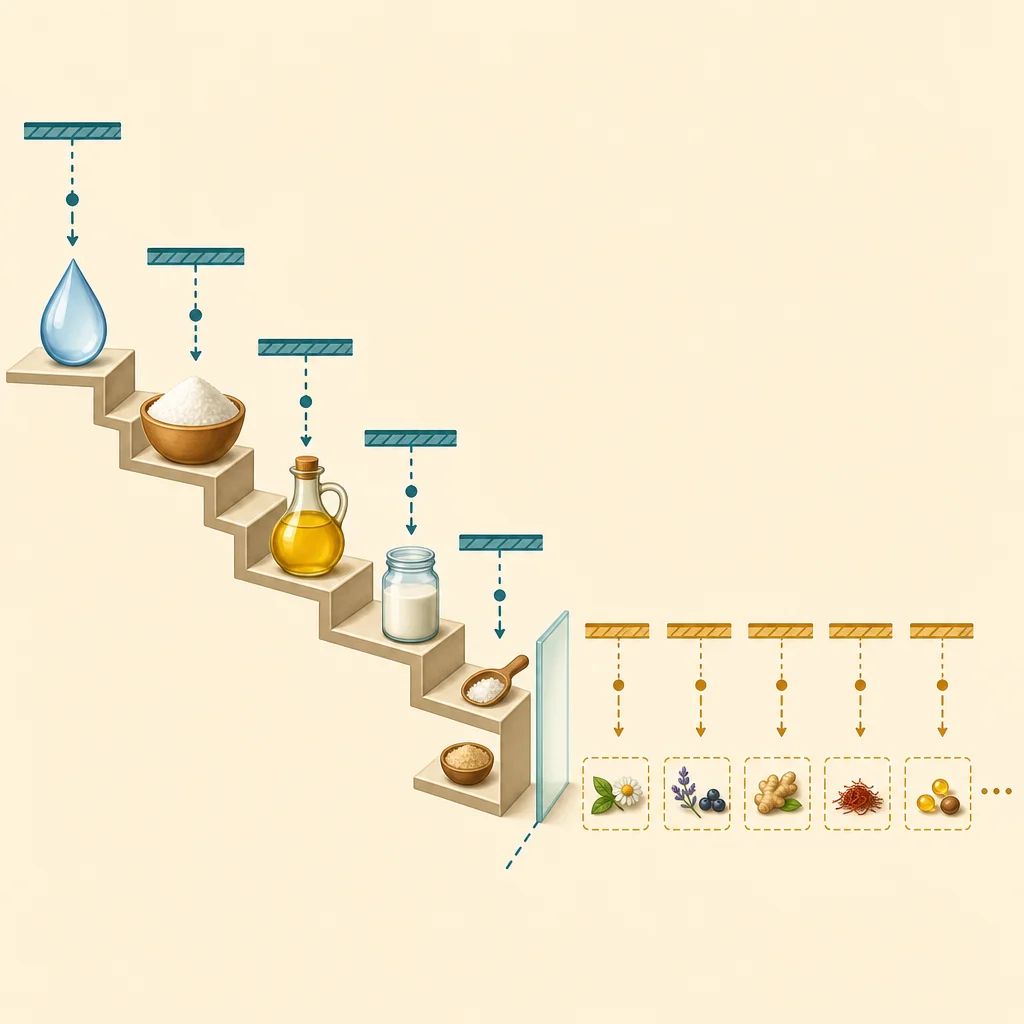
The phrase also changes how order works. Most ingredients on a U.S. label appear from greatest to least weight. Ingredients present at 2% or less may instead be placed at the end in any order when the manufacturer introduces them with an approved phrase such as "contains 2 percent or less of."

That makes the phrase a useful boundary, not a complete recipe. It tells you where the low-percentage group begins. It cannot tell you whether one of those ingredients is nutritionally trivial, safe for an allergy, or present only as a trace.
The U.S. Rule in Plain English

21 CFR 101.4 sets the basic U.S. ordering rule. Ingredients generally have to be listed by common or usual name in descending order of predominance by weight. The weight is assessed when the ingredient is used to make the food, subject to specific rules for water and ingredients that change during processing.

The same regulation creates an option for ingredients that individually make up 2% or less of the food. A company may list those low-percentage ingredients at the end in an order other than descending weight, as long as it introduces the group with wording such as:

  • "contains 2 percent or less of ..."
  • "less than 2 percent of ..."

The ordinary descending order still applies before that boundary. After the boundary, position no longer reliably tells you which ingredient is present in the greater amount.

Part of the ingredient listWhat order usually meansWhat you can conclude
Before the 2% phraseDescending weight at the time of formulationEarlier ingredients generally contribute more weight than later ones
After "contains 2% or less"The qualifying ingredients may be in any orderEach listed ingredient is at or below 2%
Entire listNames and relative order, not a formulaExact percentages remain unknown unless separately declared

It Is 2% Per Ingredient, Not 2% for the Group

It Is 2% Per Ingredient, Not 2% for the Group

Consider this simplified list:

Ingredients: tomato puree, cooked pasta, water, cheese, contains 2% or less of salt, garlic, basil, citric acid, spices.

The phrase means salt is no more than 2%, garlic is no more than 2%, basil is no more than 2%, citric acid is no more than 2%, and spices are no more than 2%. It does not promise that the five ingredients together make up only 2%.

Their combined share could be greater than 2%. The label only places a ceiling on each member of the group. It also does not prove that every member is close to 2%. One could be 1.8% while another is far below 0.1%.

This distinction matters when shoppers try to reverse-engineer a recipe. The phrase supplies a threshold, but not enough numbers to calculate the formula.

Why Manufacturers Use the Phrase

Many recipes contain a stable base and a small group of salt, flavors, colors, preservatives, acids, vitamins, gums, or spices. Small formulation changes can alter the precise order within that group. The 2% convention lets a manufacturer keep the low-percentage ingredients in a practical order without suggesting that the first tiny ingredient always outweighs the next one.

The option is not a loophole for omitting ingredients. Ingredients still need to be declared unless a separate labeling exemption applies. The phrase changes the permitted order of qualifying ingredients; it does not erase them.

It is also voluntary. A manufacturer may keep every ingredient in descending order and never use a 2% phrase. The absence of the phrase therefore does not mean every ingredient exceeds 2%.

What Ingredient Position Can and Cannot Tell You

Position is useful for broad comparisons. If sugar is first, it contributes more weight at formulation than ingredients listed after it under the ordinary rule. If a sweetener appears after a 2% phrase, the label tells you that particular ingredient is no more than 2% by weight.

Position does not answer several common follow-up questions:

  • Exact quantity: An ingredient can be anywhere from a very small amount up to the stated ceiling.
  • Nutrition impact: A low-weight ingredient can still contribute sweetness, sodium, color, acidity, or technological function.
  • Allergy importance: Allergic reactions are not screened by a two-percent cutoff.
  • Diet fit: Gelatin, an animal-derived flavor, or another avoided ingredient does not become acceptable because it is near the end.
  • Cross-contact: Advisory statements such as "may contain" concern a different issue and are not part of the 2% formula rule.
  • Processing aids: Some substances may be exempt from ingredient declaration under separate conditions, so the visible list is not a universal manufacturing inventory.

For a broader walkthrough of panels, claims, serving sizes, and allergen statements, use the existing five-minute food-label guide. This page stays focused on the narrow ordering convention.

Why Small Amounts Still Matter for Allergies

The 2% phrase is a formulation rule, not an allergy threshold. Milk, peanut, wheat, sesame, or another allergen intentionally used in the recipe can matter even when it is present below 2%.

U.S. major-allergen disclosure rules still apply. Depending on the label design, the allergen source must be clear in the ingredient list or in a nearby Contains statement. Do not stop reading when you reach the low-percentage group. Flavoring, seasoning, or a compound ingredient can also carry sub-ingredients that need review.

The same caution applies to non-allergen preferences. A vegan shopper may avoid a small amount of honey or gelatin. Someone managing sodium may care about salt even below 2%. A household rule is about the ingredient and the person, not about whether it falls before or after one printed phrase.

The EU Uses a Similar Boundary, but Labels Are Local

The European Union also starts with descending order by weight. Regulation (EU) No 1169/2011 then permits ingredients constituting less than 2% of the finished product to be listed in a different order after the other ingredients.

That similarity does not make every international label interchangeable. The exact permitted wording, allergen emphasis, ingredient categories, compound-ingredient rules, and quantitative declarations vary by jurisdiction. Canada also has its own ordering and component rules under the Food and Drug Regulations.

When reading an imported product, use the rules for the market where that package is sold. A familiar-looking ingredient list may have been prepared for a different labeling system.

Three Examples That Prevent Common Mistakes

Three Examples That Prevent Common Mistakes

Example 1: Two products reverse the last ingredients

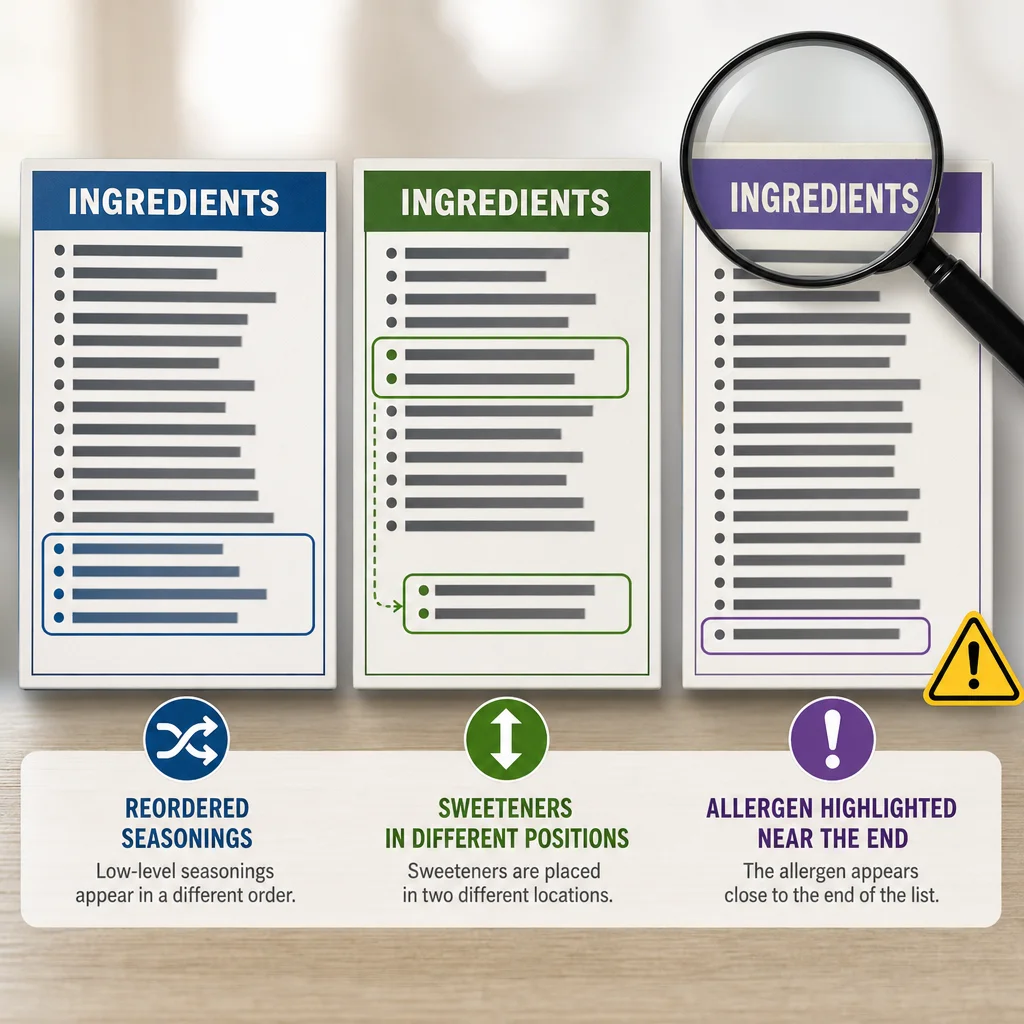
One salsa lists "contains 2% or less of lime juice, garlic, spices." Another lists "contains 2% or less of spices, garlic, lime juice." You cannot conclude that the second salsa contains more spices. Once the qualifying phrase begins, the order may be rearranged.

Example 2: Sugar appears in two forms

A food lists sugar near the top and molasses after the 2% phrase. The phrase limits molasses, not the total amount of all added sugars. Nutrition labeling and added-sugars rules answer a different question.

Example 3: An allergen sits last

A dressing lists sesame near the end of the 2% group. Its position does not make it safe for sesame allergy. The correct response is to treat the intentional ingredient as present and follow the household's allergy plan.

A Practical 2% Label Checklist

  1. Find the exact boundary phrase. Do not assume the last few ingredients are a 2% group unless the label says so.
  2. Read the phrase literally. Each listed ingredient is at or below the threshold; the group is not necessarily 2% total.
  3. Stop ranking the low-percentage group. Its printed order may not reflect relative weight.
  4. Keep reading for allergens and personal rules. Small quantity is not the same as low consequence.
  5. Use Nutrition Facts for nutrient totals. Ingredient order cannot calculate grams of sugar, sodium, or fat.
  6. Contact the manufacturer for a quantity-sensitive decision. A strict therapeutic diet or recipe question may require information the label does not provide.

When a long label makes the boundary hard to track, the IngrediCheck ingredient checker can help capture the listed terms and compare them with saved household rules. It is a review aid, not a percentage calculator, and the package remains the source to verify.

"Contains 2% or less" gives you one precise fact: each ingredient in that group is no more than 2% of the food by weight. Treat it as a boundary marker, continue reading the full list, and avoid turning relative order into an exact recipe.

Frequently Asked Questions

Does contains 2% or less mean each listed ingredient is under 2%?

Yes. In the U.S. convention, each ingredient grouped after that phrase is present at 2% or less by weight. The phrase does not mean all of those ingredients together total 2%.

Are ingredients after contains 2% or less listed from most to least?

Not necessarily. U.S. rules allow ingredients present at 2% or less to be listed in any order after the other ingredients when the qualifying phrase is used.

Can I calculate the exact amount of an ingredient from its position?

No. The ingredient list provides order and, sometimes, a 2% ceiling. It does not disclose the exact recipe percentage unless another rule or voluntary statement supplies it.

Does contains 2% or less mean the ingredient is unimportant for allergies?

No. A small amount can still matter for an allergy or another strict avoidance rule. Read the full ingredient list and required allergen disclosure regardless of position.

Next Label Check

Follow the scanner, hub, and ingredient paths connected to this guide

Get the app for clearer label decisions.

Scan labels, see what fits your food notes, and read the why in plain English.

IngrediCheck app