How the Adventist Health Study Reshaped Nutrition Science

The Adventist Health Study tracked 96,000 people and found vegetarians lived significantly longer. Here's what the data says about plant-based eating and longevity.

Mar 19, 2026|10 min read
How the Adventist Health Study Reshaped Nutrition Science

Most nutritional research is messy. Diet studies typically rely on self-reported food diaries, compare populations with wildly different lifestyles, and struggle to isolate the effect of food from everything else — income, smoking, exercise, stress. The results are often contradictory, frequently contested, and difficult to apply in practice.

That's what makes the Adventist Health Study so unusual. For the past six decades, researchers at Loma Linda University in California have been running one of the longest-running, most carefully designed diet studies in history — using a single, stable religious community as their cohort. The findings have reshaped what nutrition science knows about plant-based eating, longevity, and chronic disease risk.

Why Seventh-day Adventists Make Ideal Study Subjects

Seventh-day Adventists are a Christian denomination with deeply held dietary convictions. Most avoid alcohol, tobacco, and caffeine. Many are vegetarian or vegan. Many who do eat meat follow biblical "clean food" guidelines from Leviticus, avoiding pork, shellfish, and rabbit. Their diet is largely consistent, their lifestyle is well-documented, and their community is large and willing to participate in research.

This creates a rare scientific opportunity: a population that varies meaningfully in diet (from vegan to omnivore) while holding most other lifestyle variables relatively constant. You can compare a vegan Adventist to a meat-eating Adventist without the confounding noise of comparing a vegan to a heavy drinker or smoker.

"The Adventist population in North America represents perhaps the most important ongoing natural experiment in nutrition and health." — Adventist Health Study research team, Loma Linda University

Three Generations of Research

Three Generations of Research

The Adventist Mortality Study (1958–1966)

The first formal research on this community began in the late 1950s. Researchers observed that Adventists had notably lower death rates from several major diseases compared to the general California population — particularly heart disease and certain cancers. This was striking enough to prompt more structured, long-term investigation.

Adventist Health Study 1 (AHS-1, 1976–1988)

The first full Adventist Health Study enrolled approximately 34,000 non-Hispanic White Adventists in California. Participants completed detailed diet questionnaires and were followed for over a decade.

The headline finding was stark: Adventist men lived an average of 7.3 years longer than other California men, and Adventist women lived 4.4 years longer than other California women. Vegetarian Adventist men in particular showed dramatically reduced risks of heart disease — male vegetarians had a 37% lower risk of ischemic heart disease mortality than their non-vegetarian Adventist counterparts.

The study also linked frequent nut consumption (five or more times per week) to a roughly 31% reduction in lifetime heart disease risk — a finding that helped spark decades of subsequent research on nuts as a health food.

Adventist Health Study 2 (AHS-2, 2002–present)

AHS-2 is the most ambitious of the three studies, and the one that has generated the most influential published findings. Between 2002 and 2007, researchers enrolled 96,469 Seventh-day Adventists across the United States and Canada. Participants completed a detailed 50-page questionnaire covering diet, lifestyle, and health history, and have been followed with regular updates since.

A deliberate effort was made to recruit a racially diverse cohort — approximately 27% of AHS-2 participants are Black, making it one of the few large-scale nutrition studies with meaningful representation across racial groups.

The analytic sample used in the primary mortality study comprised 73,308 participants, with 2,570 deaths recorded over a mean follow-up of 5.79 years.

The Five Dietary Patterns — and What They Found

One of AHS-2's most valuable design choices was classifying participants into five distinct dietary patterns rather than simply "vegetarian vs. non-vegetarian":

  1. Vegan — no animal products at all
  2. Lacto-ovo vegetarian — no meat or fish, but includes dairy and eggs
  3. Pesco-vegetarian — includes fish but no other meat
  4. Semi-vegetarian — occasional meat (less than once per week)
  5. Non-vegetarian — regular meat consumption

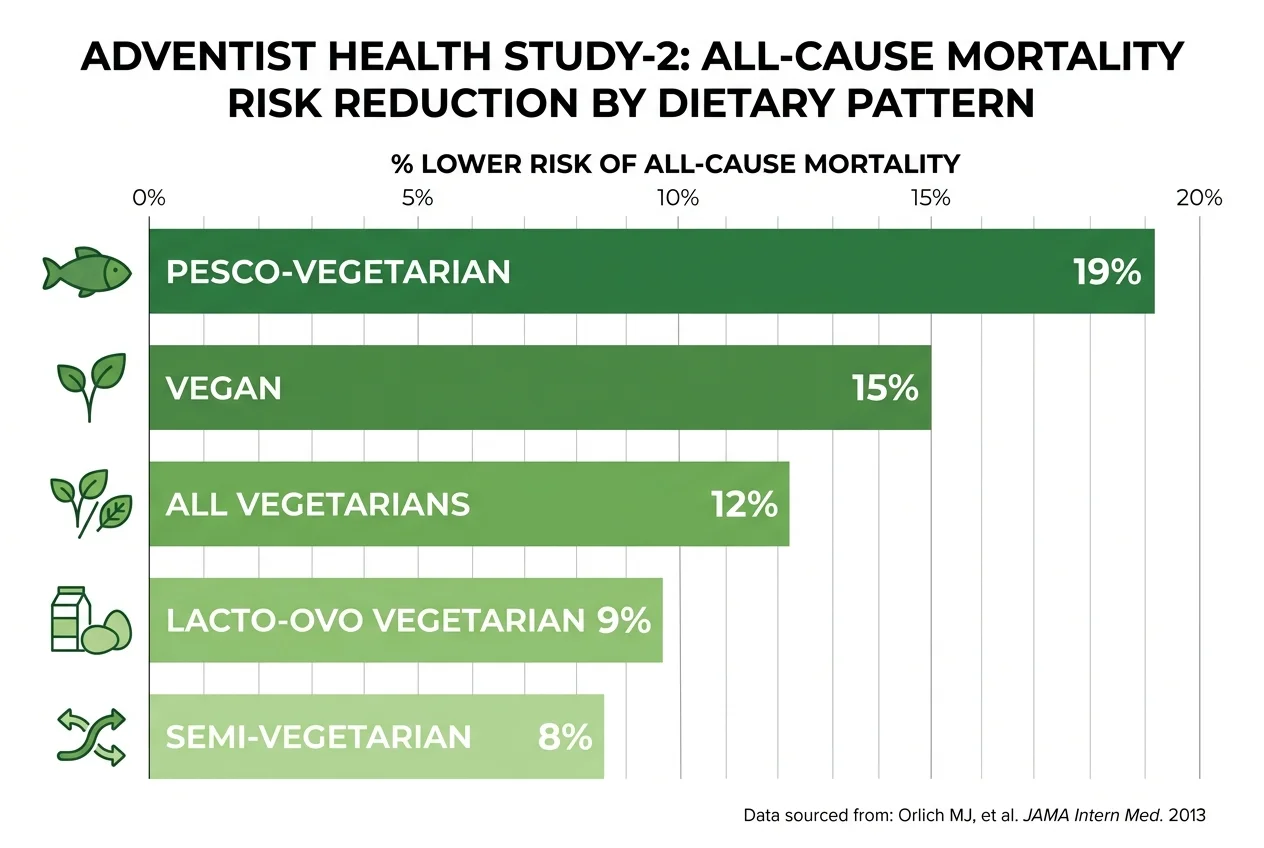
This allowed researchers to examine a gradient of plant-based eating rather than a single binary comparison. The all-cause mortality results, published in JAMA Internal Medicine, adjusted for age, sex, race, and lifestyle factors:

| Dietary Pattern | Mortality Hazard Ratio vs. Non-Vegetarian | |---|---| | All vegetarians combined | 0.88 (12% lower risk) | | Pesco-vegetarian | 0.81 (19% lower risk) | | Vegan | 0.85 (15% lower risk) | | Lacto-ovo vegetarian | 0.91 (9% lower risk) | | Semi-vegetarian | 0.92 (8% lower risk) |

The results were statistically significant for vegetarians overall and for pesco-vegetarians specifically. Pesco-vegetarians showed the largest mortality reduction of any group — a finding that has since attracted considerable attention, given that fish-inclusive plant-based diets sit in a practical middle ground for many people.

Associations were particularly strong in men, and in younger participants (under 65). The benefits appeared across cardiovascular mortality, renal mortality, and endocrine mortality.

Beyond Mortality: Chronic Disease Across the Board

Mortality was only one outcome. AHS-2 has generated a large body of published findings across multiple conditions:

Diabetes: Vegetarian dietary patterns were associated with significantly lower incidence and prevalence of type 2 diabetes, with vegans showing the lowest rates of all dietary groups.

Hypertension: Vegetarians and vegans had consistently lower blood pressure and lower prevalence of hypertension compared to non-vegetarians in the cohort.

Obesity: Body mass index was markedly lower in plant-based subgroups, with vegans on average having the lowest BMI of the five dietary groups.

Cancer: A 2025 longitudinal analysis of AHS-2 data found that vegetarian dietary patterns were associated with lower risk of colorectal cancer (HR: 0.79), stomach cancer (HR: 0.55), and lymphoproliferative cancers (HR: 0.75). However, the study found no significant reduction in overall cancer mortality for vegetarians compared to non-vegetarians — a nuanced finding that underscores the complex relationship between diet and cancer.

Cardiovascular disease: Vegetarian diets were consistently associated with lower cardiovascular risk factors — lower LDL cholesterol, lower triglycerides, lower blood pressure — reinforcing the AHS-1 findings on heart disease.

The Loma Linda Blue Zone Connection

The Adventist community in Loma Linda, California — home to roughly 9,000 Adventists — is one of only five regions in the world designated as a Blue Zone: a place where people consistently live measurably longer than average.

Dan Buettner's Blue Zones research identified Loma Linda as the only Blue Zone in the United States. Adventist men in Loma Linda live an average of 10 years longer than other American men; Adventist women live about 7 years longer than other American women. The diet — predominantly plant-based, low in processed food, free of alcohol and tobacco — is identified as the primary driver alongside community belonging and regular physical activity.

The Nuances the Study Also Revealed

Responsible interpretation of AHS-2 requires noting what the data did not show uniformly:

Age modifies the effect. A more recent AHS-2 follow-up analysis found that among the oldest participants (those in their 80s and 90s), vegetarian diets were associated with higher risk of stroke and dementia compared to non-vegetarians. This likely reflects nutrient considerations — particularly vitamin B12 and omega-3 fatty acids — that become more critical at older ages and are harder to obtain from plant foods alone.

Ultra-processed food matters too. A 2022 AHS-2 analysis specifically examining ultra-processed food intake found that higher consumption of ultra-processed foods was independently associated with increased mortality — even among vegetarian participants. In other words, a vegetarian diet built on highly processed meat alternatives and packaged snacks does not confer the same benefits as one built on whole plant foods.

Not all plant-based patterns are equal. The gap between pesco-vegetarian and lacto-ovo vegetarian outcomes suggests that the specific composition of a plant-based diet — including what animal products, if any, are included — matters more than a simple vegetarian/non-vegetarian label.

What the Research Means in Practice

What the Research Means in Practice

Taken together, the six decades of Adventist Health Studies have established a body of evidence that is difficult to dismiss:

  • Long-term plant-based eating is associated with lower mortality, lower cardiovascular risk, lower diabetes risk, lower obesity rates, and lower risk of several cancers
  • The quality and composition of the diet matters — whole foods outperform processed ones regardless of whether they contain meat
  • Fish-inclusive plant-based diets may offer advantages over strictly vegan or lacto-ovo vegetarian patterns for certain outcomes
  • Nutrient monitoring — particularly B12, omega-3s, calcium, and vitamin D — becomes especially important over decades of plant-based eating

These are not the conclusions of a single small study. They represent observations from tens of thousands of people, tracked over decades, with ongoing follow-up that continues to generate new published findings in 2024 and 2025.

Reading the Label Through an Evidence-Based Lens

If the AHS data points to anything actionable, it's that food quality and ingredient composition matter more than simple category labels. "Vegetarian" does not equal "healthy" if the diet is built around ultra-processed products. And a non-vegetarian diet built around mostly whole foods performs better in the data than a processed vegetarian one.

For anyone trying to build a diet closer to the whole-food plant-based pattern that the AHS has studied, the challenge is navigating modern food labels — where ultra-processing, hidden animal derivatives, and additives can turn an apparently plant-based product into something the Adventist cohort would barely recognize as food.

IngrediCheck makes it easier to eat closer to the whole-food patterns the Adventist Health Study identified as protective. Scan any packaged product and instantly see whether it contains hidden animal derivatives, ultra-processed additives, or ingredients that conflict with your dietary goals — so your plant-based choices are actually as clean and whole-food-based as you intend them to be.

Start making confident food choices today!

Scan food and understand what's right for you and your family, with AI.

IngrediCheck app