Not immediately. Products packaged and labelled before February 25, 2024 received a two-year stock-in-trade period. That period ended on February 25, 2026.
Is every allergen word bold?
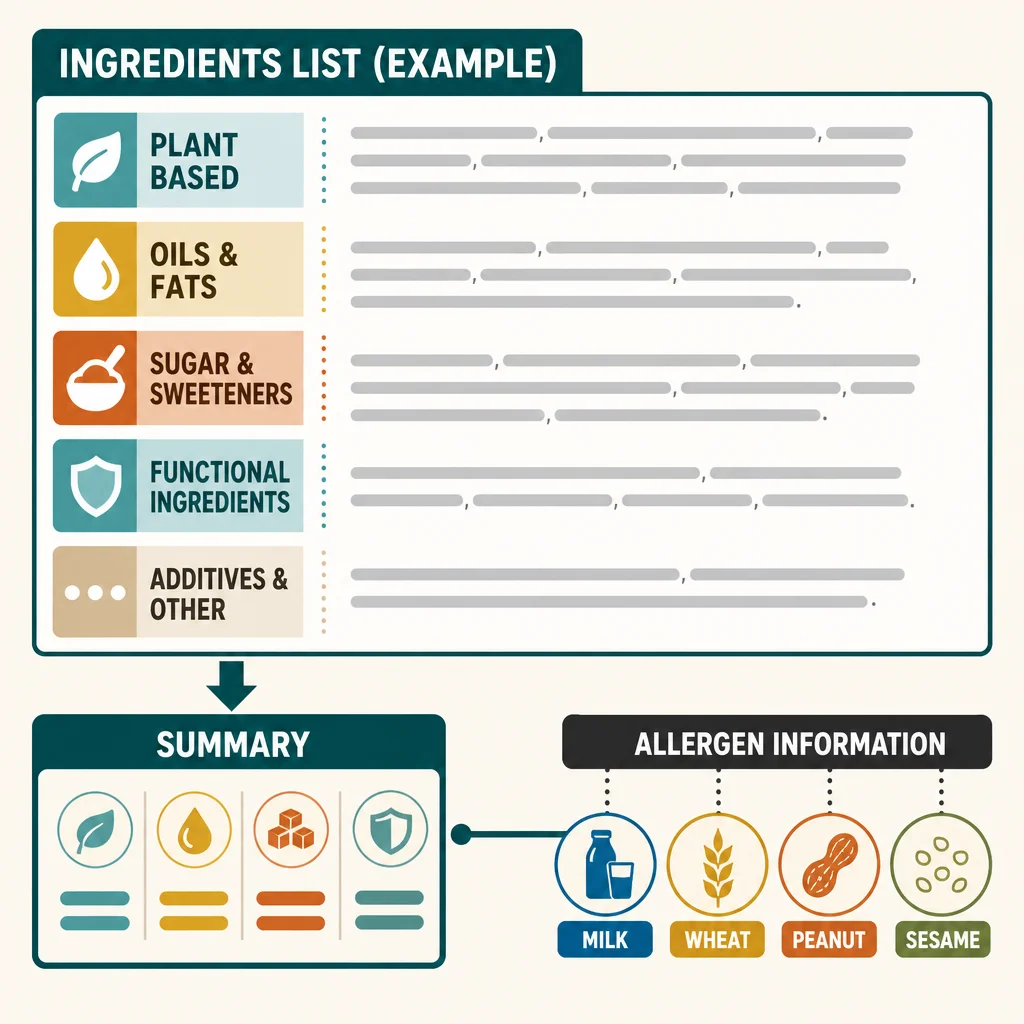
The prescribed allergen name must receive the required emphasis when the Code calls for declaration. Other words in a compound name may remain in ordinary type. Read the full phrase so you understand the source and ingredient context.
Does the Contains line cover every sensitivity?
No. It summarizes prescribed allergens. It does not serve as a complete list of intolerances, personal dietary restrictions, additives, or non-priority allergens.
Does a scanner replace the package?
No. The current physical package is the primary evidence. A scanner can structure the review and explain terms, but it cannot detect an undeclared formulation error or invisible cross-contact.
What about foods without an ingredient list?
The Code contains product-specific declaration rules and exemptions, so not every food presents information in the same layout. Where an ingredient list is not required, mandatory allergen information still needs an appropriate declaration through the applicable route. Catering, unpackaged food, and food sold in other settings can use different communication methods. Ask the business for the prescribed allergen information instead of assuming that no printed list means no allergen.
Why list the specific tree nut or cereal?
Specific names help consumers act on the allergy they actually manage. Someone allergic to cashew should not have to decode a generic nuts term, and someone avoiding gluten needs to know whether wheat, barley, rye, or oats are involved. The same specificity also helps a household maintain different profiles without treating every member as though they have the same restriction.
What if Contains and the ingredient list seem inconsistent?
Do not choose which one to trust. Treat the product as unresolved, avoid it if your allergy plan requires certainty, and contact the manufacturer. The summary and the list are designed to agree. A mismatch can reflect a packaging error, an overlooked component, or a misunderstanding that deserves clarification before consumption.