Food Policy Watch

Australia Added Sugar Labels: Why FSANZ Said No in 2026

FSANZ closed its added-sugars label proposal in March 2026 without adding a separate line to nutrition panels. Learn what labels still show and how to compare products.

Aug 14, 2026|8 min read
By Sanket Patel|Updated 2026-08-14|3 sources|Editorial standards
Australia Added Sugar Labels: Why FSANZ Said No in 2026

Australia and New Zealand will not add a mandatory added sugars line to the Nutrition Information Panel as a result of Proposal P1058. Food Standards Australia New Zealand closed the proposal on March 23, 2026 after concluding that the specific change was unlikely to produce a clear public-health benefit proportionate to its costs and could confuse some consumers.

The decision did not remove sugar information from labels. Packaged foods still declare total sugars in the nutrition panel. Ingredient lists, regulated nutrition claims, and product-specific rules provide other evidence about how sweetness entered the food.

The easiest way to understand the outcome is to avoid turning it into a dietary verdict. FSANZ made a decision about one label design. It did not conclude that added sugar is harmless, unimportant, or unregulated.

The Short Answer

QuestionAustralia and New Zealand after P1058
Does the Nutrition Information Panel show sugars?Yes. It declares total sugars
Is a separate mandatory added-sugars line being introduced through P1058?No. FSANZ closed the proposal in March 2026
Does total sugars separate naturally occurring from added sugars?No. It combines them in the declared amount
Can a product still make a no-added-sugar claim?Claims remain regulated separately under the Food Standards Code
Can the ingredient list reveal the exact grams of added sugar?No. It identifies ingredients and order, not a finished-food gram calculation

What FSANZ Considered

Proposal P1058 examined whether labels should provide more information about added sugars. Options considered during the process included changes to the nutrition panel and other ways to help consumers distinguish sugars added during manufacture from sugars naturally present in ingredients such as fruit and milk.

The P1058 proposal page records the final status and supporting reports. FSANZ said the evidence did not establish that a separate mandatory added-sugars line would deliver a clear public-health benefit. It also cited implementation costs and the possibility that the extra line could confuse or mislead consumers.

The agency noted that consumers already use total-sugars information and generally find that measure useful. Closing the proposal left the current requirements unchanged.

This is different from a regulator saying there is no reason to limit free or added sugars. Dietary guidance and label-format policy ask different questions.

What the Nutrition Information Panel Still Shows

What the Nutrition Information Panel Still Shows

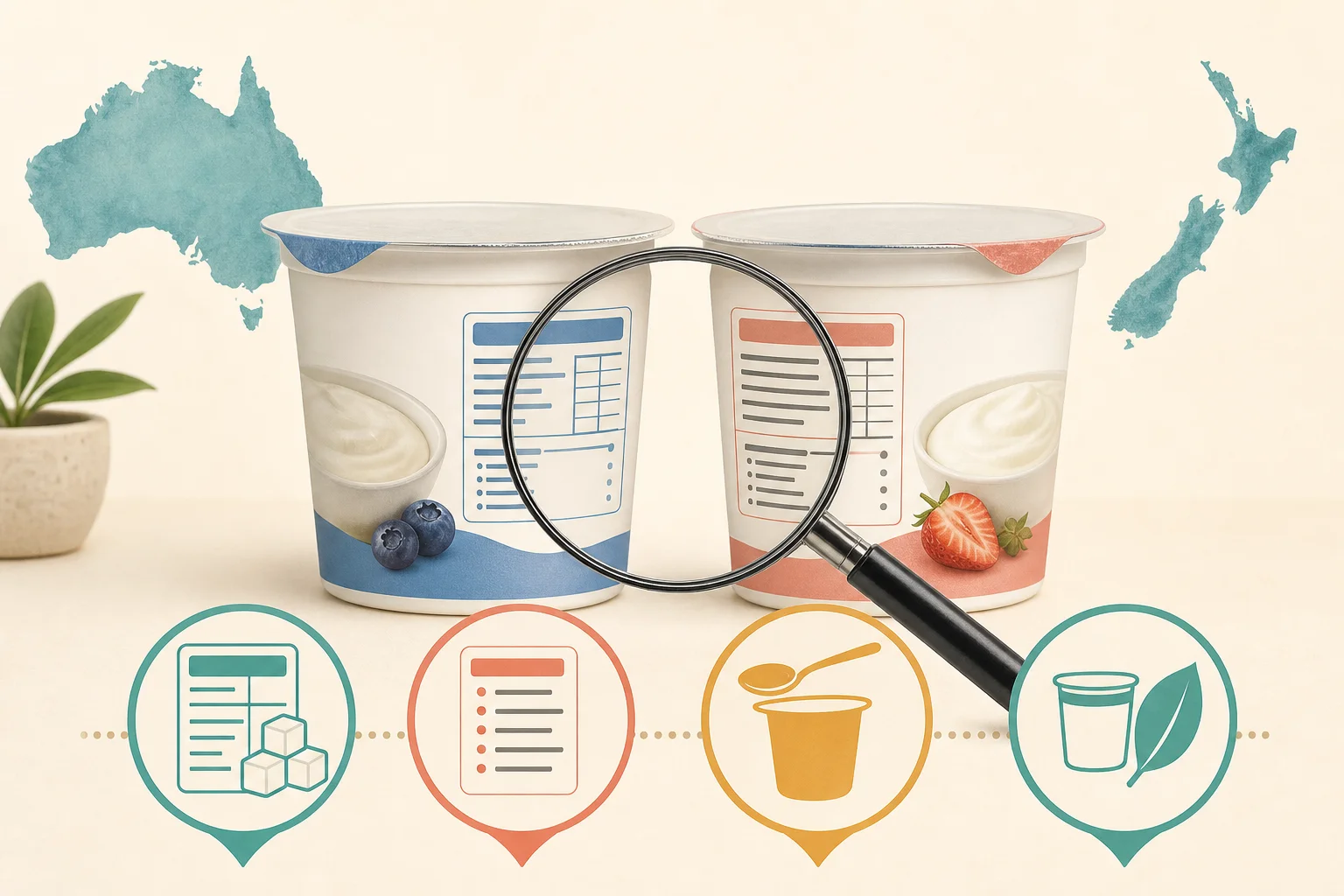
The Australia New Zealand Nutrition Information Panel usually declares energy, protein, fat, saturated fat, carbohydrate, sugars, and sodium per serving and per 100 grams or 100 millilitres, subject to the Code's details and exemptions.

Sugars is a total measure. It can include:

  • sugars naturally present in fruit
  • lactose naturally present in milk or yogurt
  • sucrose, glucose, syrups, or other sugars added during manufacture
  • sugars contributed by concentrates and compound ingredients

The number does not assign those grams to source categories. A plain milk and a sweetened dairy drink can both contain total sugars, but the ingredient list and side-by-side amount help explain the difference.

The per-100-gram or per-100-millilitre column is especially useful for comparing similar products with different serving sizes. It is not a perfect measure of real-world portions, but it reduces the distortion caused by one brand defining a smaller serving.

How This Differs From the United States

The U.S. Nutrition Facts label declares total sugars and includes a separate Includes X g Added Sugars line. The Australian and New Zealand panel does not copy that format.

That difference does not make one panel's total-sugars number comparable with the other's added-sugars number. When comparing imported products:

  • U.S. total sugars includes naturally occurring and added sugars
  • U.S. added sugars is a subset calculated under FDA rules
  • Australia/New Zealand sugars is the panel's total-sugars measure
  • ingredient names and claims follow the law of the market where the product is sold

A shopper should never interpret an Australian sugars value as if it were U.S. added sugars. They answer different questions.

Ingredient Order Helps, but It Does Not Give Grams

Ingredients are generally listed by descending ingoing weight, subject to the Code's rules and exceptions. If sugar, glucose syrup, honey, malt extract, or fruit concentrate appears near the beginning, that is useful formulation context.

Ingredient order still cannot reveal:

  • the exact amount of each sweetening ingredient
  • how much naturally occurring sugar remains in the finished food
  • water lost during cooking or concentration
  • the number of grams FSANZ would have classified as added sugar under a hypothetical panel rule
  • whether an ingredient serves more than one technical purpose

Several sweeteners can also appear under separate names. The hidden sugar names guide helps identify those names without pretending that ingredient order is a quantitative sugar calculation.

No Added Sugar Is a Separate Claim Question

Closing P1058 did not create an unregulated space for front-label claims. No added sugar, unsweetened, low sugar, and sugar free are distinct messages with conditions under the Food Standards Code.

A no-added-sugar claim does not mean the product contains zero total sugar. Fruit and dairy products can contain naturally occurring sugars. Conversely, a package without the claim may still have a lower total-sugars value than a product that uses it.

This is why a good comparison uses both:

  • the regulated claim, read literally
  • the total-sugars amount in the Nutrition Information Panel
  • the ingredient list
  • the same basis of comparison, usually per 100 grams or 100 millilitres for similar foods

Our sugar-free versus no-added-sugar guide owns the broader claim distinction.

Where Fruit Juice Concentrate Fits

Fruit juice concentrate demonstrates why a simple added-versus-natural split can become difficult. Concentrate can reconstruct juice, contribute fruit character, or sweeten another food. The ingredient name alone does not reveal its complete legal treatment or formulation role.

The existing fruit juice concentrate label guide covers the U.S. same-type-juice baseline and EU claims framework. This article stays narrower: P1058 did not add a new mandatory line to the Australia/New Zealand nutrition panel.

What the Decision Does Not Mean

“FSANZ says added sugar is harmless”

False. The agency assessed the effectiveness, clarity, and proportionality of a label change. It did not issue a general safety verdict on high added-sugar intake.

“Added sugars are unregulated”

False. Ingredient declarations, nutrition claims, composition standards, and consumer law still apply. P1058 concerned a particular mandatory information format.

“Australian labels hide all sugar”

False. Total sugars remains mandatory for covered products in the Nutrition Information Panel.

“No added sugar means sugar free”

False. Naturally occurring sugars can remain, and the two claims have different conditions.

Why One Extra Number Can Still Be Hard to Use

Why One Extra Number Can Still Be Hard to Use

An added-sugars line sounds simple, but manufacturers need a consistent method for compound ingredients, fruit preparations, concentrates, fermentation, and production losses. Shoppers also need to understand how the new number differs from total sugars.

FSANZ's conclusion was that the expected benefit of the proposed change did not clearly outweigh those costs and risks. That judgment can be debated without misrepresenting it. The agency did not say consumers are incapable of using more information. It assessed whether this particular mandatory format was the most effective regulatory tool.

For now, the best practical response is to use the evidence the label already supplies consistently rather than inventing an added-sugar gram value from ingredient order.

The decision may be revisited if new evidence, dietary guidance, or a broader nutrition-panel review changes that balance. Until then, current labels should be read under the rules that are actually in force, not under a U.S. format that was never adopted for these markets.

A Practical Product Comparison

  1. Compare the same food category. Yogurt versus yogurt is more useful than yogurt versus juice.
  2. Use the per-100-unit column. This reduces serving-size games when products are similar.
  3. Check total sugars. That is the quantity the panel provides.
  4. Read the ingredient list. Look for sugar, syrups, concentrates, honey, malt, and sweet compound ingredients.
  5. Interpret claims separately. No added sugar is not the same as sugar free or low sugar.
  6. Account for the market. Do not transfer the U.S. Added Sugars line into an Australian or New Zealand label.
  7. Choose based on the whole product. Serving size, fibre, protein, sodium, dietary needs, and overall pattern may matter alongside sugars.

FSANZ's 2026 decision leaves Australian and New Zealand shoppers with total sugars rather than a new mandatory added-sugars line. IngrediCheck can help surface the different sweetener names and concentrates in the ingredient list, while the Nutrition Information Panel and regulated claim wording provide the quantitative and legal context needed for a fair comparison.

Next Label Check

Follow the scanner, hub, and ingredient paths connected to this guide

Get the app for clearer label decisions.

Scan labels, see what fits your food notes, and read the why in plain English.

IngrediCheck app