Celeriac: The Hidden Allergen Behind the HiPP Baby Food Recall

A 2026 HiPP recall has put celery and celeriac back in the spotlight. Here is why this overlooked allergen matters, where it hides, and how to spot it on a label.

May 2, 2026|9 min read
By Sanket Patel|Updated 2026-05-02|4 sources|Editorial standards
Celeriac: The Hidden Allergen Behind the HiPP Baby Food Recall

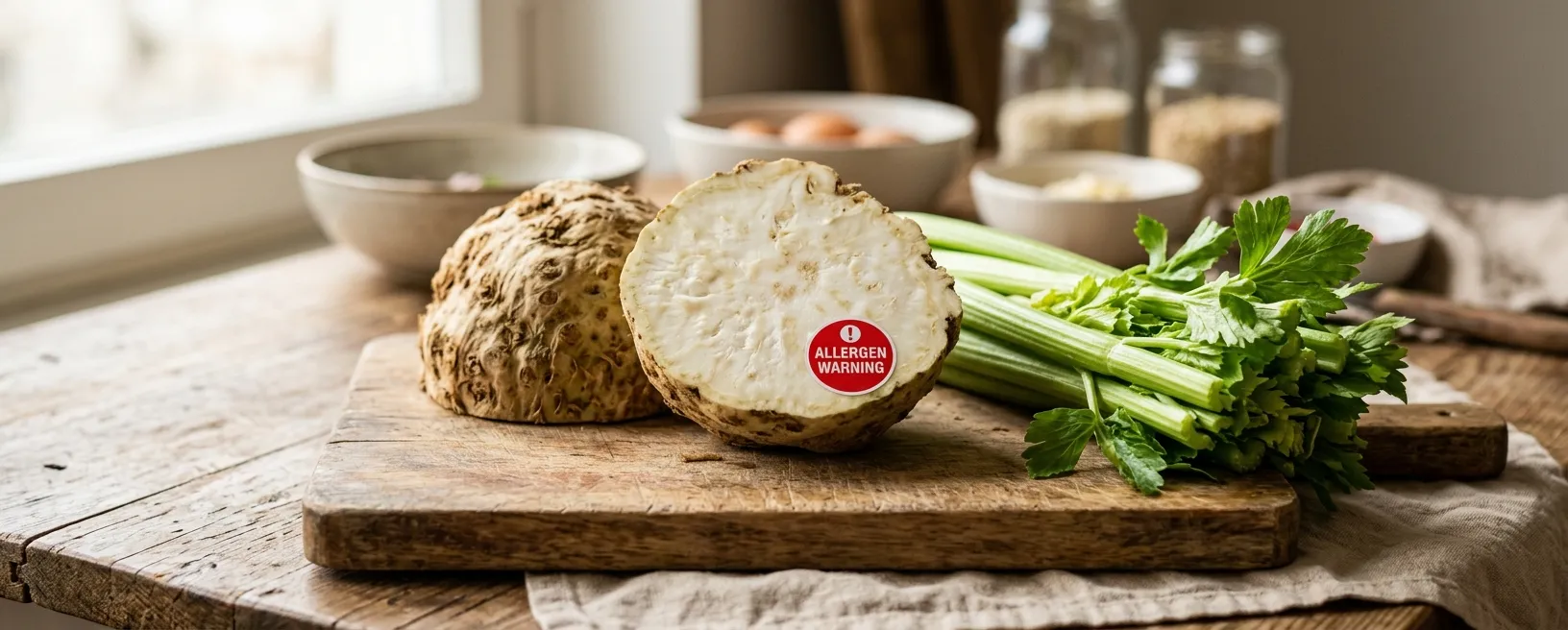
On 24 April 2026, the UK Food Standards Agency issued an allergy alert that surprised a lot of parents. HiPP Organic UK was recalling its 7+ months Vegetable Lasagne 190g jar. The reason was not contamination, spoilage, or a packaging defect. The jar contained celeriac, the swollen tuber of the celery plant, but the label did not emphasise it the way EU rules require. For most adults a small amount of celeriac in a baby food jar is harmless. For a child sensitised to celery, it can trigger anything from itchy lips to full anaphylaxis.

Celery and celeriac sit on a list of allergens that EU shoppers see in bold on every ingredient panel. Yet outside Europe, most people have never thought about them as allergens at all. The HiPP recall is a useful reminder of why this single vegetable family gets its own line on EU labels.
Why celery is on the EU "Top 14" allergen list

Why celery is on the EU "Top 14" allergen list

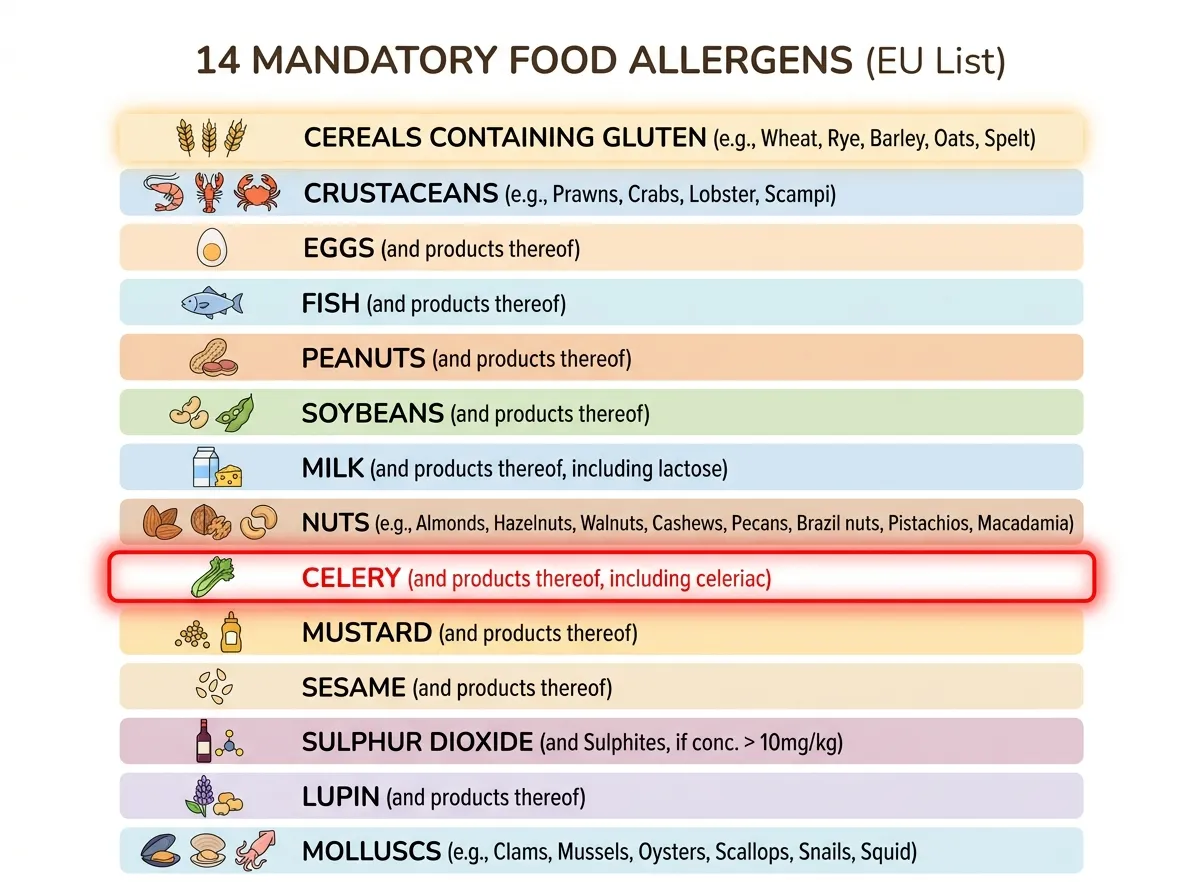
Under EU Regulation 1169/2011, 14 ingredients must be highlighted whenever they appear in a packaged food or on a restaurant menu. The list covers the usual suspects (milk, eggs, fish, peanuts, tree nuts, soy, wheat, crustaceans, molluscs, sesame, sulphur dioxide, mustard, lupin) and one entry that surprises many North American visitors: celery.

The "celery" line includes everything from the celery plant. As the UK's Safefood agency explains, this covers the stalk, the root (celeriac), celery salt, and celery seeds. The agency notes that "people are more likely to be allergic to celeriac than to the stalk but both can cause severe reactions."

The HiPP jar tripped this rule in a very specific way. Celeriac was listed in the ingredients, but it was not emphasised. EU labelling law requires allergens to be set apart from other ingredients in the list, usually by bold, italics, capitals, or a contrasting colour. A celeriac line in plain font is technically still an undeclared allergen, even if a careful reader would have spotted it.

How common is celery allergy actually?

How common is celery allergy actually?

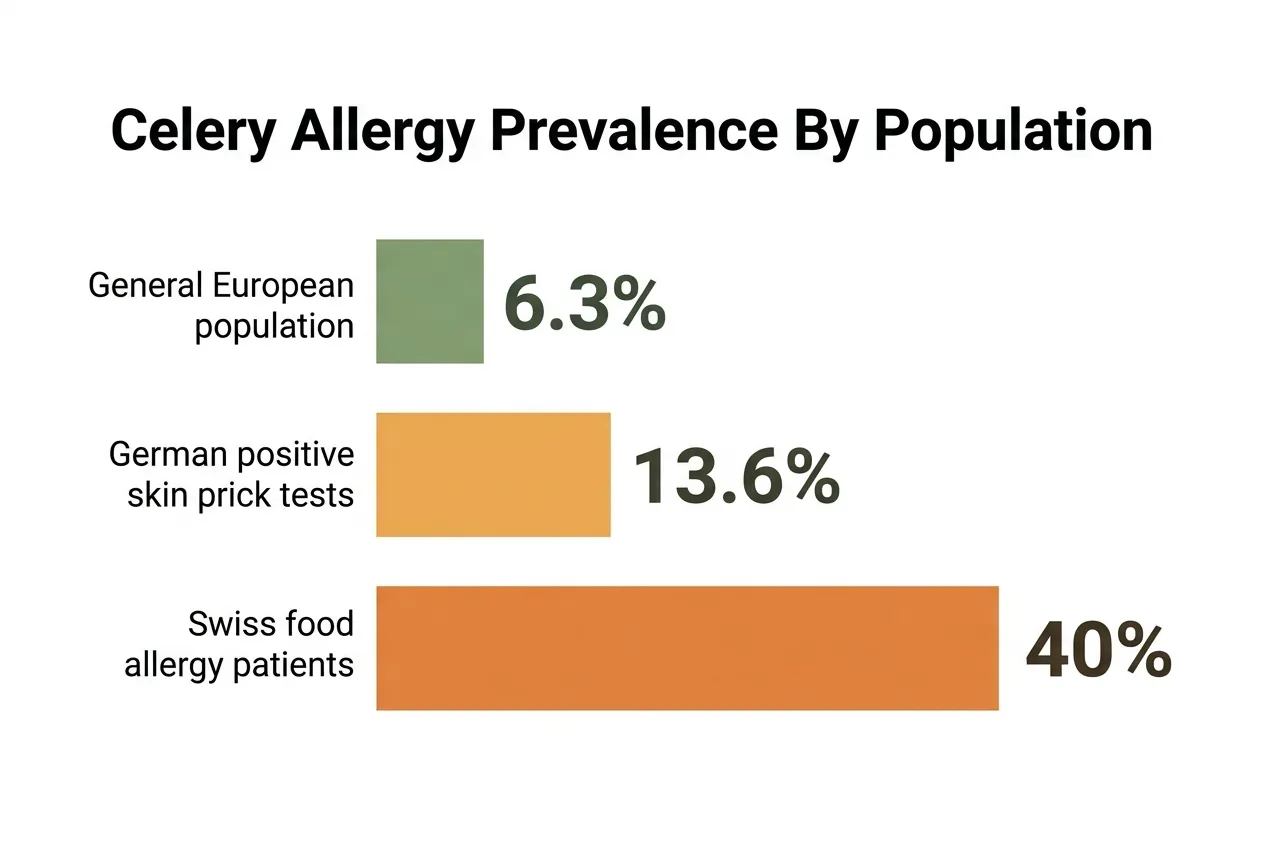
This is where the geography gets interesting. In a global survey of food sensitisation, Thermo Fisher Scientific reports that around 6.3% of the general population shows IgE sensitisation to celery. That is already higher than peanut sensitisation in many populations.

Zoom in on central Europe and the numbers climb sharply. A German population study by Zuberbier and colleagues found that 13.6% of positive skin prick tests in their cohort were to celery. In Switzerland, where celeriac is a winter staple, roughly 40% of food-allergy patients react to celery root. France's allergy vigilance network has documented severe celery anaphylaxis as well: Moneret-Vautrin et al. traced 5 of 107 cases of severe food anaphylaxis in 2002 to celery, putting it in the same risk tier as some tree nuts.

These are not fringe numbers. They are the reason the EU treats celery the same way it treats peanuts, with strict labelling and zero tolerance for casual mention.

The hidden-ingredient problem

The hidden-ingredient problem

Most parents do not pour raw celeriac into a baby food jar. The same is true at home. Yet celery proteins quietly turn up in dozens of everyday products, often labelled as something else.

The InformAll database at the University of Manchester catalogues the most common hiding places:

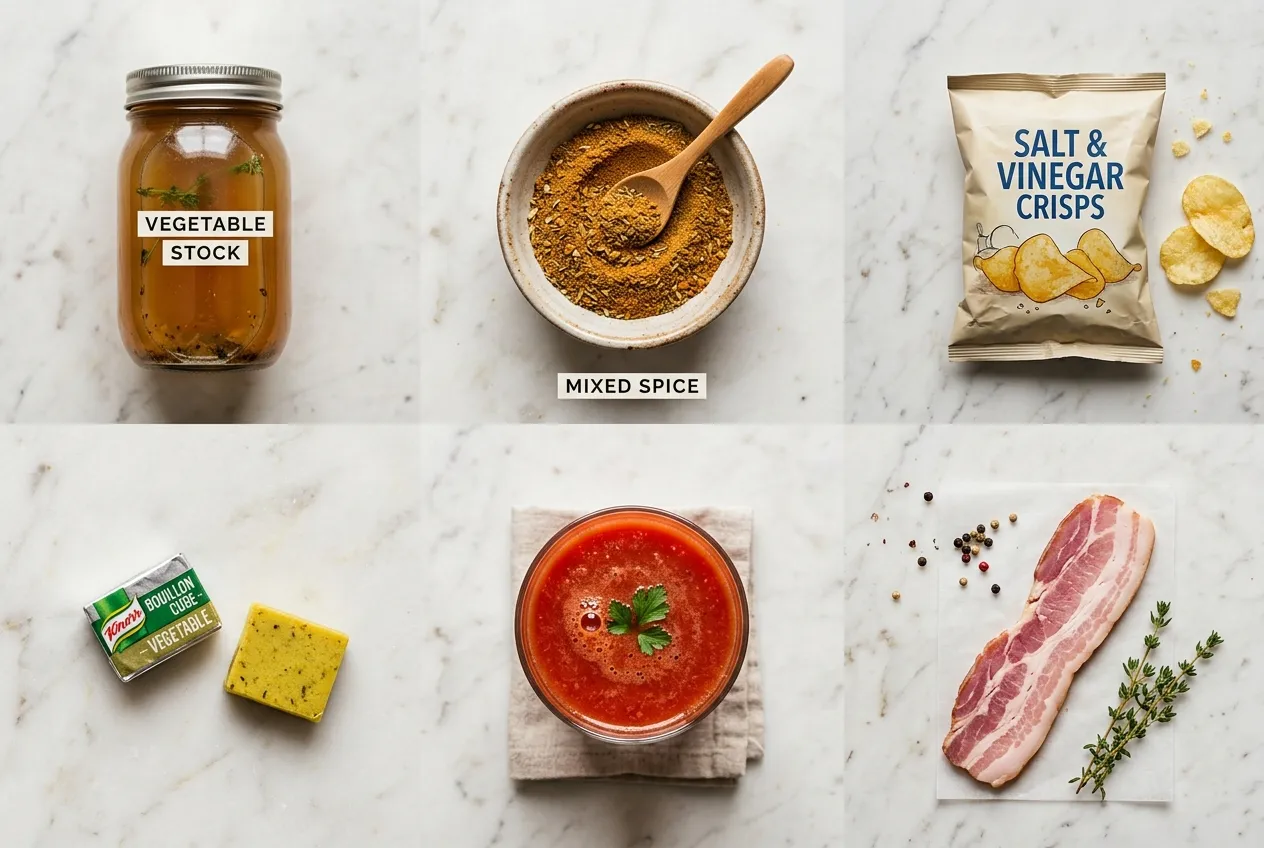
  • Stocks, broths, and bouillon cubes. Celery is one of the three classic mirepoix vegetables. A "vegetable stock" line on a soup label almost always means celery is in there.
  • Spice blends and seasoning mixes. Celery seed and celery salt are workhorse spices in dry rubs, poultry seasoning, taco mixes, and barbecue sauces.
  • Cured meats and bacon. Celery juice powder is a popular natural source of nitrates in "uncured" or "no nitrate added" meats.
  • Tomato juice and vegetable juice blends. Celery is standard in these blends and rarely makes it into the marketing copy.
  • Salads, deli sauces, marmite-style spreads, and even some potato crisps. A "natural flavour" label is enough to cover any of these.
  • Baby food. Vegetable purees, lasagnes, and risottos for infants frequently include celeriac as a soft, flavour-rounding root vegetable.

This is the trap that caught HiPP. A parent reading the label on a vegetable lasagne is unlikely to be surprised that it contains potatoes, carrots, and tomatoes. They might miss "celeriac" tucked into a long ingredient line, especially when it is not bolded.

The Birch-Mugwort-Celery Syndrome

The Birch-Mugwort-Celery Syndrome

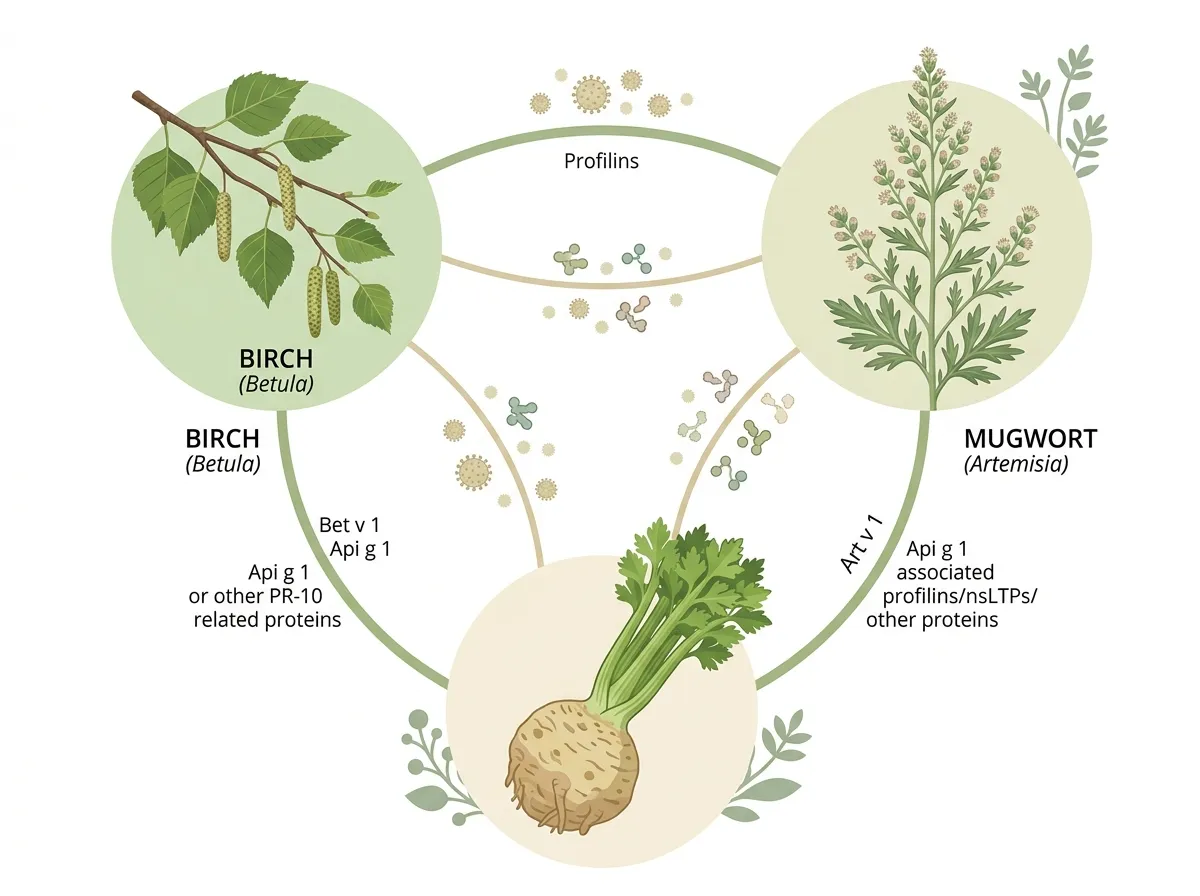
Why does celery cause so many reactions in central Europe specifically? Because it shares a set of proteins with two of the region's most common pollens: birch and mugwort.

This is the pattern allergists call the Birch-Mugwort-Celery Syndrome. Patients who develop hay fever from birch or mugwort pollen often go on to react to celery (and to apples, hazelnuts, carrots, peaches, or cherries) because their immune system reads the food proteins as the same enemy.

A landmark 1996 study by Bauer and colleagues traced this back to at least three distinct cross-reacting allergen families:

Api g 1

The major celery allergen, structurally similar to the birch pollen allergen Bet v 1. It tends to drive the milder reactions that allergists group under oral allergy syndrome: an itchy mouth, tingling lips, swollen throat after eating raw celery.

Api g 4

A celery profilin closely related to the birch profilin Bet v 2 and to soybean profilin Gly m 3. Profilins cross-react with a wide range of pollens and plant foods.

Api g 5

A glycoprotein linked to the mugwort allergen Art v 1. This is the protein most associated with severe celery reactions in mugwort-sensitive patients.

The key point for parents and shoppers: a child who has never knowingly eaten celery can still be sensitised through pollen. The first food contact may also be the first reaction. According to Stanford Health Care, up to 70% of pollen-allergic patients show some degree of pollen-food cross reactivity.

Cooking does not always make it safe

A common assumption is that allergens in vegetables get destroyed by heat. For celery, that assumption is partly true and partly dangerous.

The Bet v 1 family proteins, including Api g 1, are heat-sensitive. Many people with mild oral allergy syndrome can tolerate cooked celery in a soup or stew even though they react to a raw stick. The InformAll data shows that the immunoreactivity of Api g 1 drops sharply when heated.

Profilins like Api g 4 are similarly fragile. The trouble is the third family, Api g 5 and the cross-reactive carbohydrate determinants. These survived heating to 100 Β°C for 30 minutes in lab tests. Patients sensitised through this pathway can react to baked, boiled, or canned celery just as strongly as to raw.

That is exactly why a baby food lasagne, slow-cooked at industrial temperatures and packed in a sterile jar, is not an automatic safe haven. The heat-stable allergen fraction comes through the process intact.

The transatlantic gap: why US labels rarely flag celery

If you grew up reading US food labels, none of this is going to feel familiar. The FDA's FALCPA list of major allergens covers nine categories: milk, eggs, fish, crustacean shellfish, tree nuts, peanuts, wheat, soybeans, and (since 2023) sesame. Celery is not on it.

That does not mean American shoppers are at lower risk. It means they have less help spotting it. A US "natural flavours" line can hide celery juice powder, celery salt, or celery seed extract with no further disclosure. EU shoppers reading the same imported product would see "celery" in bold; US shoppers may see nothing at all.

The gap matters most for two groups:

  • Travellers and importers. A jar that is fully compliant in the US can fall foul of EU rules the moment it crosses the border. The reverse is also true. EU products carrying clear celery warnings can land in US homes without the bold text that helped the original buyer notice.
  • Parents introducing baby food. Imported European baby food brands are popular among US parents who prefer their formulations. Those parents inherit the EU labelling logic, which means they need to know what celeriac, celery, and cΓ©leri all mean.

What shoppers (and parents) can do

Until labelling rules converge globally, the burden of catching hidden celery falls on the buyer. A few practical habits help.

Read past the marketing front

Ignore the front of the box. Go straight to the ingredients panel and the allergen statement. On EU products, look for any bolded word in the ingredient list. On US products, scan for celery, celeriac, celery salt, celery seed, celery extract, and celery juice powder.

Treat "vegetable stock" and "natural flavour" as suspect

For someone with a known celery sensitivity, those two phrases should be treated like a question mark. If the manufacturer cannot or will not specify, it is safer to choose a product that names every component.

Watch the allergen statement for "may contain" language

EU manufacturers often add a precautionary "may contain celery" line for products made on shared lines. This is not legally required but is often the only sign of cross-contact risk.

Be alert with cured and "uncured" meats

Celery juice powder is so widely used as a natural nitrate source that almost any "no nitrates added" bacon, ham, or hot dog is suspect.

Keep the cross-reactivity map in mind

A child or adult with a known birch or mugwort pollen allergy is in a higher-risk group for celery reactions, even before they have ever clearly reacted to a celery dish. Mention pollen allergies to your allergist when celery comes up.

Where IngrediCheck fits in

The HiPP recall happened because a 14-letter word on a baby food label was not bolded. That is the level of detail allergen safety hinges on, and it is exactly the level of detail that shoppers cannot reasonably maintain across hundreds of products.

Using IngrediCheck, you can scan the barcode on a jar, a snack pack, or a stock cube and get a clear yes or no answer about whether it contains celery, celeriac, celery salt, celery seed, or celery juice powder. The same scan flags any other allergen you have set up in your profile, from mugwort-cross-reactive carrots to traditional top-allergens like peanut and milk. If you are new to multi-allergen scanning, our food allergy scanner guide walks through how to set up your profile in a few minutes. For a parent stocking the pantry for an infant, or for anyone living with the Birch-Mugwort-Celery overlap, that means the safety check happens before the food enters the house, not after the first reaction.

Next Label Check

Follow the scanner, hub, and ingredient paths connected to this guide

Get the app for clearer label decisions.

Scan labels, see what fits your food notes, and read the why in plain English.

IngrediCheck app