Fly By Jing Recall: The Shared Equipment Peanut Risk Explained

The May 2026 Fly By Jing sesame noodle recall revealed how shared manufacturing equipment can silently introduce peanuts into products that list no peanut ingredients — a systemic problem that trips up even careful label readers.

May 16, 2026|9 min read
By Sanket Patel|Updated 2026-05-16|3 sources|Editorial standards
Fly By Jing Recall: The Shared Equipment Peanut Risk Explained

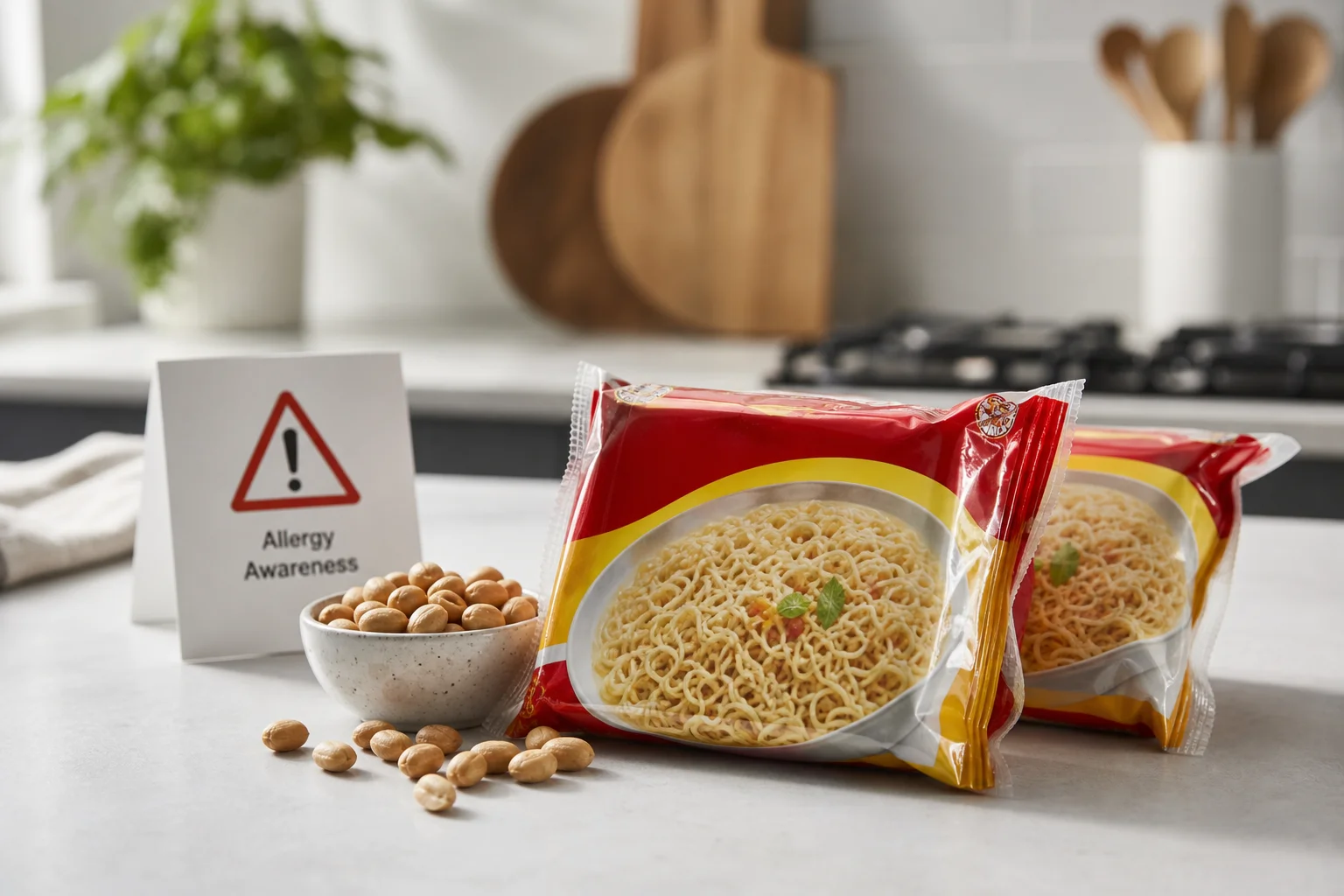
On May 13, 2026, Fly By Jing — the Los Angeles brand best known for its chili crisp — voluntarily recalled its Creamy Sesame Noodles after discovering that the product may have been exposed to peanuts during manufacturing. Peanuts are not listed as an ingredient. The noodles contain no peanut. But they may contain peanut protein anyway, because a third-party manufacturer produced them on equipment that also processes peanut-containing products.

The recall affected single packs and four-packs sold at Whole Foods and Thrive Market between February 1 and May 8, 2026, as well as products sold through TikTok Shop and the brand's website. Three best-by dates are involved: October 15, 2026; December 6, 2026; and March 23, 2027.

For anyone managing a peanut allergy, the scenario is a familiar and frustrating one. You checked the label. Peanuts were not listed. And yet here is a recall, because the product was made on shared equipment.

What Is Allergen Cross-Contact?

There is an important distinction between "cross-contamination" and "cross-contact" that matters in food allergy conversations.

Cross-contamination typically refers to pathogens — bacteria and viruses introduced into food through poor hygiene. Cross-contact is the term the FDA uses specifically for allergens: the unintentional introduction of an allergen into a food that does not contain it as an intended ingredient.

Cross-contact differs from pathogen contamination in one critical way: there is no established safe threshold. A foodborne pathogen has a dose below which most people would not become ill. Allergen cross-contact has no such floor. Trace amounts of peanut protein can trigger anaphylaxis in highly sensitized individuals — amounts invisible to the eye and well below what any palate would detect.

The FDA's Food Safety Modernization Act (FSMA), codified in 21 CFR Part 117, now explicitly addresses allergen cross-contact. The phrase appears 37 times in that regulation, reflecting the priority federal regulators place on prevention. Food facilities covered by FSMA must conduct a hazard analysis that includes allergen cross-contact and implement preventive controls where the hazard is significant.

How Shared Equipment Creates the Risk

How Shared Equipment Creates the Risk

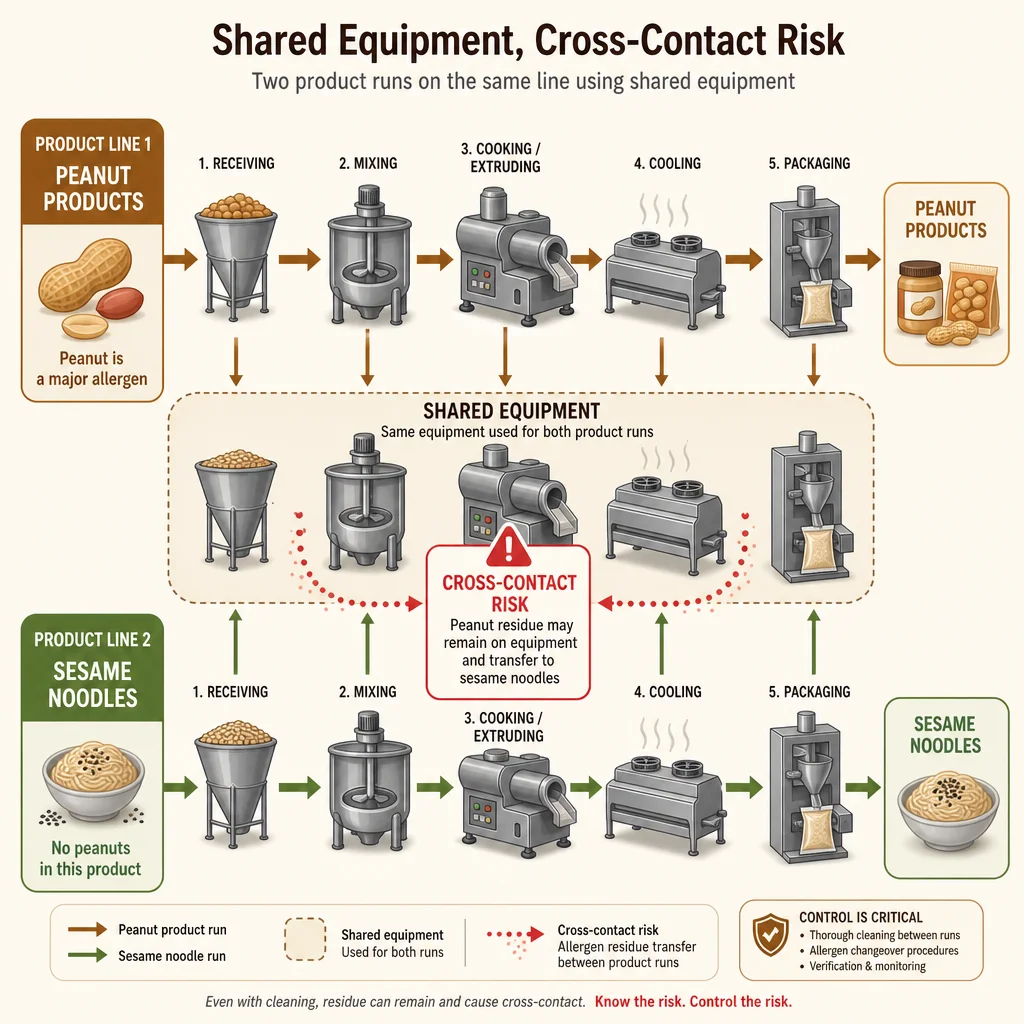
In the Fly By Jing case, the problem did not originate at Fly By Jing's own facility. It came from a third-party manufacturer — a common arrangement in the food industry. Brands often outsource production to contract manufacturers that run multiple product lines on the same equipment.

The typical sequence: a production run processes a peanut-containing product. The line is cleaned between runs. The next product — sesame noodles — is produced on the same equipment. If the cleaning procedure is not validated to remove peanut allergen to a safe level, or if the equipment has design features (hard-to-reach joints, conveyor belts, seams) that resist thorough cleaning, peanut protein can carry over into the next run.

This is not a rare scenario. A historical analysis of FDA food allergen recalls found that manufacturing equipment cross-contact was responsible for roughly 40% of all undeclared allergen recalls. Labeling errors accounted for another 51%, with supplier errors making up the remainder. Shared-equipment cross-contact is one of the two dominant causes of allergen recalls, year after year.

Fly By Jing responded quickly after identifying the issue. The company ceased distribution of all affected lots, notified retail partners and customers, placed remaining inventory on hold, and implemented strengthened allergen control procedures with the manufacturer. That response is appropriate. But it raises a question that every peanut-allergic consumer faces at the grocery store: how would you have known before the recall?

The "May Contain" Problem

The "May Contain" Problem

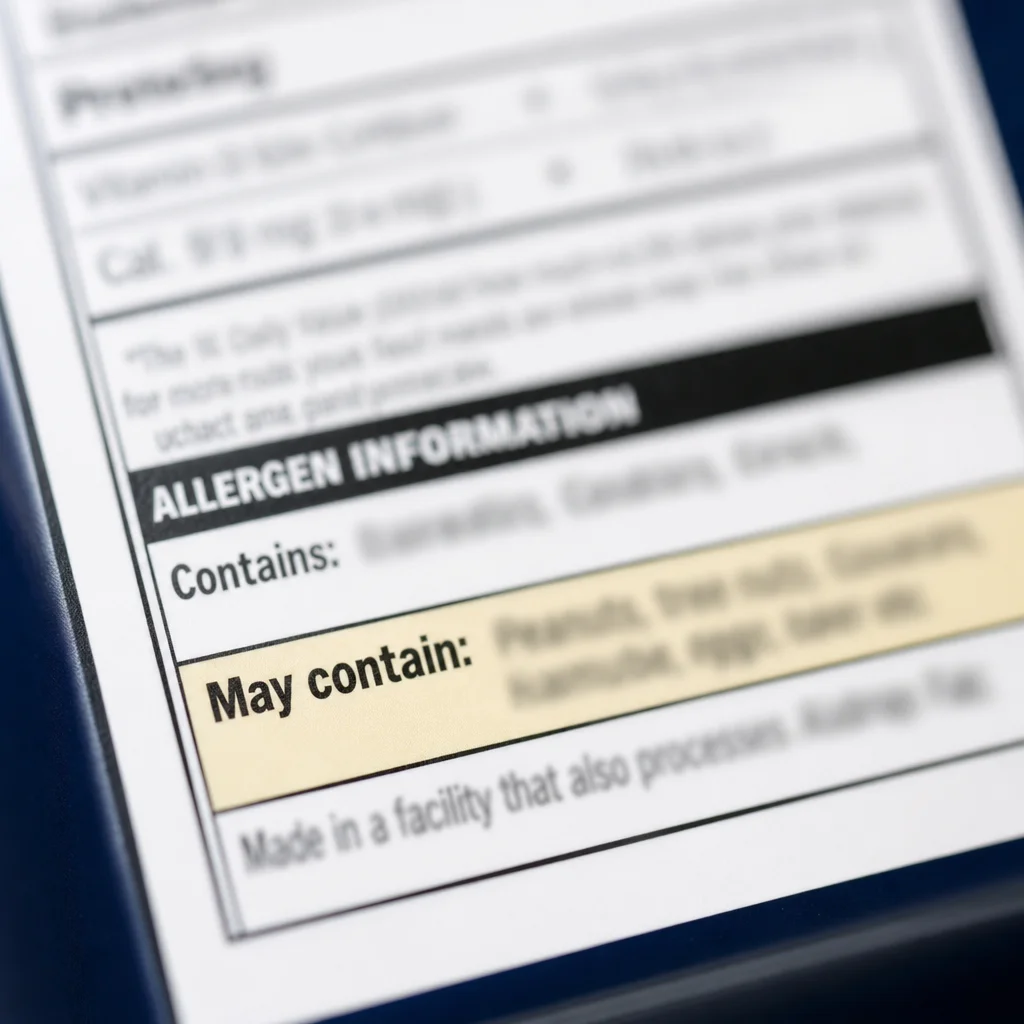
The phrase "may contain peanuts" appears on millions of food products in the United States. So do "produced in a facility that also processes peanuts" and "made on shared equipment with peanut products." These advisory statements are voluntary. No federal law requires manufacturers to use them.

The FDA states that advisory labels "should not be used as a substitute for adhering to current good manufacturing practices." Adding "may contain" to a label is not a license to skip allergen controls. But in practice, the statements are applied inconsistently. Some manufacturers use them as genuine risk disclosures after rigorous allergen assessment. Others add them as liability coverage even when their controls are robust. Some skip them entirely even when the risk is real.

This creates a structural problem for allergic consumers. You cannot trust the absence of a "may contain" warning to mean the product is definitely free of cross-contact risk, because disclosure is not mandatory. And the presence of a "may contain" warning does not tell you how significant the risk actually is.

"Consumers with food allergy are increasingly ignoring advisory labeling. Because food products with advisory labeling do contain detectable levels of peanuts, a risk exists to consumers choosing to eat such foods." — Journal of Allergy and Clinical Immunology, 2007

Research from that period found that 10% of products bearing "may contain" advisory statements contained detectable peanut allergen. The proportion of allergic consumers ignoring advisory labels also rose over the study window — from 15% to 25% between 2003 and 2006 — suggesting that as "may contain" warnings multiply and feel routine, their practical weight for consumers diminishes.

The Fly By Jing Creamy Sesame Noodles carried no "may contain peanuts" advisory at the time of the recall. There was no signal on the package that peanut cross-contact was a possibility. For a shopper with peanut allergy who checked the label carefully, this product appeared safe.
Why Peanut Allergy Makes This Especially Serious

Why Peanut Allergy Makes This Especially Serious

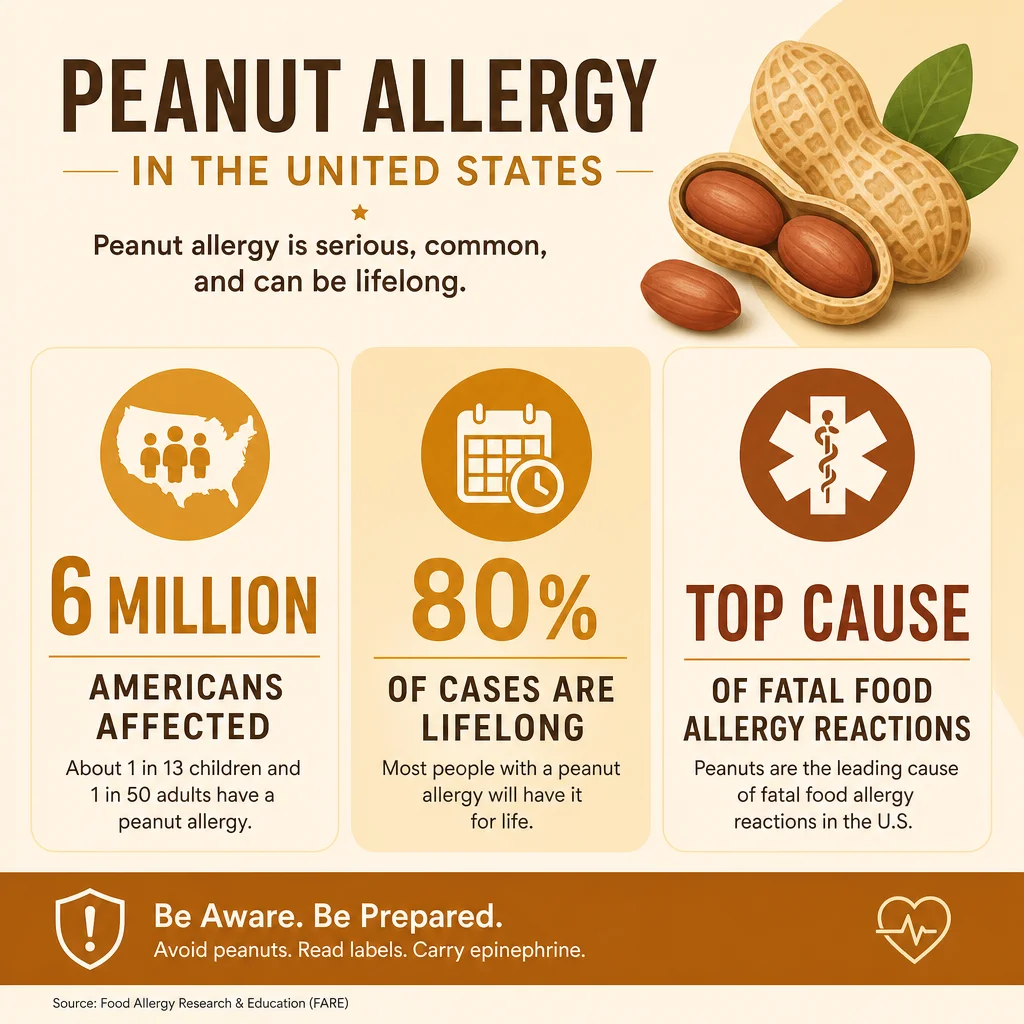
Peanut allergy is the most common cause of fatal food-induced anaphylaxis in the United States. It affects an estimated 6.1 million Americans — roughly 2% of the population — and unlike some childhood food allergies, it is rarely outgrown. Studies suggest only about 20% of children with peanut allergy eventually lose it, meaning most diagnoses are lifelong.

According to a study published in the Journal of Allergy and Clinical Immunology, approximately 4.6 million US adults have convincing peanut allergy. Of those, more than 800,000 appear to have developed the allergy after age 18 — a reminder that peanut allergy is not exclusively a pediatric condition.

The clinical stakes are significant. Peanut-induced anaphylaxis can begin within minutes of ingestion. Symptoms include hives, severe throat swelling, difficulty breathing, and a sharp drop in blood pressure. Without prompt epinephrine administration, a severe reaction can be fatal. For highly sensitized individuals, trace amounts well below any sensory detection threshold are sufficient to initiate a reaction.

Among people with peanut allergy, approximately one in five has visited an emergency department related to a food allergy reaction in the past year. Roughly half carry an epinephrine auto-injector. The recall of a product that appeared label-safe — and that was sold through mainstream retailers including Whole Foods — is exactly the kind of event that drives those emergency visits.

What FSMA Requires — and Where It Stops

Under FSMA, food facilities must implement written allergen control procedures, monitor their effectiveness, take corrective actions when monitoring reveals failures, and verify the overall system is working. Those requirements apply to domestic facilities and to foreign facilities exporting to the United States, though enforcement complexity increases for the latter.

Third-party manufacturing introduces another variable. The legal responsibility for allergen controls runs through the supply chain to the brand, but the brand's ability to verify those controls depends on how rigorously it audits its contract manufacturers. A brand can do everything right on its end and still face a recall if the contract manufacturer's cleaning validation is inadequate.

The FDA updated its draft guidance on allergen cross-contact in 2023, with specific guidance on cleaning validation, production scheduling, and equipment design. That guidance is a meaningful step, but compliance requires investment and verification, and recalls remain one of the primary signals that a gap exists.

Steps for Peanut-Allergic Shoppers

No label-reading strategy eliminates shared-equipment risk entirely, but several practices help reduce exposure.

Contact the manufacturer before you buy

Many brands have allergen FAQ pages. If the website does not address shared-equipment status, call the manufacturer directly. Ask whether the facility or its contract manufacturers run peanut-containing products on the same equipment, and whether cleaning has been validated for peanut allergen removal.

Prioritize dedicated-facility products when sensitivity is high

Some manufacturers produce in facilities that handle no peanuts and say so explicitly on the label. "Produced in a dedicated peanut-free facility" represents a materially higher assurance level than the absence of any advisory.

Stay current on recalls

The FDA's recalls and safety alerts page publishes allergen recalls as they are announced. Email subscription or recall-tracking apps can surface relevant notices faster than waiting to hear through the news cycle.

Use IngrediCheck to scan ingredients

IngrediCheck flags peanut as a declared ingredient the moment it appears in a product's formulation — see how the peanut and tree nut allergy scanner works in practice. Setting a peanut allergy profile means any product listing peanut — or an ingredient derived from peanut — triggers an immediate alert. For products like the Fly By Jing sesame noodles, where the label shows no peanut, the scan would return a clean result. That is the accurate picture for the declared formulation. The manufacturer contact and recall-monitoring habits above fill the gap that label scanning alone cannot cover: undisclosed shared-equipment cross-contact.

The Systemic Problem Behind Individual Recalls

Each allergen recall is reported as a single product event. The cumulative record tells a different story. Shared-equipment cross-contact has been among the top causes of allergen recalls for two decades. The voluntary nature of advisory labeling means consumers have no reliable way to distinguish a product with no advisory because the risk is genuinely controlled from one with no advisory because disclosure was simply skipped.

Fixing that gap would require mandatory advisory labeling for known shared-equipment scenarios, stricter enforcement of existing FSMA allergen control requirements, or both. Several bills in the current Congress address aspects of allergen labeling and FDA oversight. Until one becomes law, the burden of caution falls disproportionately on the people who have the most to lose.

IngrediCheck makes it fast to verify what a manufacturer chose to declare. Combine it with direct manufacturer outreach and recall monitoring, and you have a substantially more complete picture than any label alone can provide.

Next Label Check

Follow the scanner, hub, and ingredient paths connected to this guide

Get the app for clearer label decisions.

Scan labels, see what fits your food notes, and read the why in plain English.

IngrediCheck app