Hepatitis A in Grated Coconut: When Freezing Isn't Enough

In March 2026, two brands of grated coconut were recalled in Australia for Hepatitis A contamination within the same week. Here's how HAV gets into frozen pantry staples, why freezing doesn't stop it, and what the pattern of outbreaks tells us.

May 27, 2026|9 min read
By Sanket Patel|Updated 2026-05-27|8 sources|Editorial standards
Hepatitis A in Grated Coconut: When Freezing Isn't Enough

On March 5, 2026, a Western Australian food company recalled its frozen grated coconut after testing detected Hepatitis A virus. Eight days later, a second company did the same thing, for the same reason, in the same state.

Two brands. Two separate supply chains. One pathogen. And one reminder that has come up repeatedly in food safety over the past decade: frozen food is not necessarily safe food.

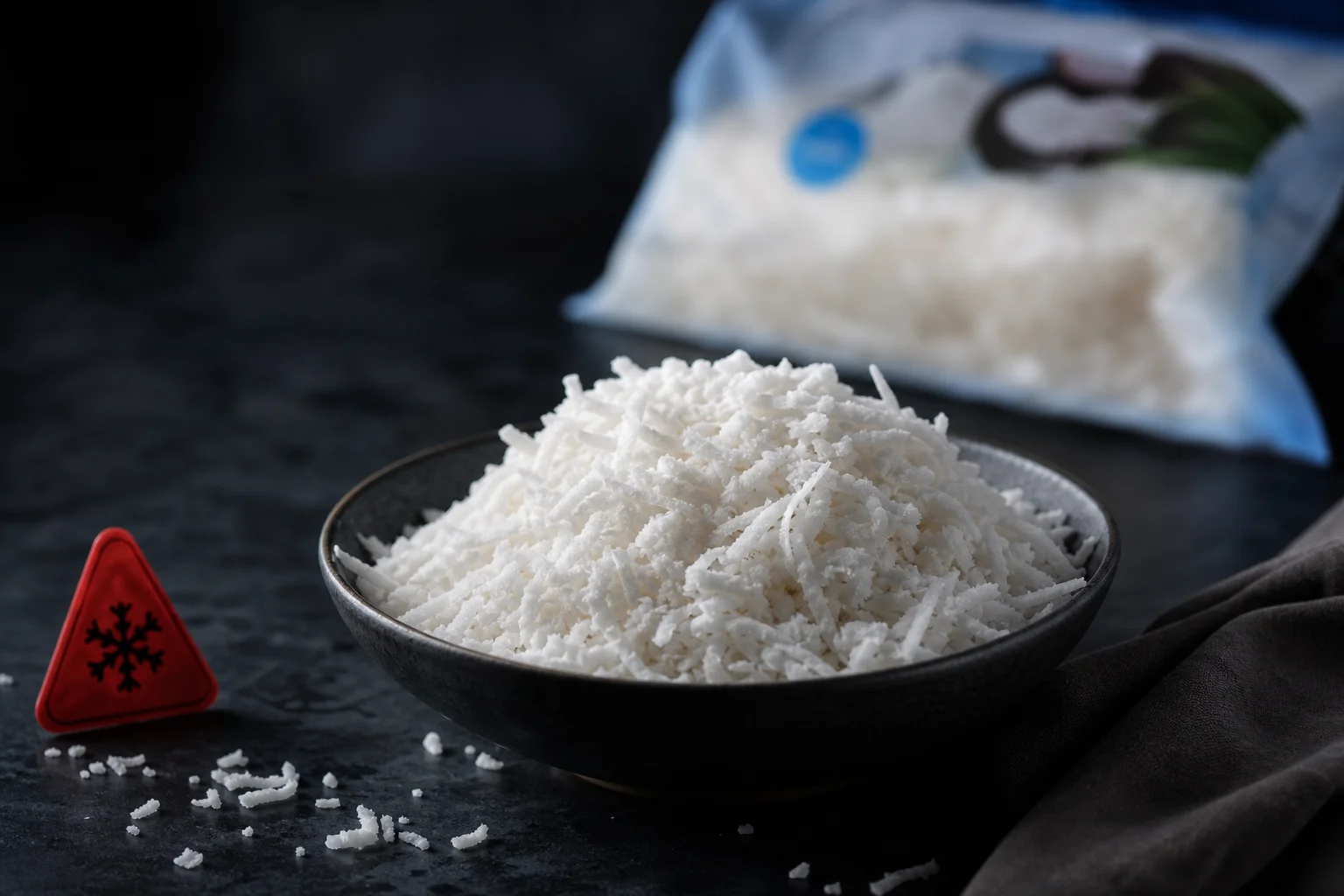
Grated coconut is the kind of ingredient most shoppers do not think twice about. It sits in the freezer, pre-portioned, ready to go into curries, desserts, and chutneys. The cold storage feels like protection. For Hepatitis A virus (HAV), it offers almost none.

The Two Recalls

The first recall came from Bajaria Global Pty Ltd, trading as The Spice Merchants. The product was Fresh 'N' Frozen Favour-ita Grated Coconut (400g, batch FI-08-25, best before July 2028), sold at independent retail stores in Western Australia. Food Standards Australia New Zealand classified the recall as high risk.

The second recall, issued March 12 and 13, covered two sizes of Vadilal Grated Coconut: 312g and 624g, batch 003OUY0B, best before July 2027. The product was distributed by Datah International (Aust) Pty Ltd, a distributor of the Indian food brand Vadilal, also sold through independent supermarkets in Western Australia. FSANZ likewise rated the contamination as high severity.

The consumer instruction in both cases was the same: do not eat the product, return it for a full refund.

Both recalls were limited to Western Australia. Consumers outside WA were not contacted. But the story of how Hepatitis A ends up in a bag of frozen coconut, and why a freezer cannot stop it, is relevant to anyone who buys imported frozen or dried coconut products in any country.

What Hepatitis A Actually Is

What Hepatitis A Actually Is

Hepatitis A is a liver infection caused by the Hepatitis A virus, a non-enveloped RNA virus. Unlike Hepatitis B and C, it does not cause chronic liver disease, but it can trigger acute liver failure in severe cases. The WHO's May 2026 fact sheet reports that an estimated 35,569 people died from Hepatitis A globally in 2023, representing 2.6 percent of all viral hepatitis deaths.

The virus spreads through the fecal-oral route: a person ingests microscopic amounts of fecal matter from an infected person, almost always through contaminated food or water. The infectious dose is extremely small. There are no sensory signals. Contaminated food looks, smells, and tastes completely normal.

Symptoms and the Deceptive Timeline

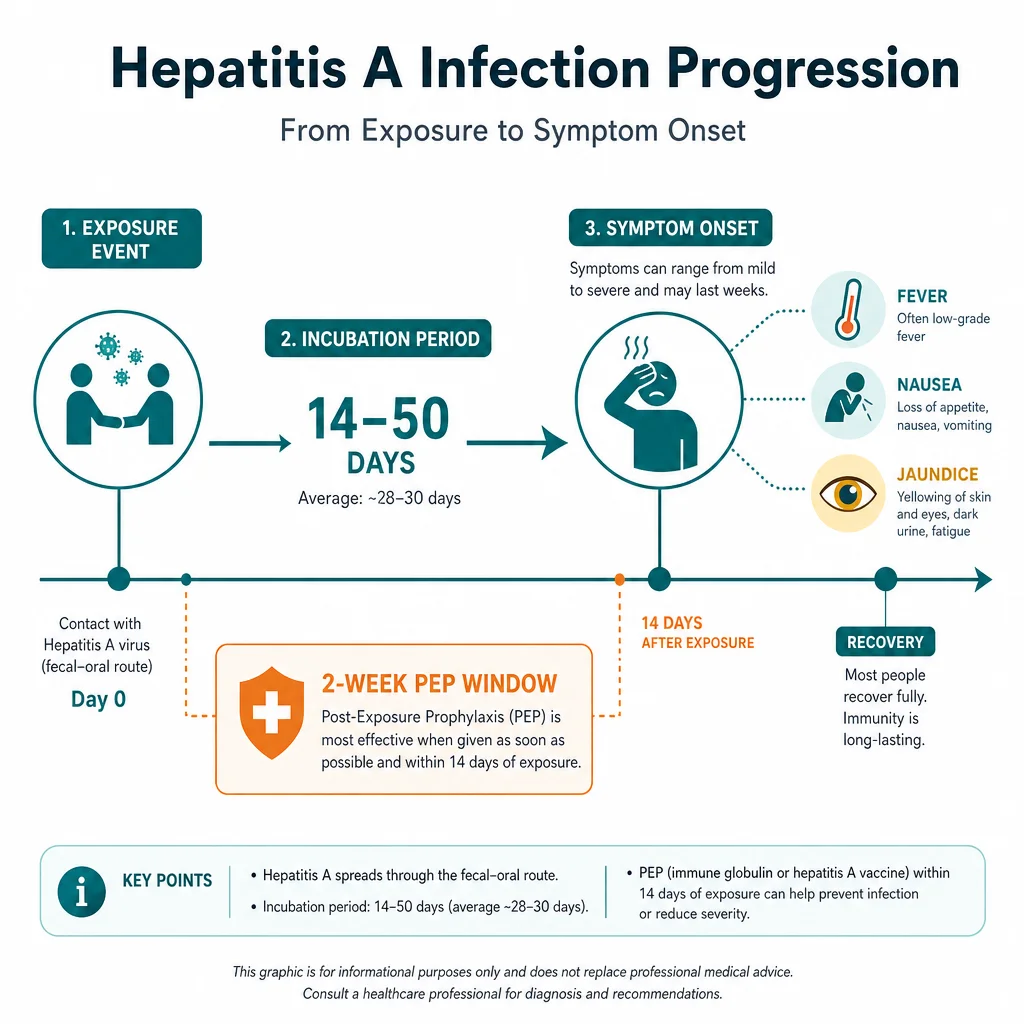
Symptoms typically appear 14 to 50 days after exposure, with most cases surfacing two to four weeks after contact. That delay is part of what makes food-borne Hepatitis A difficult to trace. By the time a patient develops symptoms, the contaminated product may have been consumed weeks earlier and long since discarded, forgotten, or sold out.

Symptoms include fever, general malaise, loss of appetite, nausea, abdominal discomfort, dark-coloured urine, pale or clay-coloured stools, and jaundice, the yellowing of eyes and skin that makes many patients seek care. Children under six often show no symptoms at all, but can still transmit the virus to others.

There is no specific antiviral treatment. Recovery is supportive: rest, fluids, nutrition. Mild cases typically resolve in one to two weeks; severe cases can last several months.
How HAV Gets Into Frozen Food

How HAV Gets Into Frozen Food

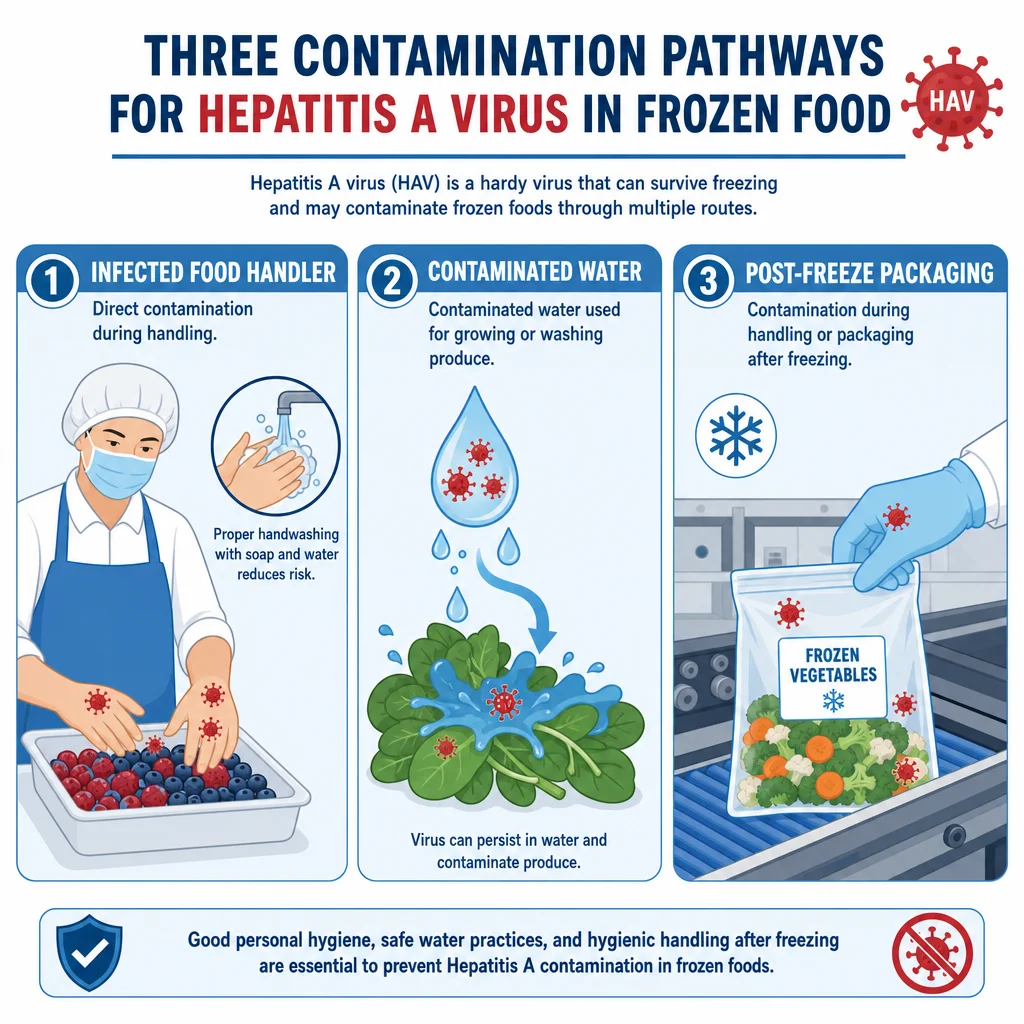
Three main pathways explain how Hepatitis A ends up in a product that was never anywhere near raw sewage.

Infected food handlers. HAV is shed in stool for one to two weeks before the infected person develops any symptoms. A worker who handles food at any point in the supply chain, picking, shredding, sorting, or packing, can contaminate product without knowing they are sick. Standard alcohol-based hand sanitisers do not kill HAV. Only thorough soap-and-water handwashing removes it from hands.

Contaminated processing or irrigation water. In regions where sewage infrastructure is inadequate or where agricultural water is not properly treated, wash water and irrigation water can carry HAV. FSANZ's technical analysis of the 2015 berry outbreak confirmed that water used for rinsing or processing is a direct contamination route, depositing virus directly onto food surfaces.

Post-freeze handling. Contamination is not only a farm-level risk. FSANZ explicitly noted in its berry safety review that contamination can occur after processing, including after freezing, when an infected handler touches product during hand-sorting or repackaging. The frozen state of the product at that moment offers no barrier.

The practical result: any product that passes through multiple hands in a labour-intensive supply chain, in a region without comprehensive food hygiene infrastructure, carries risk at each transfer point.

Why Freezing Gives a False Sense of Safety

The intuition that frozen means safe is understandable, and for many bacterial pathogens it has some basis. For Hepatitis A, the evidence is clear: freezing does not eliminate the risk.

Research published in the Journal of Food Protection (Zhang et al., 2021) measured HAV survival after freeze-drying at low temperatures. Even after 56 days of post-freeze storage at room temperature, total viral reduction remained below 2.75 log (less than 99.9 percent). The virus declined fastest in the first two weeks of storage, then levelled off substantially. A review in Food and Environmental Virology (Cook et al., 2018) confirmed that on frozen products, HAV can persist for several months.

Complete inactivation requires heating to 85°C for at least one minute. That temperature threshold is not reliably reached in all grated coconut preparations. Desserts, chutneys, and raw toppings may never reach 85°C. Even curries where coconut is added late in cooking may not sustain that temperature through the full mass of product.

This matters because both recalled products had best-before dates of July 2027 and July 2028. A contaminated batch purchased months earlier could still be sitting in a home freezer when a recall announcement is issued. The long shelf life that makes frozen pantry staples convenient is the same characteristic that extends the window of consumer exposure after a recall.

The Coconut Supply Chain Problem

Grated coconut is a long-distance, multi-step product. The Philippines, Indonesia, Thailand, and India together supply more than 70 percent of the world's coconuts. Desiccated and grated coconut processing typically involves farmers, copra processors, desiccated coconut mills, export packers, importers, secondary distributors, and retailers.

Each step at which human hands contact the product is a potential contamination point. Many small-scale processors in the region operate without HACCP certification, ISO 22000 compliance, or third-party food safety audits. Even among certified facilities, implementation quality varies considerably.

The Vadilal brand recalled in March 2026 is an Indian food brand distributed through South Asian diaspora grocery networks across Australia, the UK, and North America. The Bajaria product was a private-label frozen range. The common thread: products sourced from the Indian subcontinent, processed through small-scale operations, imported to independent grocers serving communities where these ingredients are everyday pantry staples. This supply chain structure is not unique to Australia. The same products, from the same sources, reach markets across Europe, Canada, and the United States.

A Pattern, Not a One-Off

A Pattern, Not a One-Off

The March 2026 coconut recalls fit a well-documented pattern of Hepatitis A contamination in imported frozen and dried food.

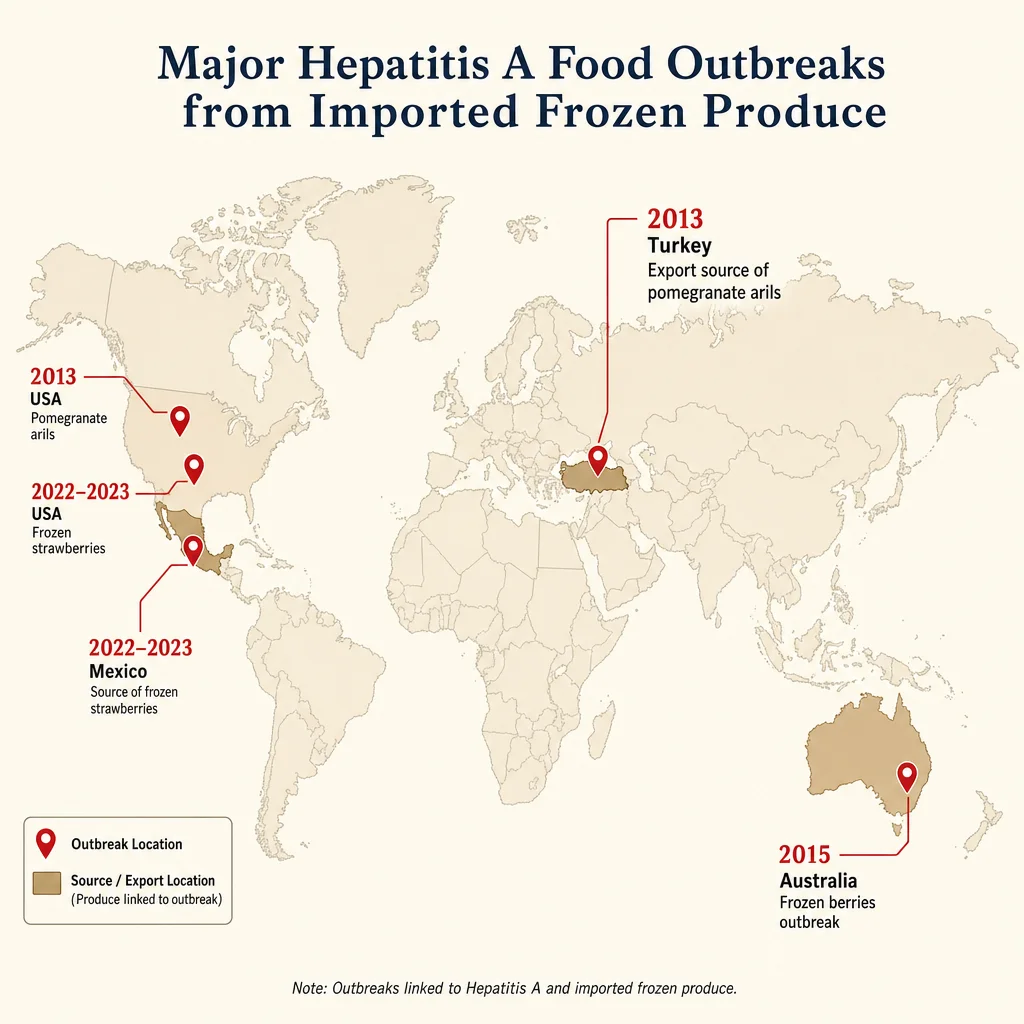
In 2015, Australia experienced its largest modern Hepatitis A food outbreak, traced to Nanna's frozen mixed berries and Creative Gourmet frozen berries sourced from China, Turkey, and Chile. At least 14 people were confirmed infected. The outbreak generated significant media coverage of imported versus domestic sourcing practices.

In 2013, a US outbreak involving 165 people across 10 states was traced to pomegranate arils from Turkey included in a Townsend Farms Organic Antioxidant Blend sold at Costco. Seventy-one people were hospitalised. The FDA detained all shipments from the Turkish importer.

In 2022 and 2023, two linked US outbreaks were traced to frozen organic strawberries from a single farm in Baja California, Mexico, sold under multiple labels including Kirkland at Costco. The HAV strain was genetically identical between both years, indicating a persistent contamination source at the same farm across two harvest seasons.

SGS Digicomply's food safety intelligence platform reported a 39-fold surge in Hepatitis A incidents involving frozen berries between 2021 and 2022, with incident rates remaining more than 30 times higher than the pre-2022 baseline through 2025.

The 2026 Australian coconut recalls appear to be among the first documented HAV recalls specifically in grated or desiccated coconut products. The product category is new; the contamination mechanism is not.

What to Do If You Were Exposed

If you or someone in your household consumed one of the recalled products, the most critical factor is timing.

Post-exposure prophylaxis (PEP) can prevent illness when given within two weeks of exposure. The FDA's guidance on HAV recommends a hepatitis A vaccine for people aged one to forty. Immune globulin (IG) is preferred for those outside that range or for immunocompromised individuals. Beyond the two-week window, PEP is no longer considered effective.

If you develop symptoms consistent with Hepatitis A, including fatigue, nausea, dark urine, or jaundice, tell your doctor what you have eaten over the past four to seven weeks. The long incubation period means a source that feels distant in time may still be the cause.

The specific recalled products are identified by batch number: FI-08-25 (Bajaria, WA) and 003OUY0B (Datah/Vadilal, WA). If you have these products in your freezer and live in Western Australia, return them to the place of purchase for a full refund.

The Wider Lesson About Imported Frozen Ingredients

Hepatitis A in grated coconut sits outside what ingredient-scanning apps are designed to address. It is a food safety recall event, not a labeling issue — more similar in structure to production mix-up allergen alerts than to a labeling omission that a scanner can catch. No scanner can detect a viral pathogen. The protection here comes from monitoring recall announcements, applying heat when possible, and understanding that cold storage is not the same as pathogen-free storage.

What IngrediCheck can help with is identifying whether a product you are buying contains grated coconut, desiccated coconut, or coconut in any other form. Knowing the specific ingredient form in a product lets you cross-reference more precisely against recall notices when a specific product type is named. It also helps shoppers understand more broadly which imported ingredients feature in the products they buy regularly.

Next Label Check

Follow the scanner, hub, and ingredient paths connected to this guide

Get the app for clearer label decisions.

Scan labels, see what fits your food notes, and read the why in plain English.

IngrediCheck app