Ingredient FAQs

Is Riboflavin E101 Vegan? How Vitamin B2 Is Made

Riboflavin and E101 can be made by fermentation or chemical processes. Learn why vitamin B2 labels do not always disclose the full production medium.

Jul 22, 2026|8 min read
By Sanket Patel|Updated 2026-07-22|6 sources|Editorial standards
Is Riboflavin E101 Vegan? How Vitamin B2 Is Made

Quick answer: Riboflavin, vitamin B2, and E101 are often vegan-suitable because commercial riboflavin can be produced through microbial fermentation or chemical synthesis. The ingredient name or E-number does not disclose every fermentation nutrient, processing aid, carrier, or finished-product ingredient. Most shoppers can look for a vegan statement; strict shoppers should request product-specific confirmation when the label provides no source information.

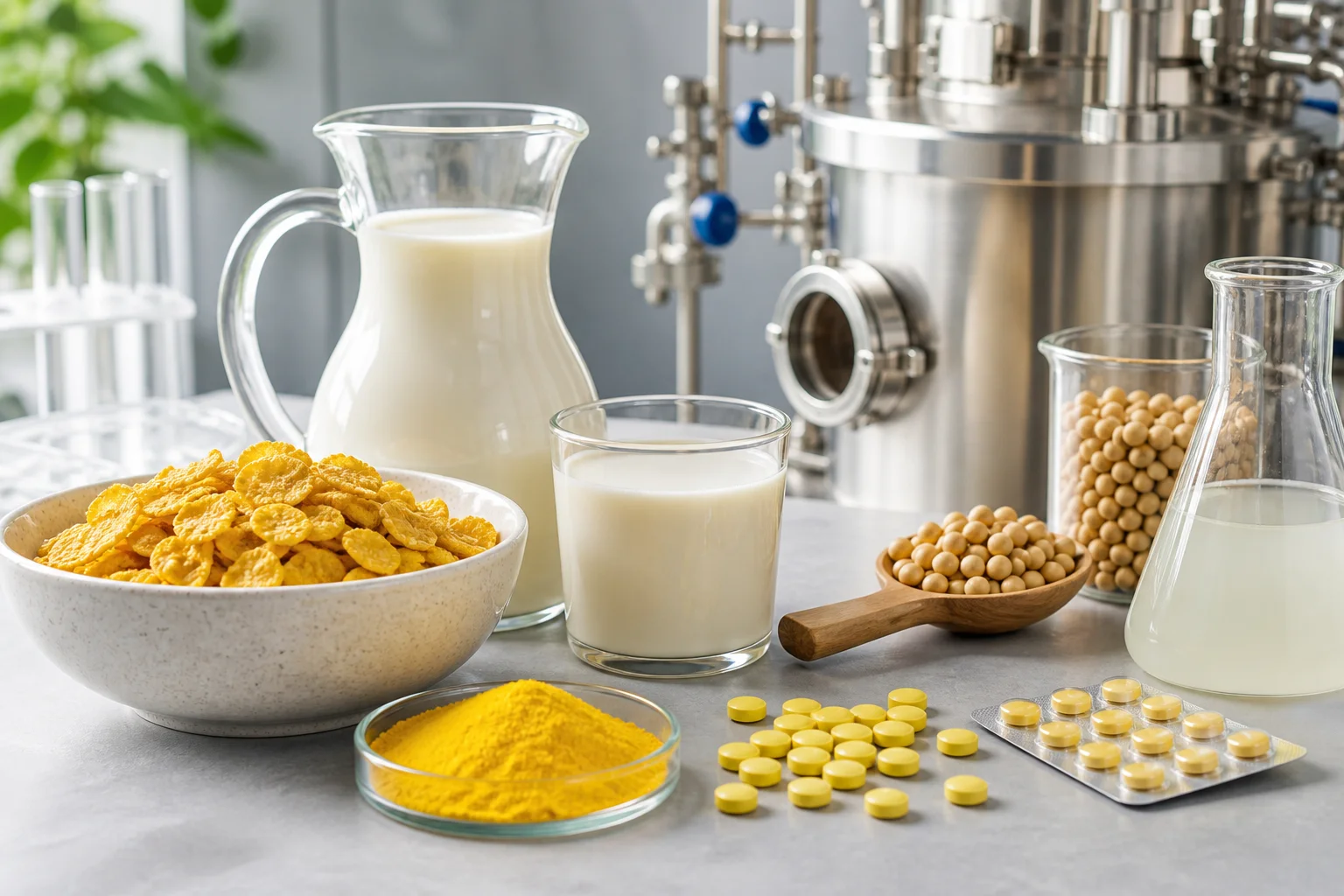
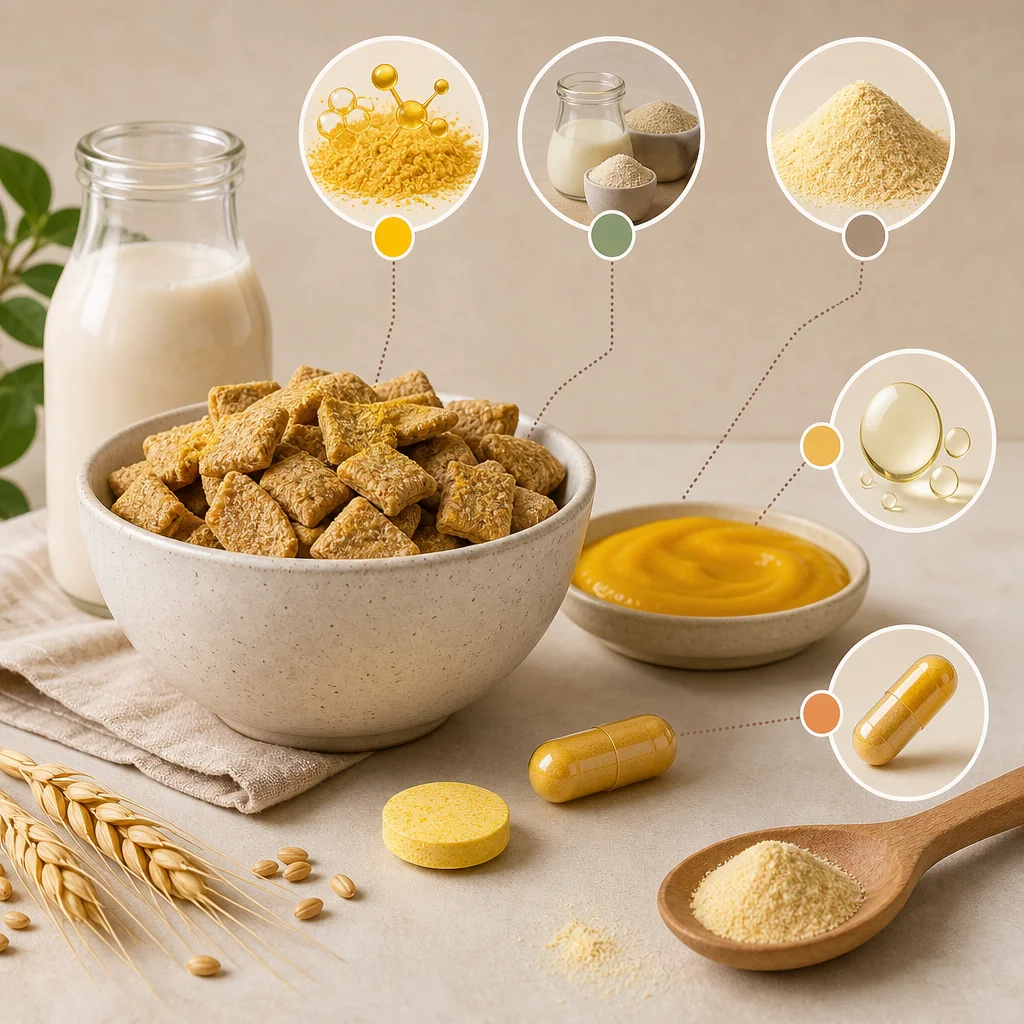
Riboflavin sits in an unusual place on ingredient labels. It is an essential vitamin, a fortifying nutrient, and a yellow food color. The same molecule can appear in breakfast cereal to restore vitamin content, in a supplement for nutrition, or in a food primarily for color.

That variety creates confusion about the E-number. E101 is not a separate artificial dye that happens to resemble vitamin B2. It is the European additive identity used for riboflavin forms authorized as food colors.
What Riboflavin Is

Riboflavin is a water-soluble B vitamin. The body uses it to form coenzymes involved in energy metabolism and other cellular processes. It occurs naturally in dairy, eggs, meat, mushrooms, almonds, and various plant foods, and it is added to enriched or fortified products.

The fact that milk and eggs contain riboflavin does not make the isolated commercial vitamin dairy- or egg-derived. Natural occurrence and industrial manufacture are separate facts.

Labels may use:

  • riboflavin
  • vitamin B2
  • E101
  • E101(i), riboflavin
  • riboflavin-5'-phosphate or a sodium salt form
  • color added, with the specific name supplied elsewhere

The additive specification establishes chemical identity and purity. It does not act as a vegan certification.

How Commercial Vitamin B2 Is Made

How Commercial Vitamin B2 Is Made

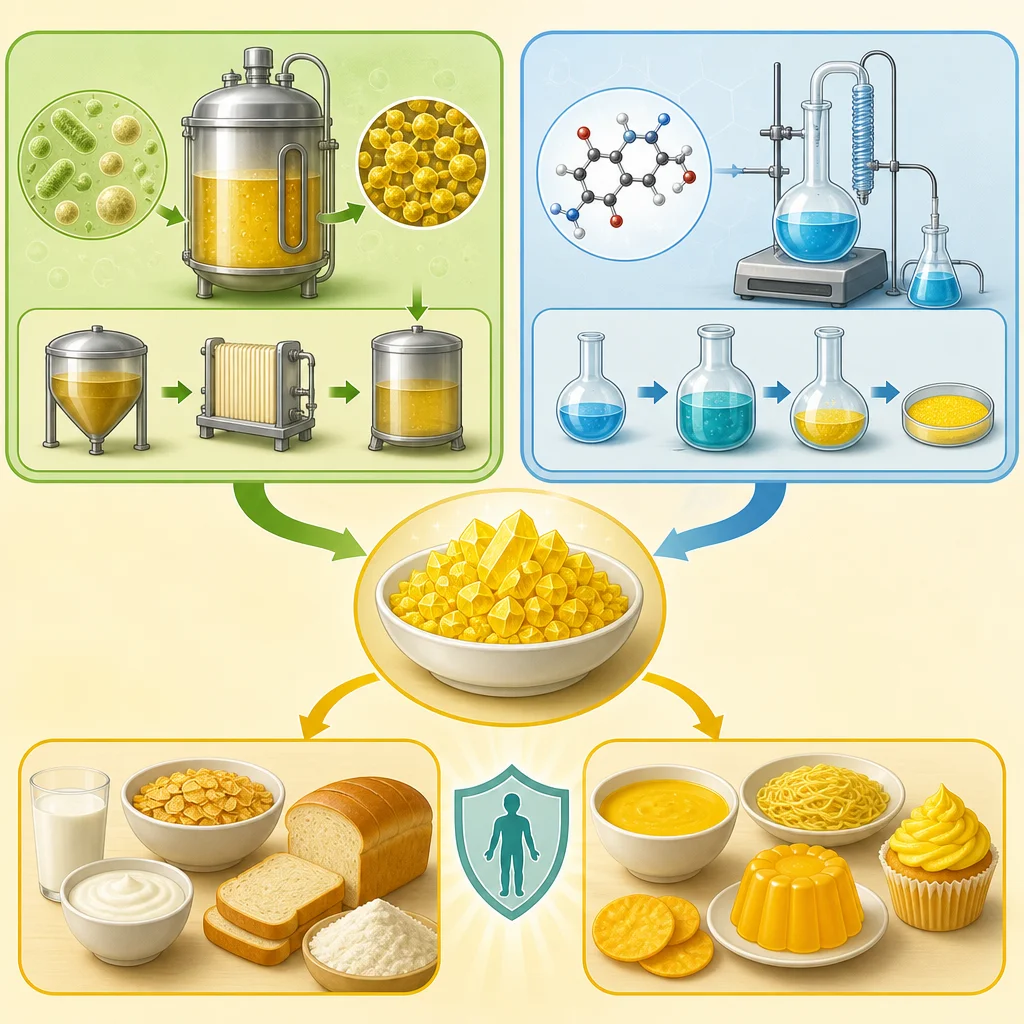
Modern production can use microbial fermentation. A selected microorganism is grown in a controlled medium, produces riboflavin, and is separated from the vitamin during downstream purification. Industrial strains and process details vary by manufacturer.

Chemical synthesis has also been used. Both routes can produce a purified compound that meets a food or pharmaceutical specification.

The U.S. food rule for riboflavin explicitly documents three possibilities: chemical synthesis, biosynthesis by Eremothecium ashbyii, and isolation from natural sources. That official list is strong evidence that "riboflavin" does not encode one universal route. It does not tell us the market share of each method or which supplier made a particular cereal premix.

Fermentation is not automatically plant-based. Microorganisms are not animals, but the culture medium may contain sugars, nitrogen sources, minerals, vitamins, antifoaming agents, or other inputs whose exact origin matters to a strict certification standard. Manufacturers can formulate non-animal media, and many do, but an ordinary ingredient label does not list the fermentation recipe.

This is the same evidence boundary discussed in the guide to enzymes and microbial versus animal rennet. "Microbial" is strong information about the producing organism. It may not be the final word on every processing input.

Does E101 Mean Artificial Color?

An E-number means that an additive has an identity in the European food-additive system. It does not mean the substance is necessarily petroleum-derived, nutritionally useless, or made by one fixed method.

Riboflavin is naturally yellow and fluorescent. Manufacturers can use it to contribute color as well as nutrition. If its technological role is coloring, labeling rules may present it as a color additive. If it is added as a nutrient, the presentation can differ by product and jurisdiction.

The dietary-origin question remains the same: E101 tells you what the additive is, while certification or supplier documentation tells you whether its production satisfies a vegan standard.

Where Riboflavin Appears

Common categories include:

  • enriched flour, bread, pasta, and cereal
  • breakfast cereals and meal replacements
  • plant milks and fortified beverages
  • infant formula and medical nutrition
  • multivitamins and B-complex supplements
  • energy drinks and nutrition powders
  • yellow confectionery, desserts, sauces, and prepared foods

Naturally occurring riboflavin in an animal-derived food does not make the food vegan. Added riboflavin in a plant-based food does not make the entire formula vegan. Always review the product rather than assigning a verdict to the nutrient alone.

Fermentation Media: How Strict Should You Be?

Vegan standards differ in how they discuss distant production inputs, unavoidable traces, and substances not present in the final product. Individual shoppers also draw boundaries differently.

A practical approach is to divide evidence into three levels:

  1. Unqualified ingredient name: riboflavin, vitamin B2, or E101 identifies the compound only.
  2. Manufacturer source statement: fermentation-produced or synthetic, with explicit non-animal inputs, answers more of the process question.
  3. Credible vegan certification: evaluates the product against a published standard and is the strongest quick signal.

Avoid claiming that fermentation always hides animal material. That is as unsupported as claiming it never can. The correct label-reading category is "commonly vegan-suitable, verify if your standard requires production-input evidence."

Riboflavin in Supplements

Riboflavin in Supplements

Supplement labels usually separate active ingredients from "other ingredients." Review both.

A B-complex tablet can contain riboflavin while using magnesium stearate, glycerin, lactose, shellac, or a color coating. A softgel or capsule may use gelatin. A gummy can contain gelatin or beeswax. A liquid may use flavors whose sources are not detailed.

The active vitamin's production route is only one checkpoint. Related guides explain why glycerin/E422 and stearates/E570/E572 need their own evidence.

A Practical Verification Ladder

1. Identify its role and form

Note whether the package lists riboflavin, vitamin B2, E101, or riboflavin phosphate. Check whether it appears in a vitamin blend, color list, or supplement facts panel.

2. Read nearby ingredients

Review capsule material, colors, flavors, glazes, carriers, and anti-caking agents. A short active-ingredient panel can distract from a longer "other ingredients" section.

3. Look for current certification

Use a recognized vegan mark or an official manufacturer statement. Retailer dietary filters and crowd-sourced product databases can be stale.

4. Ask a complete question

Use wording such as:

Is the riboflavin, vitamin B2, or E101 in this product manufactured without animal-derived feedstocks or processing aids, and are its fermentation medium, carrier, coating, and capsule suitable for vegans?

The company may not disclose proprietary details, but it can often confirm whether the material meets a documented vegan-suitability standard.

5. Match the answer to the market

Fortification premixes and suppliers can differ by country. Confirm the product name, flavor, package size, lot context if relevant, and date of the response.

Common Questions

Is riboflavin made from milk?

Milk naturally contains riboflavin, but commercial vitamin B2 is not automatically extracted from milk. The name does not identify a dairy source. A current supplier or manufacturer statement is the appropriate evidence.

Is E101 vegan?

E101 can be vegan-suitable and commonly is, but the number alone does not certify the production medium, processing aids, or complete product.

Is riboflavin-5'-phosphate vegan?

It is a related riboflavin form whose purified chemical identity does not disclose every production input. Apply the same source-verification process rather than assuming its extra chemical wording proves or disproves vegan origin.

Does a "contains milk" statement change the riboflavin answer?

It changes the product answer: a product that contains milk is not vegan regardless of the riboflavin source. It does not establish that the riboflavin itself came from milk.

Can yellow color prove riboflavin is present?

No. Many substances color food yellow. Only the ingredient declaration or product documentation identifies the color used.

Is riboflavin deficiency a vegan issue?

Riboflavin intake is a nutrition question. People can obtain it from fortified foods and varied plant foods, but individual needs and dietary adequacy should be discussed with a qualified professional. Ingredient-origin guidance should not be used to diagnose deficiency or prescribe supplements.

The Best Decision Rule

Treat riboflavin and E101 as commonly vegan-suitable commercial ingredients that still require product-level verification when strict source evidence matters. This reflects fermentation and synthesis without pretending that the label discloses a complete factory process.

What Useful Documentation Looks Like

A useful answer identifies the supplied grade and the scope of the claim. "Riboflavin is a vitamin" does not answer origin. "Our food-grade riboflavin is produced by fermentation on a non-animal medium, and the downstream processing aids are suitable for vegan products" is far more useful.

Supplier documents may include a technical specification, production-flow summary, allergen declaration, origin statement, or vegan-suitability letter. These documents answer different questions. An allergen declaration focuses on defined allergens. A purity certificate confirms the finished ingredient meets chemical limits. Neither automatically proves that the process meets a vegan standard.

Check the document's product code, manufacturing site, issue date, and validity. A statement for pharmaceutical-grade riboflavin from one factory may not cover the food-color preparation used in a cereal from another supplier. Product-specific certification reduces that paperwork for ordinary shoppers because the certifier evaluates the relevant formula and production scope.

Use the complete vegan label-reading guide to compare vitamin B2 with other ambiguous vitamins, enzymes, colors, and coatings. The vegetarian hidden-ingredient guide covers the broader set of animal-derived ingredients that can appear in supplements and fortified foods.

IngrediCheck can recognize riboflavin, vitamin B2, and E101 and surface the surrounding formula against your saved rules. Use the vegan ingredient checker or vegetarian ingredient checker for a systematic review, then rely on current certification or manufacturer documentation for production details that the label does not disclose.

Next Label Check

Follow the scanner, hub, and ingredient paths connected to this guide

Get the app for clearer label decisions.

Scan labels, see what fits your food notes, and read the why in plain English.

IngrediCheck app