Ingredient Deep Dives

Mixed Tocopherols in Food: Vitamin E and Preservation

Understand why mixed tocopherols preserve fats, how that differs from vitamin E nutrition, and which source questions matter when avoiding soy.

Sep 5, 2026|9 min read
By Sanket Patel|Updated 2026-09-05|3 sources|Editorial standards
Mixed Tocopherols in Food: Vitamin E and Preservation

Mixed tocopherols usually appear in an ingredient list to help protect fats from oxidation. They belong to the vitamin E family, but their presence does not automatically make the food a meaningful source of vitamin E. Preservation and nutrition are two different questions.

That distinction matters when you compare cereals, crackers, oils, nuts, or snack bars. A package may say "mixed tocopherols to preserve freshness" without making any vitamin claim. Another food may be fortified with a measured amount of vitamin E. Similar terminology does not mean the two products serve the same purpose.

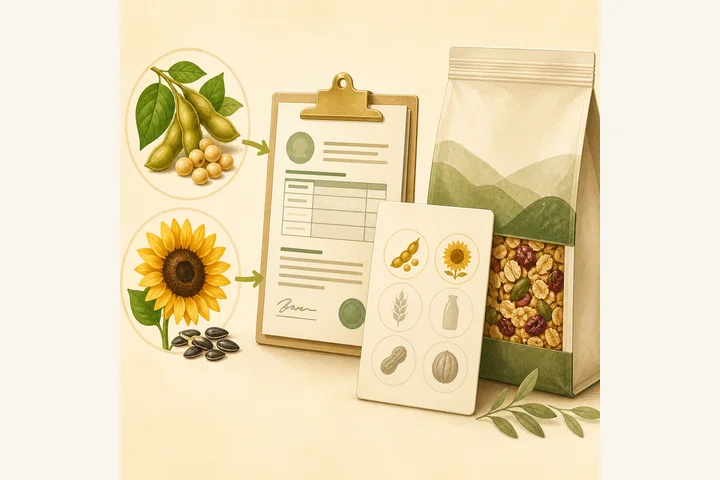
Source questions add another layer. Tocopherol preparations can come from vegetable-oil processing, including soybean sources, and the ingredient name alone may not identify the starting oil. If you avoid soy, you need to separate origin, allergenic protein, and the rules of the country where the food is sold. This guide reviews those distinctions using sources checked on September 5, 2026.

Mixed Tocopherols at a Glance

Question on the labelPractical answer
Why are they in crackers or cereal?Often to slow oxidation of fats and preserve flavor
Are they related to vitamin E?Yes, but a mixture is not a declared nutrient dose
Do they prevent every kind of spoilage?No; antioxidant protection is not a complete microbial safety system
Are they necessarily soy-derived?No; the specific source needs confirmation
Does "natural" identify their origin?No; it does not tell you the exact starting oil or carrier
Does the absence of a soy warning prove no soy derivation?No, particularly where a specific labeling exemption applies
What should a shopper compare?Intended function, nutrition information, source details, and personal avoidance requirements

The U.S. tocopherols provision in 21 CFR 182.3890 recognizes their use under good manufacturing practice. That regulatory status is about conditions of food use. It is not a vitamin-content claim, a soy-free certificate, or a promise that every product using them is nutritionally preferable.

Why Food Manufacturers Add Them

Fats and oils can react with oxygen during processing and storage. Oxidation can change flavor and aroma, eventually producing the stale or rancid characteristics that make a food unpleasant. Light, heat, packaging, and the types of fats present influence how quickly that happens.

An antioxidant helps interrupt those oxidation reactions. Tocopherols can be used for this job in foods containing fats or in an oil ingredient that later becomes part of a larger recipe. You might therefore find them near the end of a long ingredient list or within the components of a particular oil blend.

This is different from adding sweetness, bulk, or protein. The ingredient may be present in a relatively small amount for a functional reason. Its position in the list does not give you a precise dose, and it does not let you estimate vitamin E intake reliably.

The U.S. chemical-preservative labeling rule calls for a common or usual name and an explanation of function when a chemical preservative is added, subject to its exceptions. Phrases such as "to help protect flavor" or "to preserve freshness" tell you why an ingredient is there. They should not be read as disease-prevention claims.

An unopened, well-packaged food can still become stale if stored poorly. Adding an antioxidant does not remove the need to follow storage instructions, keep a package sealed, or respect a product's refrigeration requirements after opening.

Vitamin E Nutrition Is a Separate Question

Vitamin E Nutrition Is a Separate Question

Vitamin E is not a single label word with one interchangeable meaning. The NIH Office of Dietary Supplements explains that naturally occurring vitamin E includes eight forms: four tocopherols and four tocotrienols. Alpha-tocopherol is the form recognized as meeting human requirements.

Mixed tocopherols are a preparation containing more than one tocopherol form. Their use as an antioxidant does not tell you how much alpha-tocopherol is supplied per serving. Nor does it tell you that the food meets a "good source" or "high in" vitamin E claim.

For a nutrient question, use the nutrition information and any substantiated vitamin claim. For a preservation question, use the ingredient list and its stated function. Treating those as separate checks avoids both overvaluing a snack because it contains a vitamin-related name and assuming the ingredient has no useful role.

It also avoids transferring concerns about high-dose supplements directly to ordinary food use. Supplements have their own amounts, formulations, and interaction questions. A snack listing mixed tocopherols is not equivalent to taking a concentrated vitamin E capsule, and its ingredient list is not enough to calculate a supplement-like exposure.

Is It a Replacement for BHA or Other Preservatives?

Mixed tocopherols and some synthetic antioxidant preservatives can address the same broad problem: oxidation in fat-containing foods. That makes them relevant when a manufacturer changes an antioxidant system. It does not make them interchangeable gram for gram or equally effective in every recipe.

The fat composition, processing temperature, package, other ingredients, and intended shelf life affect a formulation. A claim that a brand has removed BHA tells you something specific about BHA. It does not establish that the replacement product has no additives or that the entire food has become healthier.

Our BHA, BHT, and TBHQ food-label guide covers how to identify those names. The propyl gallate explainer addresses another antioxidant family. Use those pages for their individual evidence and rules rather than treating this article as a ranking of every preservative.

Antioxidants also do not replace every antimicrobial preservative. Preventing fat oxidation is not the same as stopping mold in bread or controlling pathogens in a chilled food. "Preserved with vitamin E" does not mean a product can be kept at room temperature when its package says refrigerate.

Where Soy Questions Become Complicated

Where Soy Questions Become Complicated

There are three distinct questions to ask about a soy-derived ingredient:

  1. Origin: Was a soybean material used to make it?
  2. Allergenic protein: What protein remains in this particular preparation?
  3. Labeling: What must the relevant jurisdiction disclose?

The answers are related but not identical. A highly processed ingredient may originate from a crop without having the same protein profile as the whole bean. Equally, an unfamiliar derivative should not be assumed suitable for a particular person merely because it sounds refined.

For U.S. foods, FDA's food-allergy guidance explains the major-allergen framework and the importance of proteins derived from the specified sources. It does not justify a blanket rule that every soy-derived tocopherol product is exempt or safe. The preparation, applicable exemption, other ingredients, and manufacturing information matter.

If your goal is avoiding every soy-derived input as a preference, a compliant allergen label may not answer that broader sourcing question. Ask the manufacturer for the tocopherols' starting oil and any carrier ingredients. State clearly whether you are asking about soy derivation or managing a diagnosed soy allergy.

The EU has a specific exception

Annex II of Regulation (EU) 1169/2011 lists exceptions under soybeans. These include natural mixed tocopherols E306 and specified natural D-alpha-tocopherol forms from soybean sources. The wording is ingredient-specific, not permission to omit soy information for every derivative.

The practical consequence is that a product can use a qualifying soybean-derived tocopherol preparation without that ingredient triggering the usual soy allergen declaration. The absence of emphasized soy is therefore not proof that no soybean material was involved anywhere in producing the ingredient.

Do not export that exception into a different country's rules. Imported products, local-market labels, and U.S. labels can differ. The refined oils and food-allergy guide explains a related source-versus-protein distinction, but an oil exception should not be assumed to cover every tocopherol preparation.


Comparing Two Snacks Without Guesswork

Imagine two fictional crackers. One lists mixed tocopherols to protect freshness. The other uses a different antioxidant and advertises "no artificial preservatives." You cannot choose the better match for your diet from those two statements alone.

First compare the actual serving sizes. Then look at sodium, saturated fat, fiber, and any nutrients that matter to your goal. Read the complete allergen information. If both otherwise fit, taste, price, and storage convenience may decide the purchase. There is no need to turn one ingredient into a score for the entire food.

Now imagine a third cracker that says "sunflower-derived mixed tocopherols." That is more useful source information for someone avoiding soybean-derived inputs, but it still does not establish that the other ingredients are soy-free or that there is no cross-contact. A specific source statement answers a specific question.

A brand can also change suppliers without changing the short ingredient name. If a manufacturer response is central to your purchase decision, keep it tied to the exact product and market. Recheck after a reformulation or when the package information changes.

Questions to Send the Manufacturer

Make the request concrete rather than asking whether an ingredient is simply "clean" or "healthy":

  • Which vegetable-oil source is used for the mixed tocopherols in this exact product?
  • Does the preparation contain a carrier oil or other ingredients?
  • What allergen information applies to that preparation and the finished food?
  • Does the answer apply to the product sold in my country and to the current formulation?

A response that only says "natural vitamin E" leaves the original source question unresolved. A response about a different flavor or country is not a substitute. For strict avoidance, an unanswered question is a reason to choose a product with clearer information, not a reason to fill in the missing details optimistically.

A Practical Label Check

Start by recognizing mixed tocopherols as an antioxidant name, then read the stated function. Move to the nutrition panel if your question is vitamin E intake. Move to source and allergen information if your question is soy. Finally, assess the whole food against the dietary requirement that prompted the check.

The soy allergy dietary guide provides the broader list of soy-related names. Use the soy-free ingredient checker for a first-pass ingredient review, and the preservatives hub when you need to identify another preservation system.

IngrediCheck helps you spot mixed tocopherols and related label terms against your preferences. It can organize the ingredient check, but an unspecified source or manufacturing detail still needs confirmation from the current package or manufacturer.

Frequently Asked Questions

What do mixed tocopherols do in food?

They act as antioxidants that help slow oxidation of fats and oils. This protects flavor and freshness, but is not the same job as controlling all bacteria or mold.

Does mixed tocopherols mean a food is high in vitamin E?

No. The ingredient name does not disclose an amount that meets a nutrient claim. Check the nutrition information; alpha-tocopherol is the form recognized as meeting human vitamin E requirements.

Are mixed tocopherols always made from soy?

No. Vegetable-oil sources can vary. The words mixed tocopherols alone do not identify the source, carrier, or residual protein profile of a particular preparation.

Are soy-derived tocopherols always labeled as a soy allergen?

Rules differ by market and ingredient. EU law specifically exempts certain soybean-derived tocopherol forms from its allergen declaration requirement. Do not treat that as a universal exemption in every country or proof that a product is suitable for every soy-allergic person.

Next Label Check

Follow the scanner, hub, and ingredient paths connected to this guide

Get the app for clearer label decisions.

Scan labels, see what fits your food notes, and read the why in plain English.

IngrediCheck app