Label Reading Guides

Potassium Sorbate vs Sorbic Acid: E200-E203 Explained

Compare sorbic acid with potassium, sodium, and calcium sorbates by chemistry, preservative function, E-number, permitted use, and label wording.

Jul 28, 2026|9 min read
By Sanket Patel|Updated 2026-08-26|7 sources|Editorial standards
Potassium Sorbate vs Sorbic Acid: E200-E203 Explained

Sorbic acid and potassium sorbate are related preservatives, not identical names. Sorbic acid is E200. Potassium sorbate is its potassium salt, E202. Sodium sorbate is E201, and calcium sorbate is E203. Manufacturers choose among forms based on solubility, formulation, permitted uses, and the market where the food is sold.

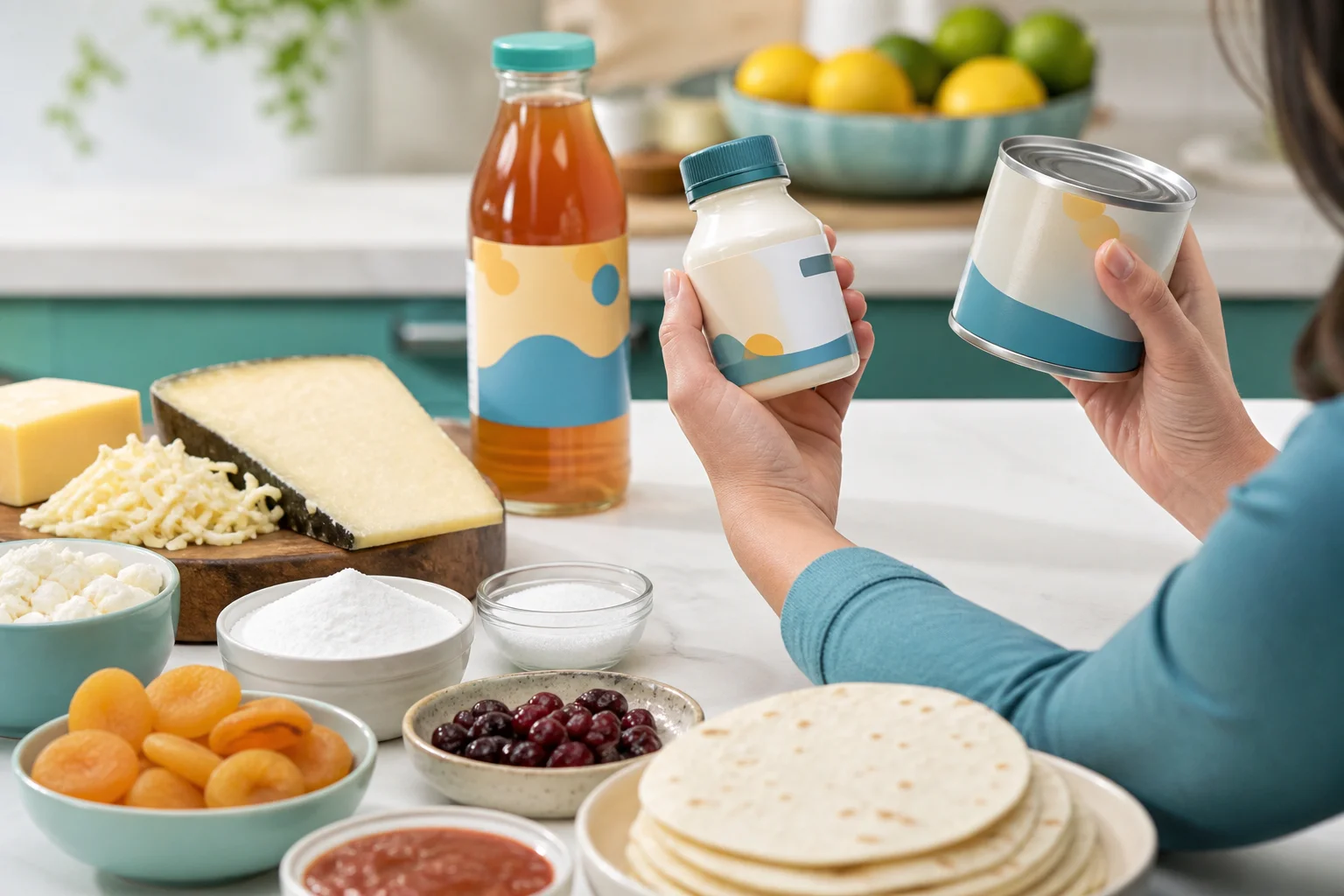
The family is used mainly to slow molds and yeasts in foods such as cheese, baked goods, sauces, beverages, dried fruit, and prepared fillings. Seeing one sorbate does not prove the food is unsafe, shelf-stable, or free of other preservation steps.

This comparison uses official identity, authorization, and safety-assessment sources checked on August 26, 2026. It compares label meaning and technological function. It does not rank products, estimate a person's tolerance, or treat the presence of one preservative as a diagnosis.
The E200-E203 Family at a Glance

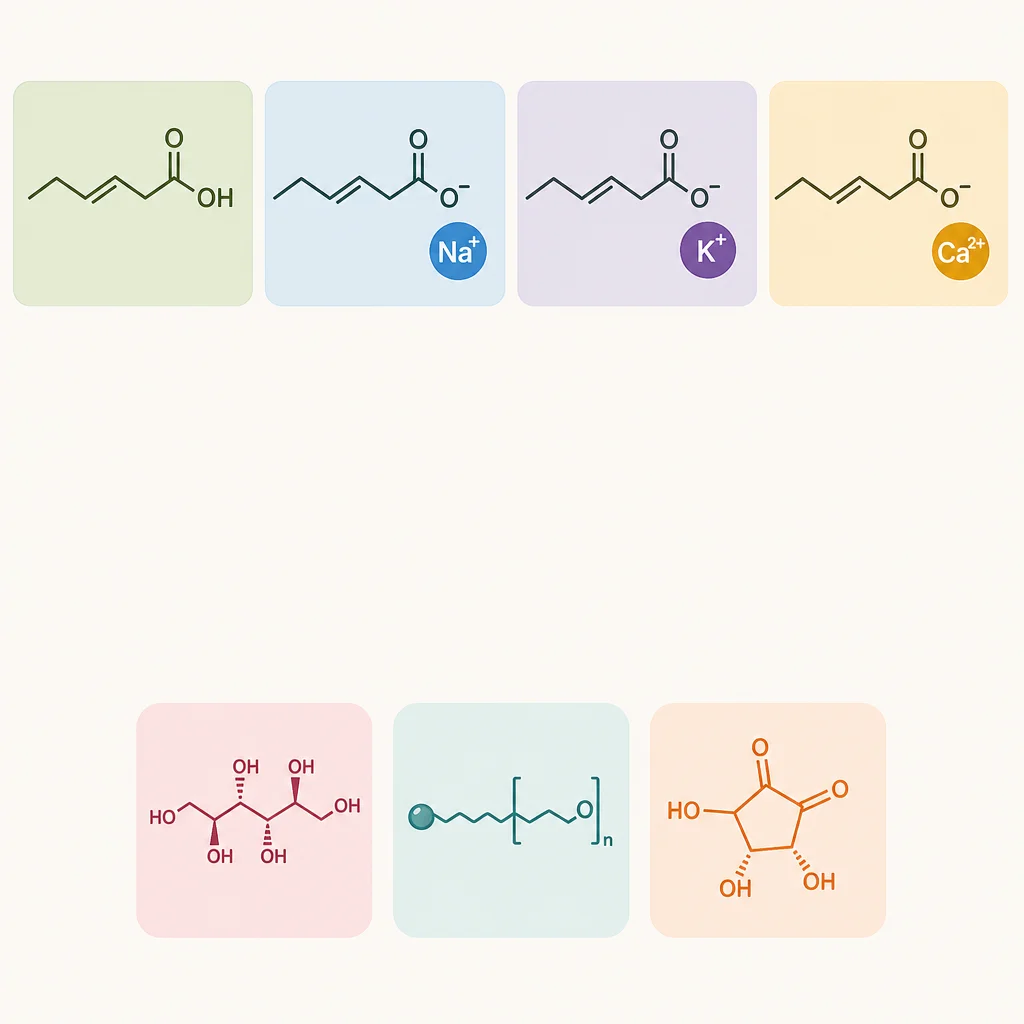
CodeIngredientFormPractical formulation clue
E200Sorbic acidAcidLimited water solubility; active form is favored in acidic foods
E201Sodium sorbateSodium saltWater-soluble salt, but authorization and use differ by market
E202Potassium sorbatePotassium saltHighly practical water-soluble form used widely in manufacturing
E203Calcium sorbateCalcium saltAnother salt form with market-specific authorizations

The code tells you identity under the E-number system. It does not tell you concentration, pH, total preservative exposure, or whether the food contains the other family members.

One Preservative System, Different Ingredient Forms

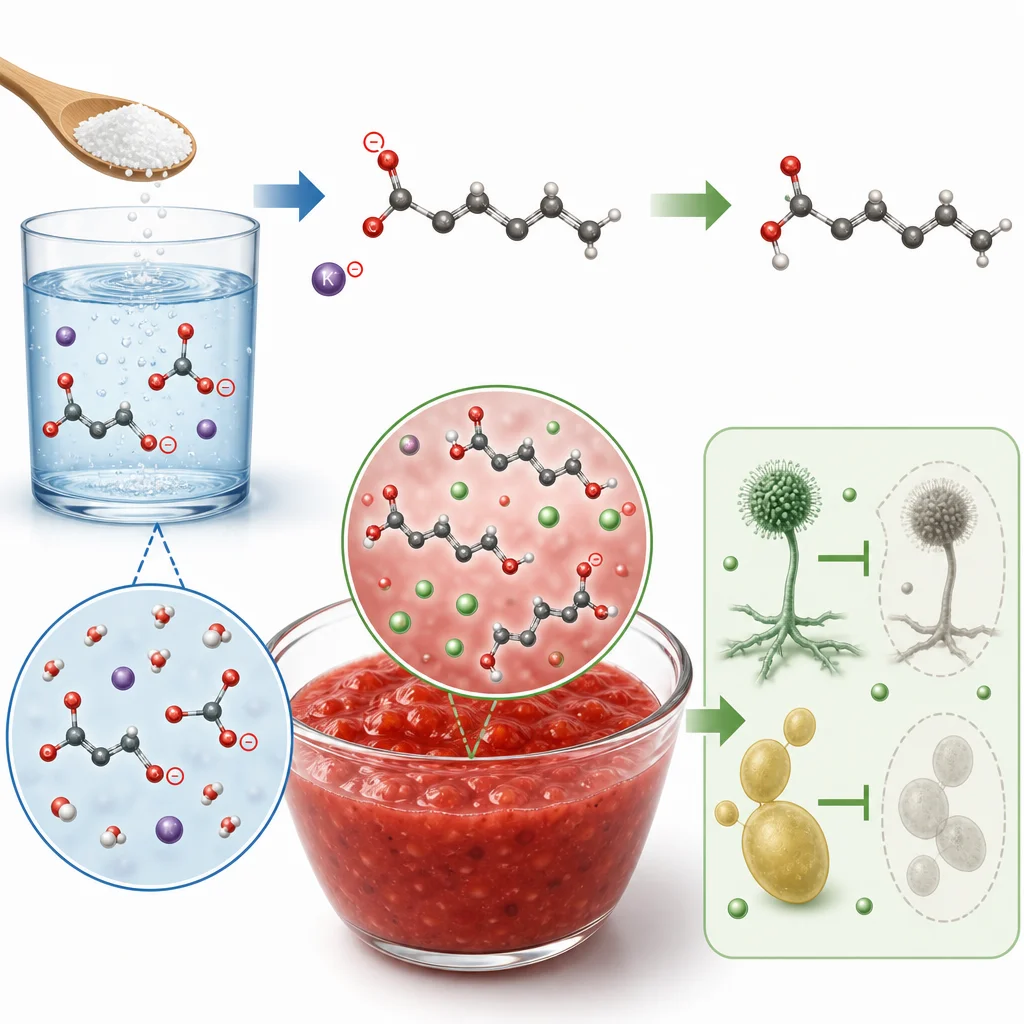
Sorbic acid is a weak organic acid. Adding potassium, sodium, or calcium creates a sorbate salt that behaves differently during manufacturing, especially when it is mixed into water.

Potassium sorbate is popular because it dissolves far more readily than sorbic acid. A manufacturer can prepare an even solution and distribute the preservative through a beverage, sauce, dairy mixture, or bakery filling. Once inside an acidic food, the salt and acid forms establish an equilibrium shaped by pH.

The undissociated acid form is particularly important to antimicrobial activity. More acidic conditions favor that form, which is one reason sorbates generally work better in acidic and moderately acidic foods than in neutral foods. This does not mean a sour taste proves effective preservation. Recipe composition, water activity, dose, organisms, temperature, packaging, and sanitation all matter.

The label should still name the form added. A formulator who adds potassium sorbate does not simply write sorbic acid because the two participate in the same equilibrium. Ingredient identity and food chemistry are separate layers.

Potassium is also part of the salt form, but the ingredient list does not show how much potassium the additive contributes per serving. The Nutrition Facts panel reports total declared potassium under the rules for that market and product. Do not calculate a clinical potassium dose from the position of potassium sorbate in the ingredient list.

What Sorbates Do

What Sorbates Do

Sorbates are used chiefly against molds and yeasts. They can help extend the acceptable life of foods that would otherwise support surface mold, fermentation, or spoilage. They are not a universal kill step and should not be described as sterilizing a food.

Common contexts include:

  • cheese, cheese products, and cultured dairy foods
  • tortillas, cakes, fillings, and other baked products
  • fruit preparations, jams, and dried fruit
  • sauces, dressings, dips, and condiments
  • wine, cider, juice drinks, and flavored beverages
  • pickled or acidified foods
  • plant-based spreads and refrigerated prepared foods

Actual permission depends on the food category and jurisdiction. A use allowed under U.S. good manufacturing practice may have a numerical maximum or a different scope under EU legislation. A list of common foods is a shopping clue, not an authorization table.

Preservation works as a system. Sorbate may be paired with refrigeration, reduced water activity, hygienic filling, modified-atmosphere packaging, or acidity control. Removing it from a recipe can require a different validated process rather than a simple one-for-one substitution. A shorter ingredient list is not evidence that the new shelf-life controls are equivalent.

U.S. Rules: Separate GRAS Listings and Functional Labeling

U.S. regulations separately list sorbic acid, potassium sorbate, sodium sorbate, and calcium sorbate as generally recognized as safe when used according to good manufacturing practice.

That status is not a blank check. Good manufacturing practice ties use to the amount reasonably required for the technical effect and to food that can legally contain the ingredient. Standards of identity can impose their own conditions.

U.S. 21 CFR 101.22(j) also requires a chemical preservative to be declared by common or usual name together with a description of its function, such as potassium sorbate (a preservative) or wording that describes what it does.

Read the actual U.S. ingredient list for the exact form. Do not translate potassium sorbate to E202 mentally and then assume every EU condition applies to the American product.

EU Rules: Codes, Categories, and Important Gaps

The EU additive framework uses E-numbers, category permissions, and maximum levels or quantum satis conditions. Regulation 1333/2008 is the controlling authorization framework, while Regulation 231/2012 supplies specifications.

The familiar code sequence can create a trap. A neat numerical family does not guarantee that every member remains authorized in the same way. EFSA's major 2015 re-evaluation addressed sorbic acid E200, potassium sorbate E202, and calcium sorbate E203. It noted that sodium sorbate E201 was not an authorized EU food additive in the framework assessed. The legal list in force, not a legacy code chart, decides what may be used.

EFSA later published a follow-up opinion after additional data were submitted for sorbic acid and potassium sorbate. Safety assessments can evolve as regulators receive new reproductive, exposure, or specification evidence. That does not change the core label-reading distinction between E200 and E202.

For an EU package, check both the additive name or code and the food category. Preservative: potassium sorbate and preservative: E202 identify the same additive, but neither wording shows the permitted maximum or actual concentration in that product.

Sorbate Is Not Sorbitol, Ascorbate, or Polysorbate

Several label names look similar while belonging to unrelated systems:

  • sorbitol / E420 is a polyol used as a sweetener or humectant
  • polysorbate 80 / E433 is an emulsifier
  • ascorbic acid / E300 is vitamin C and can function as an antioxidant
  • potassium ascorbate / E303 is an ascorbate salt
  • potassium sorbate / E202 is a sorbate preservative

Spelling is not a chemistry map. The food-additive master list groups these ingredients by function so a shopper does not collapse them into one risk category.

What a Sorbate Label Does Not Prove

What a Sorbate Label Does Not Prove

Finding potassium sorbate or E202 does not tell you:

  • the preservative concentration
  • the food's pH or water activity
  • whether sorbic acid was added separately
  • how long the food remains safe after opening
  • whether cold storage is still required
  • whether the product is free of benzoates, propionates, sulfites, or cultured preservatives
  • whether a reported symptom was caused by the additive

It also does not prove that the product is ultra-processed under every classification. Sorbates can appear in otherwise simple formulas because mold control is difficult in moist packaged foods. A processing classification and a toxicological assessment answer different questions.

How to Compare Two Products

  1. Identify the exact sorbate. Record the full name or E-number, not just β€œpreservative.”
  2. Read the function statement. On a U.S. label, look for wording such as preservative, mold inhibitor, or protects freshness.
  3. Check the food category. Cheese, beverages, baked goods, and dried fruit face different spoilage problems and legal conditions.
  4. Look for the whole preservation system. Acids, salt, sugar, refrigeration, packaging, cultured ingredients, and other preservatives may work together.
  5. Do not estimate dose from position. Ingredient order offers only limited relative-weight information and can include a permitted low-level ordering phrase.
  6. Use the current package. Recipes and market authorizations change, so a web image or foreign label may not match the item in hand.
  7. Ask a precise question if needed. Request the actual preservative, concentration, or storage instruction rather than a general claim that the food is chemical-free.

Sorbic acid and potassium sorbate belong to one preservative family, but the form, code, food category, and market still matter. IngrediCheck helps detect E200-E203 names in an ingredient list, separate them from similar-sounding additives, and apply the exact preservative rules a shopper chooses to save.

Frequently Asked Questions

Is potassium sorbate the same as sorbic acid?

No. Potassium sorbate is the potassium salt of sorbic acid. They belong to the same preservative family and share the active sorbic-acid system in food, but they are distinct ingredients with different molecular forms, solubility, names, and codes.

What do E200, E201, E202, and E203 mean?

E200 is sorbic acid, E201 is sodium sorbate, E202 is potassium sorbate, and E203 is calcium sorbate. Authorization is market-specific. A code in the family does not prove that every sorbate form is permitted in every food category or jurisdiction.

Why is potassium sorbate used more often than sorbic acid?

Potassium sorbate is much easier to dissolve in water, which simplifies dosing into beverages, sauces, dairy products, and bakery applications. In acidic food it establishes an equilibrium with sorbic acid, the form most associated with antimicrobial action.

Is potassium sorbate related to sorbitol or polysorbate 80?

No. Similar spelling does not make them one family. Sorbitol is a sugar alcohol, polysorbate 80 is an emulsifier, and potassium sorbate is a preservative salt of sorbic acid. Their functions, chemistry, and label codes are different.

Next Label Check

Follow the scanner, hub, and ingredient paths connected to this guide

Get the app for clearer label decisions.

Scan labels, see what fits your food notes, and read the why in plain English.

IngrediCheck app