Label Reading Guides

Silicon Dioxide vs Calcium Silicate: Anti-Caking Agents

Compare silicon dioxide with calcium silicate by identity, anti-caking function, E-number, U.S. limits, and the evidence an ingredient label does not provide.

Jul 30, 2026|9 min read
By Sanket Patel|Updated 2026-08-28|6 sources|Editorial standards
Silicon Dioxide vs Calcium Silicate: Anti-Caking Agents

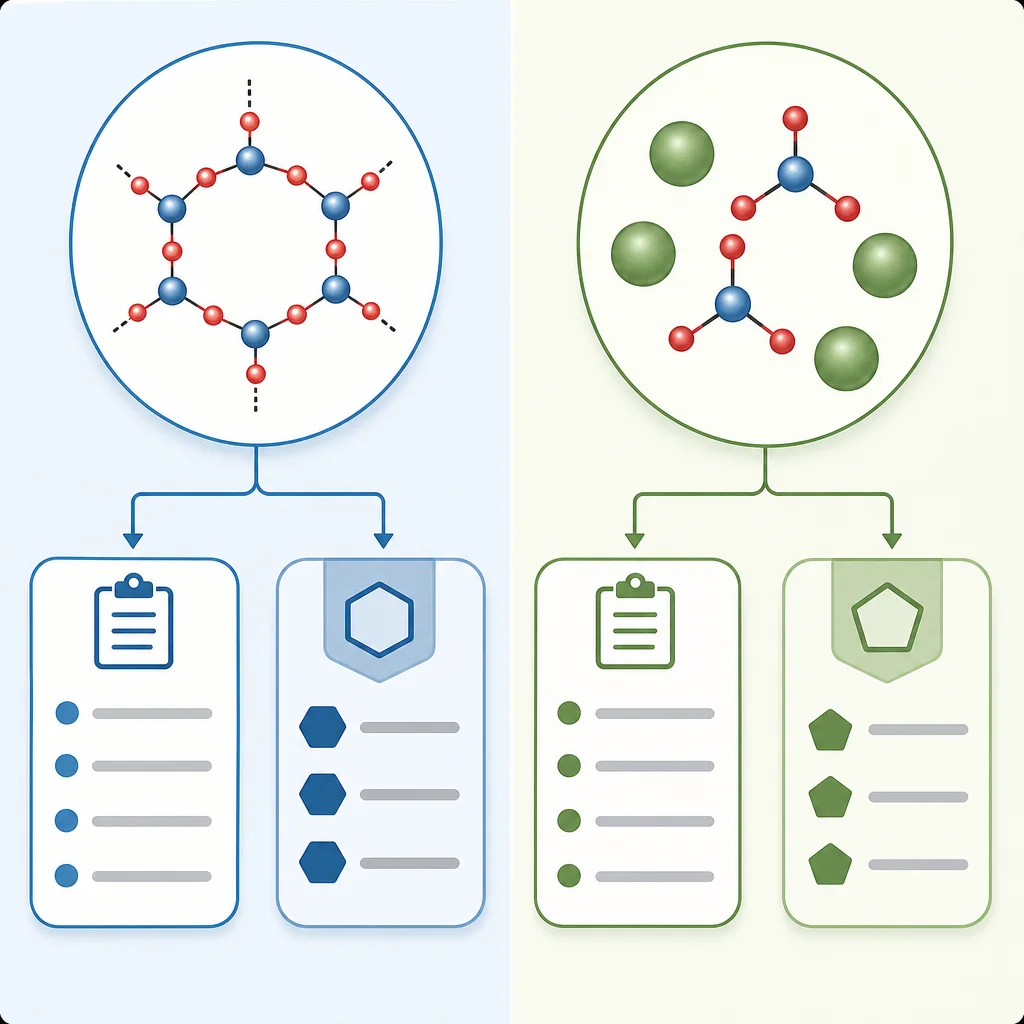
Silicon dioxide and calcium silicate are separate mineral-based additives that can perform the same broad job: helping powders resist clumping. Silicon dioxide is INS or E551. Calcium silicate is INS or E552. Similar function does not make them interchangeable names, and the code does not tell you how much was used.

You may see them in powdered seasonings, baking ingredients, grated or processed foods, drink mixes, salt substitutes, and other dry products. The exact permitted foods and limits vary by jurisdiction. Their presence is evidence of a technical function, not proof that a product is dangerous, highly processed, or nutritionally poor.

E551 and E552 at a Glance

FeatureSilicon dioxideCalcium silicate
International additive numberINS 551INS 552
EU label codeE551E552
Basic identitySilica, composed of silicon and oxygenCalcium-silicate compound
Shared food functionAnti-caking and free-flow supportAnti-caking and free-flow support
U.S. anti-caking ceiling in cited ruleUp to 2% by food weight, and no more than reasonably requiredUp to 2% by food weight, plus up to 5% in baking powder, and no more than reasonably required
Same as silicone?NoNo

An additive number is an identity shortcut within a regulatory system. It is not a universal permission for every food, a concentration declaration, or a safety score.

Why Food Powders Cake

Why Food Powders Cake

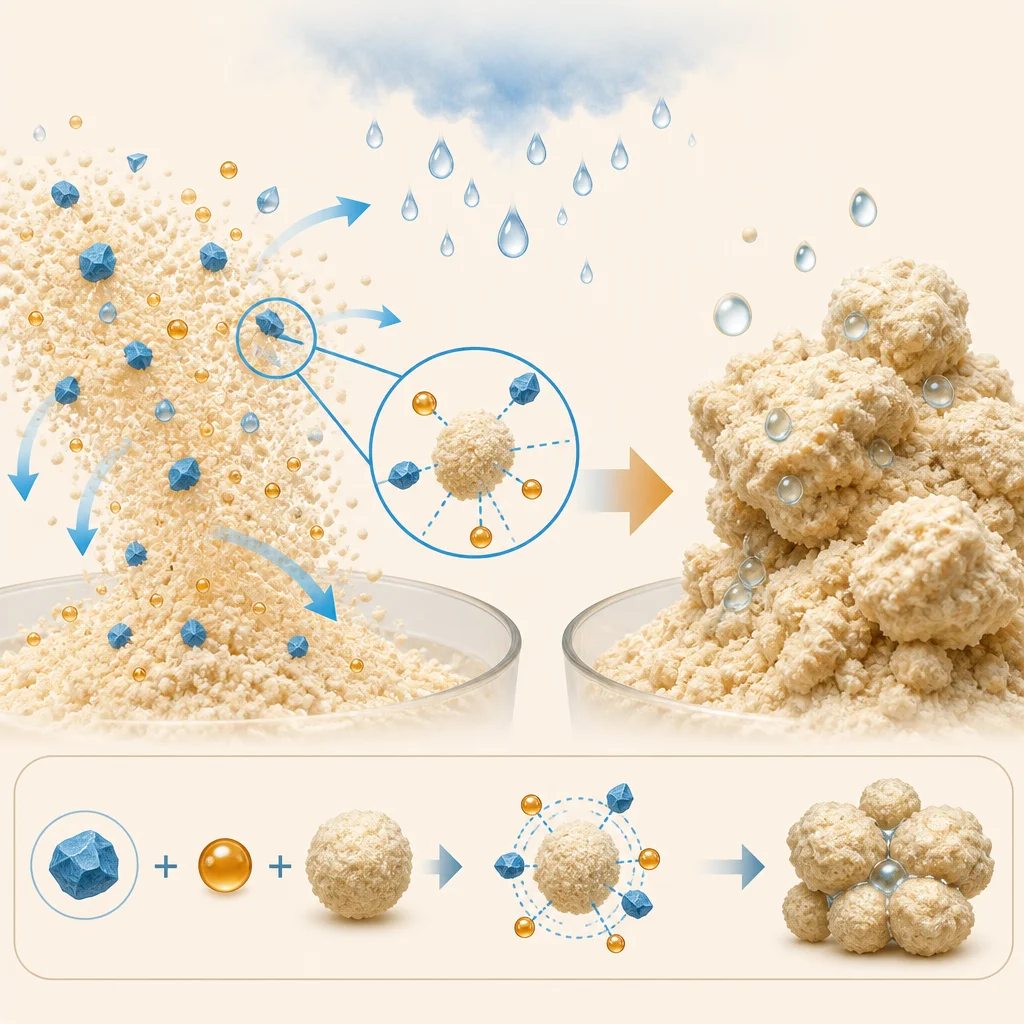
Powders are collections of small particles with a large combined surface area. Humidity, temperature changes, pressure, fat, electrostatic forces, and soluble ingredients can make those particles bridge or stick together. A free-flowing seasoning can become a solid lump before the package reaches a kitchen.

Anti-caking agents are added in small amounts to help manage that problem. Depending on the ingredient and food, they can reduce direct contact between particles, interact with moisture at particle surfaces, or make the mixture easier to move through production and dispensing equipment.

They do not make a package waterproof. A poorly sealed container can still absorb humidity. A powder can still compact under pressure or cake after repeated exposure to steam. Packaging, storage, particle size, and recipe design remain part of the system.

Anti-Caking Is Not the Same as Drying

An anti-caking agent does not necessarily remove all water from a food. The useful effect occurs at particle surfaces and within the powder's flow behavior. A product can contain moisture and still pour well, or be very dry and still compact because pressure and particle shape make the grains lock together.

The function is also different from emulsification. An emulsifier helps two phases such as oil and water remain mixed. An anti-caking agent helps solid particles remain separable. It is different again from an antifoaming agent, which destabilizes gas bubbles in a liquid or hot oil.

These distinctions keep a label explanation honest. One additive can have more than one authorized technical function in some systems, but a shared word such as agent does not make all food additives interchangeable. The relevant evidence is the additive's identity, declared functional class, food category, and current permission.

Silicon Dioxide: Silica, Not Silicone

Silicon dioxide is a compound of silicon and oxygen. In additive terminology it is commonly called silica and assigned INS 551 or E551. Food-grade specifications describe the material regulators are evaluating; the word silica should not be treated as a statement about every naturally occurring or industrial form of silicon dioxide.

This distinction matters because online discussions often combine several unlike concepts:

  • silicon is a chemical element
  • silicon dioxide is a compound also called silica
  • silicate describes compounds built around silicon and oxygen with other elements
  • silicone refers to a family of polymers, including dimethylpolysiloxane

The names share a linguistic root, not one label identity or function. Silicon dioxide commonly supports powder flow. Dimethylpolysiloxane is used as an antifoaming agent in certain food-processing contexts. The dimethylpolysiloxane guide explains that separate ingredient.

Calcium Silicate: A Distinct Calcium-Silicate Additive

Calcium silicate contains calcium as part of its chemical identity and uses INS 552 or E552. It can also help dry foods remain free-flowing. It should not be described as silicon dioxide with added dietary calcium.

The ingredient's name does not tell a shopper how much nutritionally available calcium the product provides. Nutrition declarations, serving size, and applicable nutrient-claim rules are the correct evidence for a calcium decision. An anti-caking dose can be technologically useful without making the food a meaningful calcium source.

Calcium silicate also should not be confused with calcium carbonate, calcium phosphate, sodium silicate, or other calcium and silicate ingredients. Similar mineral words can refer to different identities, functions, and permissions.

The word mineral is not a safety conclusion either. It can describe chemical origin or composition without answering purity, particle form, exposure, or authorization. Food-grade specifications define identity and purity criteria, while the food-use rule defines where and how much may be used. Both layers matter more than a marketing label such as natural or synthetic.

U.S. Rules: Similar General Limit, One Baking-Powder Difference

The U.S. direct-food-additive rule for silicon dioxide permits it as an anti-caking agent, subject to conditions including a maximum of 2 percent by weight of the food and no more than reasonably required to produce the intended effect.

The cited calcium-silicate rule also sets a 2 percent ceiling for anti-caking use in food and says the amount should not exceed what is reasonably required. It separately allows calcium silicate in baking powder at up to 5 percent by weight.

Those numbers need careful wording:

  • they are regulatory maxima under the cited U.S. provisions, not typical amounts in every food
  • a 2 percent ceiling does not mean the manufacturer always uses 2 percent
  • the baking-powder allowance does not apply automatically to every product containing baking powder
  • other uses and jurisdictions must be checked under their own rules

A label usually does not declare the additive's percentage. Ingredient order cannot reveal an exact amount because other ingredients and processing conditions affect the sequence.

International Codes Do Not Replace Local Permissions

International Codes Do Not Replace Local Permissions

JECFA records and international numbering help identify the additives. National or regional law still determines which foods may contain them, at what level, and under what conditions.

Canada's permitted anti-caking list, for example, is organized by additive, food category, purpose, and maximum level. That food-specific structure is more informative than assuming that an INS number works like a worldwide license.

EU labels may show the additive's functional class with its specific name or E-number under applicable labeling rules. A package might therefore use wording such as an anti-caking class followed by E551 or E552. The code answers “which additive,” not “how much” or “why this exact recipe needed it.”

Where You May Encounter Them

Permitted categories differ, but anti-caking agents are most relevant when a food must remain dry, portionable, or easy to dispense. Examples worth checking include:

  • table salt and salt substitutes
  • spice, seasoning, and soup mixes
  • powdered beverages and supplements
  • baking powder and dry baking mixes
  • grated or shredded products where particles can stick together
  • powdered food ingredients used by manufacturers

This is not a promise that every product in those categories contains E551 or E552. It is a map of where the technical problem of caking often occurs.

What the Label Does and Does Not Prove

Seeing silicon dioxide, silica, calcium silicate, E551, or E552 can establish the declared additive identity. It does not establish:

  • the exact percentage used
  • the material's full supplier specification
  • the food's moisture history
  • whether another anti-caking method was used
  • whether the product meets a personal dietary rule
  • whether the same additive is permitted in another country

Likewise, an additive-free product is not automatically better at every task. A manufacturer may use different processing, packaging, starch, particle design, or moisture controls. Compare the finished product and your decision criteria rather than treating one omitted additive as a universal health claim.

How to Compare Two Products

  1. Match names and codes. Treat E551 and E552 as separate entries.
  2. Identify the product category. A baking powder rule cannot be generalized to a seasoning or supplement.
  3. Check the market. Use the rules for the country where the package is sold.
  4. Read the whole formula. The anti-caking agent says little about sodium, sugars, allergens, or overall nutrition.
  5. Ask a specific question if needed. Manufacturers can clarify the additive, function, supplier controls, and market authorization.

The food-additive master list helps place anti-caking agents beside preservatives, colors, emulsifiers, and other functions without treating them as one risk category. For broader evidence boundaries, use the Ingredient Safety hub and Food Additives hub.

Silicon dioxide and calcium silicate solve a similar powder-flow problem through distinct additive identities. IngrediCheck can flag E551, E552, and their label-name variants, separate them from silicone antifoaming agents, and help shoppers review each match in the correct food and market context.

Frequently Asked Questions

Are silicon dioxide and calcium silicate the same ingredient?

No. Silicon dioxide is a form of silica and is identified as INS or E551. Calcium silicate contains calcium and silicate and is INS or E552. Both can serve as anti-caking agents, but they are separate additives with separate specifications and permissions.

What do anti-caking agents do in food?

They help powdered or particulate foods resist clumping and remain free-flowing during manufacturing, transport, storage, and dispensing. Performance depends on moisture, particle size, recipe, packaging, and the specific additive.

How much silicon dioxide or calcium silicate can U.S. food contain?

The cited U.S. direct-food-additive rules permit each for anti-caking use at no more than 2 percent by weight of the food, with no more than reasonably required. Calcium silicate has a separate allowance up to 5 percent in baking powder. Other markets and food uses have their own rules.

Is silicon dioxide the same as silicone?

No. Silicon is an element, silicon dioxide is silica, and silicones are polymers with silicon-oxygen backbones and organic groups. Dimethylpolysiloxane is a silicone antifoaming agent, not another name for silicon dioxide.

Next Label Check

Follow the scanner, hub, and ingredient paths connected to this guide

Get the app for clearer label decisions.

Scan labels, see what fits your food notes, and read the why in plain English.

IngrediCheck app