Ingredient Deep Dives

Dimethylpolysiloxane in Food: What an Anti-Foaming Agent Does

Learn why dimethylpolysiloxane is used to control foam, where food rules permit it, how E900 and INS 900a relate, and when it may appear on a label.

Jul 30, 2026|9 min read
By Sanket Patel|Updated 2026-08-28|7 sources|Editorial standards
Dimethylpolysiloxane in Food: What an Anti-Foaming Agent Does

Dimethylpolysiloxane is a silicone-based polymer used at very low levels to control unwanted foam in authorized food applications. It can appear in frying systems, preserves, beverages, and other products where foam interferes with processing. EU references use E900, while JECFA lists polydimethylsiloxane as INS 900a and recognizes several related names.

The ingredient is not automatically present in every fried food, and it is not permitted at one global level in every category. U.S., EU, and Canadian rules define different food-specific conditions. Label declaration can also depend on whether the substance remains functional in the finished food or qualifies for a processing-aid exemption.
Quick Label Facts

QuestionEvidence-based answer
What is it?A silicone polymer, commonly called dimethylpolysiloxane or polydimethylsiloxane
Main food functionAntifoaming or defoaming agent
EU codeE900
JECFA numberINS 900a
U.S. general level in the cited ruleGenerally up to 10 ppm, with specific exceptions and prepared-food conditions
Always listed?No. Ingredient and processing-aid rules depend on use, residue, final function, and jurisdiction
Same as silicon dioxide?No. Silicon dioxide is silica, E551 or INS 551, and commonly serves as an anti-caking agent

The shorthand terms identify the additive. They do not establish the product concentration, supplier specification, food authorization, or labeling exemption.

Why Foam Becomes a Processing Problem

Why Foam Becomes a Processing Problem

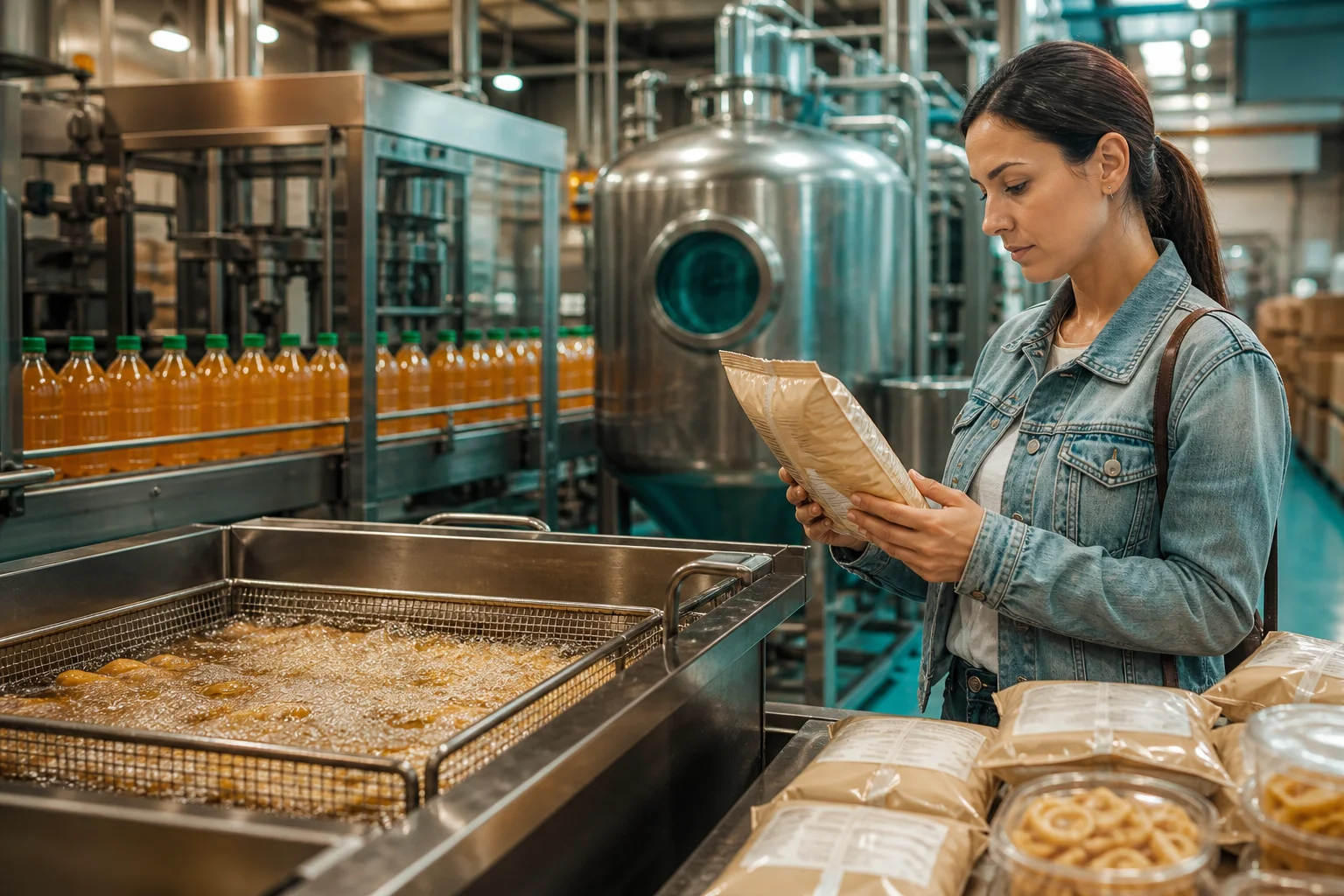
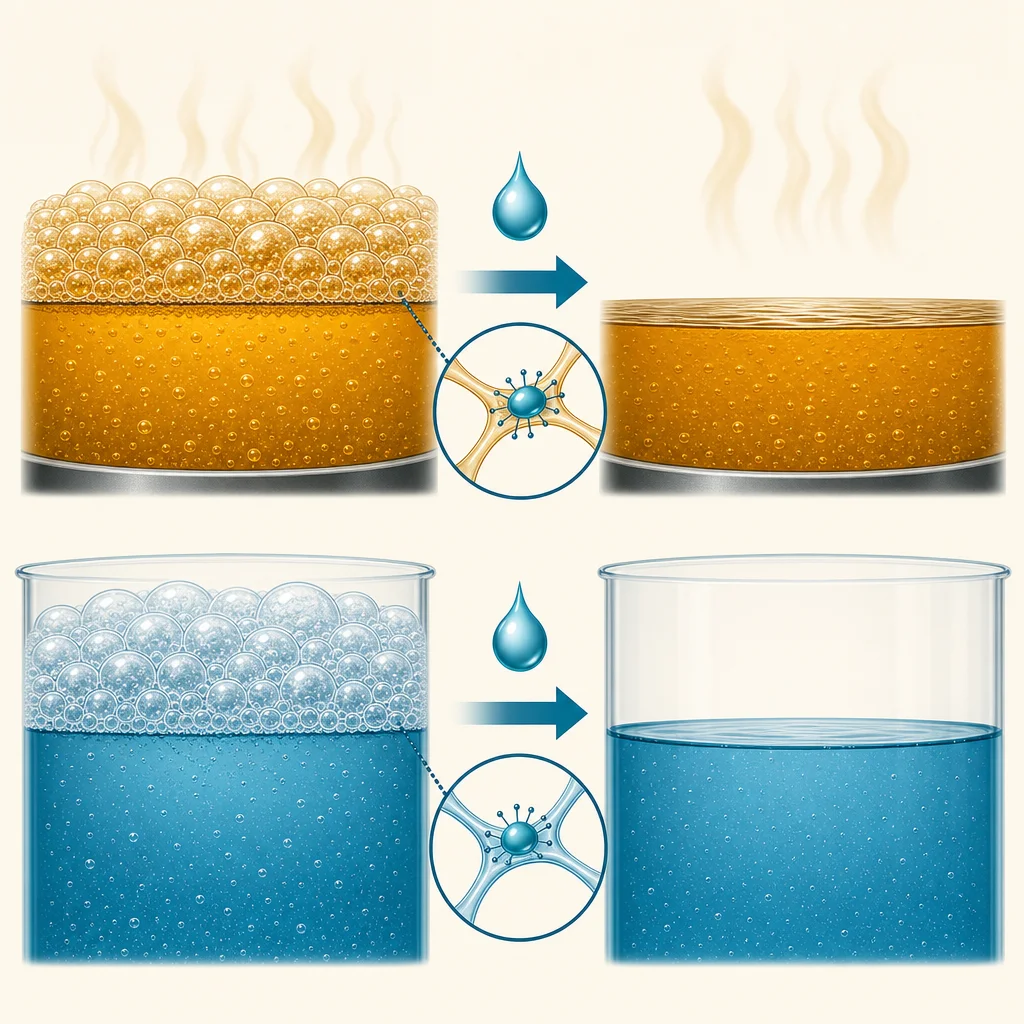
Food liquids and frying systems can develop unwanted foam during mixing, heating, pumping, and cooking. The cited U.S. rule groups dimethylpolysiloxane with defoaming agents and requires that no more than reasonably needed be used to inhibit foaming.

That defined purpose is the reliable conclusion. The ingredient is used to control foam in an authorized food or process. Its presence does not prove that it sterilizes the food, preserves against microbes, replaces process controls, or performs the same job as every other additive.

Antifoaming and Defoaming Describe the Same Control Problem

The U.S. provision is titled Defoaming agents and describes the intended effect as inhibiting foaming. Other official lists use antifoaming agent. The two terms can therefore appear in authoritative food records for the same general control purpose.

Neither term changes the authorization test. The additive still needs a permitted food, purpose, and level, and the amount should not exceed what the applicable rule allows.

The Name Family: PDMS, Dimethicone, E900, and INS 900a

Polydimethylsiloxane is often shortened to PDMS. Regulatory and technical references may also use dimethylpolysiloxane, dimethyl silicone fluid, dimethyl silicone oil, or dimethicone in defined contexts.

Those terms should not be matched carelessly across cosmetics, medical products, industrial materials, and food. Food rules apply specifications and use conditions to the food-grade additive. Finding the same polymer family in a nonfood product does not prove that the materials, purity requirements, or applications are identical.

Numbering also requires context:

  • the EU food-additive system identifies dimethyl polysiloxane as E900
  • the International Numbering System record uses INS 900a
  • a U.S. label is more likely to use the common or usual ingredient name when declaration is required

The numbers are useful aliases for screening labels. They are not a substitute for the jurisdiction's authorization table.

U.S. Conditions Are More Specific Than “10 ppm”

The U.S. defoaming-agent rule specifies dimethylpolysiloxane and generally limits it to 10 parts per million in food, with no more used than reasonably required to inhibit foaming. The same provision includes important product-specific conditions.

For example, it sets zero use in milk. It permits a higher level in dry gelatin dessert mix only when the ready-to-serve food does not exceed the specified lower amount. It also permits a higher amount in cooking salt only when the prepared food remains within a lower final level.

That structure prevents several common mistakes:

  • 10 ppm is not one unqualified global rule
  • a dry-mix limit is not the amount eaten after preparation
  • a permitted maximum is not proof that every manufacturer uses the maximum
  • an authorization for one food does not extend to every food that can foam

The correct question is whether the food, level, and technical purpose fit the current rule for that product. That check must use the exact product and market.

EU Permissions Are Food-Category Specific

EU Permissions Are Food-Category Specific

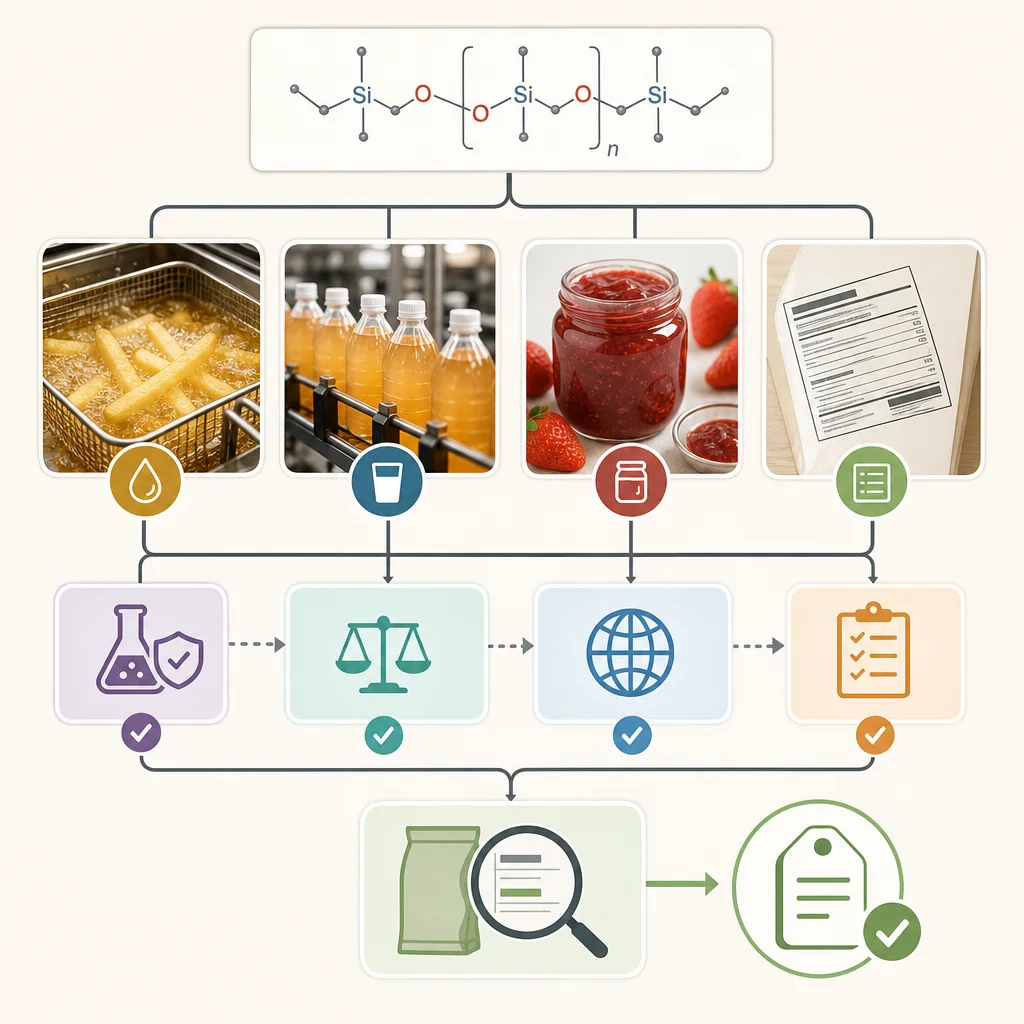
The European Commission database lists E900 permissions across defined categories. Representative examples include certain fats and oils for frying, canned or bottled fruit and vegetables, jams and similar spreads, confectionery, batters, soups and broths, cider and perry, and limited beverage or supplement uses.

Many of those entries use a maximum of 10 milligrams per kilogram or liter, but not all. Chewing gum is one example with a different maximum. Some categories have exclusions or narrower product descriptions.

This is why a summary saying “E900 is allowed in the EU” is incomplete. Authorization attaches to the category and conditions. It does not create a universal permission for any recipe at any dose.

Canada Also Uses a Defined Food List

Health Canada's list of food additives with other accepted uses identifies dimethylpolysiloxane as an antifoaming agent in specified products and processing contexts. Examples include listed jams, jellies and marmalades, many fats and oils, certain fruit or wine products, citrus juices, shortening, skim milk powder, beer wort, and unstandardized foods under stated conditions.

The Canadian list also includes a release-agent use with a residue condition. This reinforces the same reading principle: function, food category, and residual level travel together.

Does It Have to Appear on the Ingredient List?

In the United States, ingredients generally use their common or usual names unless an exemption applies. One relevant exemption concerns incidental additives and processing aids.

A processing aid is not merely “something used during processing.” The U.S. provision describes several routes, including substances removed before packaging, substances converted to ordinary food constituents, and substances present at insignificant levels with no technical or functional effect in the finished food. That last route is particularly relevant when discussing residual antifoam. If it continues to perform a function, that route may not fit.

EU ingredient-list exemptions also have defined conditions. Canada has its own framework. A missing name therefore does not automatically prove illegal concealment, and a declared name does not prove the food contains more of it than an undeclared food.

For a high-stakes sourcing question, ask the manufacturer:

  • whether a dimethylpolysiloxane antifoam is used in the finished food or upstream process
  • whether it remains with a technical effect
  • which market's labeling rule applies
  • whether the ingredient or aid is included in the full specification available to consumers

Silicon Dioxide Is a Different Additive

Dimethylpolysiloxane is a silicone polymer. Silicon dioxide is silica. The latter is E551 or INS 551 and commonly helps powders resist caking.

The silicon dioxide versus calcium silicate comparison explains those mineral anti-caking agents. Shared words such as silicon do not make E551 and E900 interchangeable.

What the Ingredient Does Not Prove

Seeing dimethylpolysiloxane on a label does not show:

  • that the product was deep-fried
  • that the additive is present at a particular maximum
  • that every food from the same restaurant or manufacturer uses it
  • that the food is safe or unsafe for a particular person
  • that the same use is authorized in another country
  • that the food lacks other foam-control methods

It is also unhelpful to compare a food-grade antifoaming agent directly with silicone caulk. Materials can share a polymer class while having different additives, specifications, manufacturing controls, and intended uses.

A Practical Review Workflow

  1. Match the full name. Search for dimethylpolysiloxane, polydimethylsiloxane, permitted aliases, E900, and INS 900a without merging them with silica.
  2. Identify the food and market. Permission is category- and jurisdiction-specific.
  3. Separate use level from legal maximum. The label rarely states the actual concentration.
  4. Check whether declaration rules apply. Processing-aid status is a legal and functional question, not a casual synonym for low dose.
  5. Review the whole product. An antifoaming agent says little about allergens, nutrition, cooking-oil quality, or the rest of the formula.

The Food Additives hub organizes ingredients by technical function, while the Ingredient Safety hub helps separate identity, authorization, exposure, and personal decision criteria.

Dimethylpolysiloxane is a narrowly used foam-control tool whose meaning depends on the food, dose, market, and label rule. IngrediCheck can detect its common names and codes, separate E900 from mineral anti-caking agents, and help shoppers route each match to the right evidence instead of a generic additive verdict.

Frequently Asked Questions

Why is dimethylpolysiloxane added to food?

It is used in permitted food and processing applications to inhibit unwanted foam. A very small amount can disrupt foam films in frying oil, beverages, preserves, and other authorized systems, helping processing remain controlled.

Is dimethylpolysiloxane E900?

EU materials identify dimethyl polysiloxane as E900. JECFA uses INS 900a for polydimethylsiloxane and lists names including dimethylpolysiloxane and dimethicone. E-number and INS notation should be read within the relevant market rather than treated as identical label systems.

Is dimethylpolysiloxane always limited to 10 ppm?

No. The U.S. rule generally uses 10 ppm but includes product-specific conditions and higher limits for certain dry mixes or cooking salt that must yield lower levels when prepared. EU and Canadian permissions are food-specific, and chewing gum is one EU example with a different maximum.

Must dimethylpolysiloxane appear in every ingredient list?

Not necessarily. Labeling depends on jurisdiction, use, residue, and whether a processing-aid or incidental-additive exemption applies. In the United States, a processing aid must be present at an insignificant level and have no technical or functional effect in the finished food to qualify for that exemption.

Next Label Check

Follow the scanner, hub, and ingredient paths connected to this guide

Get the app for clearer label decisions.

Scan labels, see what fits your food notes, and read the why in plain English.

IngrediCheck app