The reason tahini keeps appearing in recall notices is not bad luck or poor manufacturing practice across multiple unrelated companies. It is chemistry.
The Low Water Activity Problem
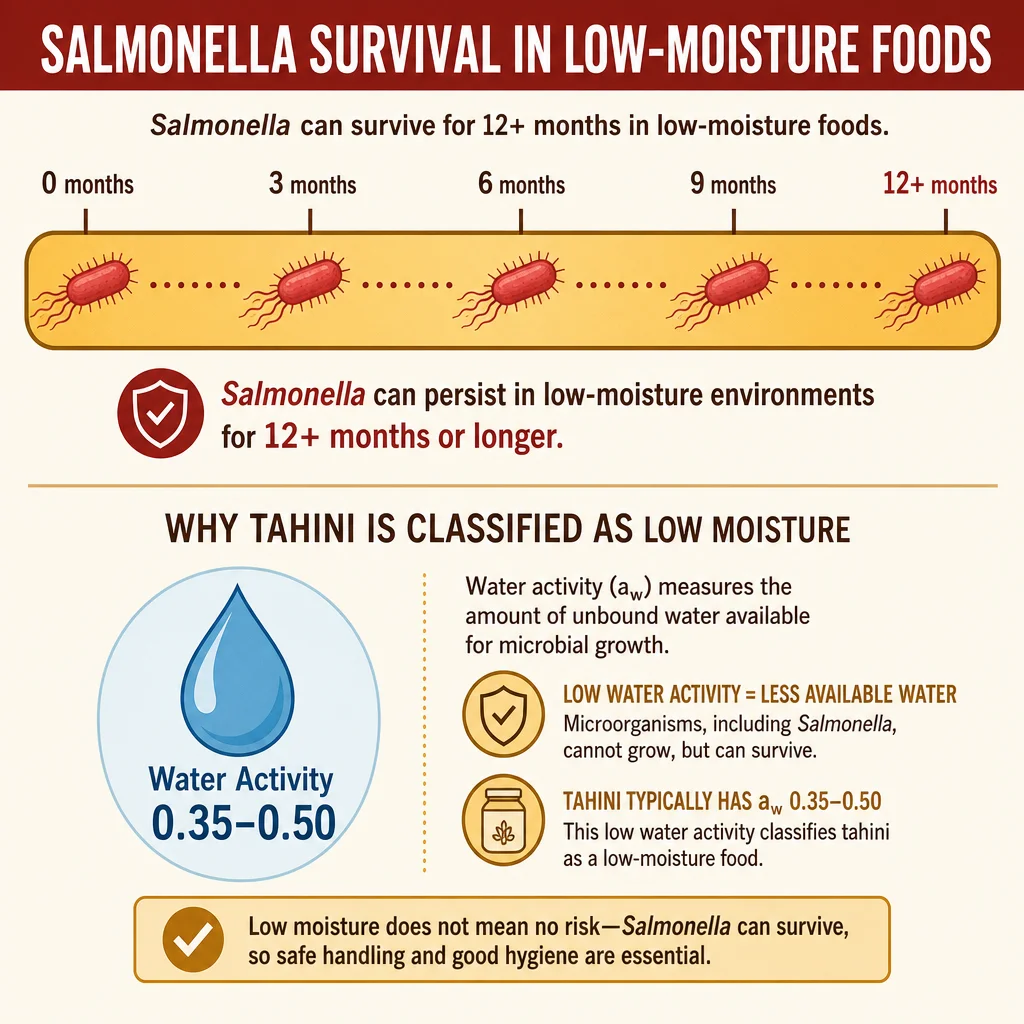
Water activity (aw) measures how much "free" water is available in a food. Bacteria need free water to grow and reproduce. At water activity below 0.93, Salmonella cannot multiply. Tahini has a water activity well below that threshold, typically around 0.35 to 0.50, placing it firmly in the category food scientists call "low moisture ready-to-eat" (LMRTE) foods.
The problem is that low water activity is not the same as Salmonella-free. The bacteria cannot grow, but they survive. Research published in the Journal of Food Protection has shown that Salmonella can persist in low-water-activity environments for months and, under certain conditions, for more than a year. In fatty environments like sesame paste, survival times can be even longer because the lipid matrix provides a protective buffer against environmental stressors.
This is why a jar of tahini contaminated at the point of manufacture does not "self-decontaminate" during the months it sits on a warehouse shelf or in a consumer's refrigerator. The bacteria wait.
The Roasting Step and Its Limits
During commercial tahini production, sesame seeds are roasted at high temperatures. Roasting is supposed to serve as a "kill step," reducing pathogen loads to safe levels. In theory, adequate time and temperature should eliminate Salmonella. In practice, this step does not always work as intended.
Several factors complicate the kill step:
- Seeds can arrive at the facility already contaminated in clusters or pockets, creating uneven heating during roasting.
- If seeds are contaminated after roasting, during hulling, milling, or packaging, the kill step is irrelevant to that contamination.
- The fat-rich environment of sesame seeds can shield bacterial cells from heat, raising the effective temperature required for elimination.
- Cooling the seeds after roasting, then passing them through more equipment, creates opportunities for post-roast recontamination.
The FDA's guidance on LMRTE food production acknowledges that wet cleaning of production lines, which introduces moisture, can paradoxically increase contamination risk if not carefully controlled. Even a small amount of residual water in a dry production environment can allow Salmonella to grow, spread through the facility, and contaminate product that passes through after cleaning.
Origin and Supply Chain
Most of the tahini consumed in the United States, the United Kingdom, Canada, and Australia is manufactured in the Middle East, primarily Israel, Turkey, and Lebanon, with sesame seeds sourced from Ethiopia, Sudan, Nigeria, and other parts of East Africa and South Asia. Sesame is grown in the soil, and Salmonella is an environmental organism. Seeds can pick up contamination in the field, during harvest, in storage, or during transit across long international supply chains.
Import sampling programs catch some contaminated product. But with hundreds of thousands of tonnes of sesame products moving through global trade each year, testing is far from comprehensive. The repeated detection of Salmonella in finished tahini products sold in North America and Europe reflects both the frequency of contamination in the supply chain and the limits of surveillance.