What Causes Salicylate Sensitivity? Gut Health and Genetics

Salicylate sensitivity isn't random. A gene variant carried by 1 in 3 people reduces the enzyme that clears salicylates, while gut dysbiosis amplifies the load. Here's the science.

Jun 4, 2026|10 min read
By Sanket Patel|Updated 2026-06-04|3 sources|Editorial standards
What Causes Salicylate Sensitivity? Gut Health and Genetics

Everyone has a threshold. For some people, a blueberry smoothie and a tomato sauce on the same day crosses it. For others, years of eating berries, spices, and wine cause no problems until gut inflammation, an antibiotic course, or prolonged stress shifts their baseline. Salicylate sensitivity is not all-or-nothing, and that variability is exactly what makes it hard to understand and harder to diagnose.

The explanation for why some people react to salicylates and others don't comes down to two compounding factors: how efficiently your liver enzymes can clear salicylates, and what your gut bacteria are doing with them before they get there. Both are shaped by genes, lifestyle, and conditions you may already have.
What Salicylate Sensitivity Actually Is

Salicylates are a family of phenolic compounds produced naturally by plants as a defense against insects, fungi, and microbial attack. They are present in virtually every fruit, vegetable, spice, and herb in varying concentrations. Spices like curry powder and paprika sit at the extreme high end. Peeled starchy vegetables like potato and parsnip are among the lowest.

In people who tolerate salicylates well, these compounds are metabolized efficiently and excreted in urine. In sensitive individuals, the metabolic system is outpaced, and uncleared salicylates trigger an inflammatory cascade through COX-1 enzyme inhibition: the same mechanism used by aspirin and ibuprofen. The result is threshold-dependent. Below it, no symptoms. Above it, reactions that can include hives, nasal congestion, asthma, migraines, gut inflammation, or behavioral changes in children.

This is not a true allergy. No IgE antibody is involved. The technical term is pseudoallergy, meaning the reaction is pharmacological rather than immunological.

Prevalence data is hard to pin down precisely, but a systematic review cited in BMJ found that approximately 21% of adults with asthma react on formal oral salicylate challenge, compared to only 3% who self-report sensitivity. The condition is probably widespread and substantially underrecognized.

The Genetic Root: SULT1A1 and the Sulfation Pathway

The Genetic Root: SULT1A1 and the Sulfation Pathway

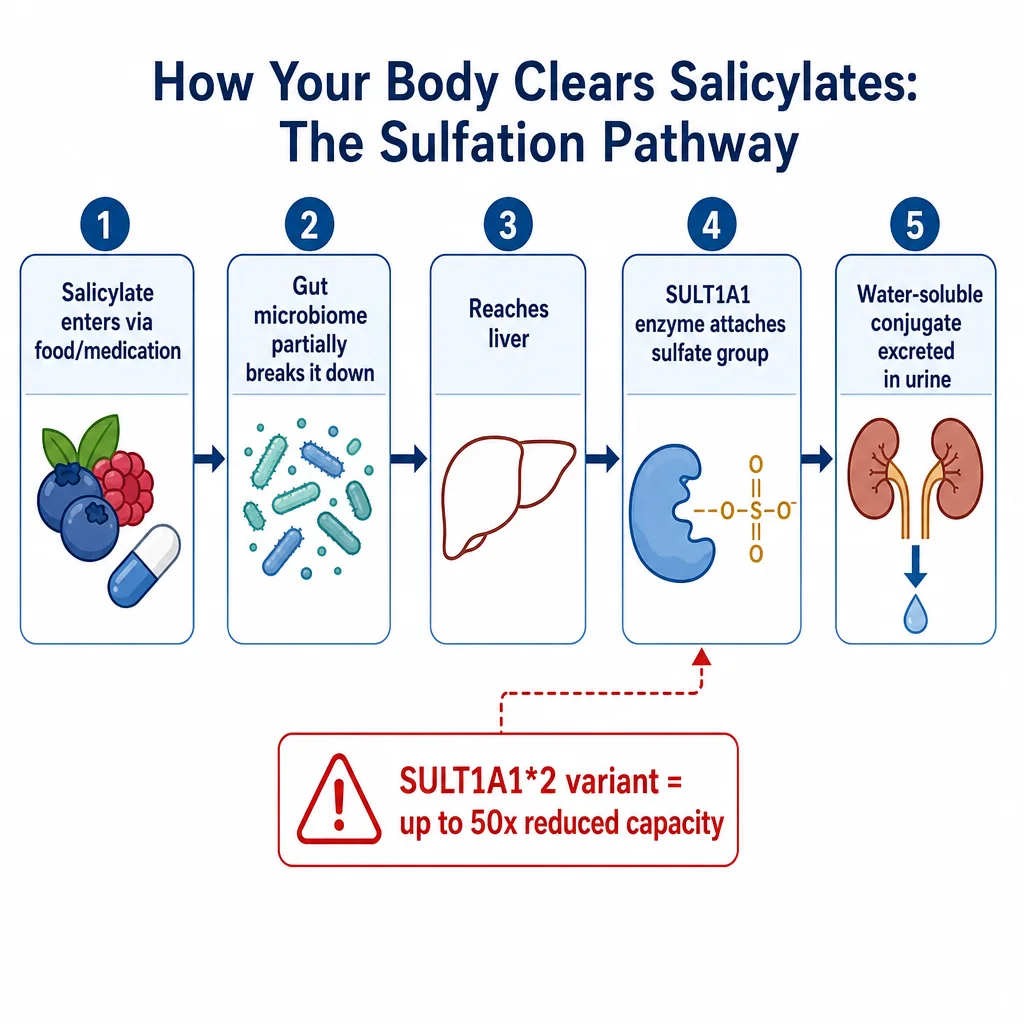
The primary route the body uses to clear salicylates is called sulfation. A liver enzyme attaches a sulfate group to the salicylate molecule, making it water-soluble and excretable in urine. The enzyme responsible is SULT1A1, a phenol sulfotransferase expressed in the liver, gut, lung, brain, and platelets.

SULT1A1 is highly polymorphic, meaning it varies substantially across individuals at the genetic level. The most studied variant is the SULT1A1*2 allele (rs9282861), caused by a single nucleotide change that substitutes a histidine for an arginine at position 213 in the protein. The consequence is measurably reduced enzyme activity and altered protein stability.

This variant is not rare. Research published in Pharmacogenetics found the SULT1A1*2 allele in 32.1% of Caucasians and 26.9% of Africans studied, making it common enough to affect a substantial portion of the general population. Individuals carrying this variant have a lower-capacity salicylate clearance system from birth.

More than 50-fold variation in sulfation activity has been documented across individuals with different SULT1A1 genotypes. That is not a marginal difference. It means one person's liver can process the same meal's salicylate load 50 times faster than another's.

A second enzyme, SULT1A3, also participates in phenol metabolism. Its substrate preference differs from SULT1A1 by a single amino acid at position 146. It is more active toward monoamines like dopamine, but it contributes to overall phenol-processing capacity, and variants in SULT1A3 reduce the system's total throughput further.

A related gene, SUOX (sulphite oxidase), converts sulphites to sulphate: the raw material SULT enzymes need to perform the sulfation reaction. When SUOX function is impaired, the entire pathway can stall even when the SULT gene itself is normal.

Dr. Rosemary Waring at the University of Birmingham documented measurably low phenolsulfotransferase-P (PST) activity in children with food intolerances and autism spectrum conditions in the 1990s, establishing PST deficiency as a real, measurable phenomenon with biochemical underpinning.

The Gut Microbiome: The First Line of Salicylate Processing

Before dietary salicylates reach the liver, they pass through the gut. The microbial community living there has its own capacity to degrade them. When that capacity is disrupted, more salicylate reaches systemic circulation in unprocessed form.

A 2021 metagenomics study published in Scientific Reports mapped aromatic compound catabolism across the human gut microbiome and found that 87.5% of the gut's capacity to degrade benzoate compounds (which share aromatic ring degradation pathways with salicylate) resided in Firmicutes, particularly Ruminococcaceae (29.7%) and Lachnospiraceae (14.5%). These same bacterial families are consistently depleted by processed food diets, antibiotic use, and chronic physiological stress.

When Ruminococcaceae and Lachnospiraceae populations fall, the pre-absorption breakdown of dietary salicylates and related phenolics is reduced, increasing the load arriving at the liver's SULT enzymes.

A landmark 2024 study in Cell Host and Microbe made this connection more specific. Researchers found that aspirin, a synthetic salicylate, selectively depletes Parabacteroides goldsteinii, a gut bacterium that produces protective bile acids, specifically 7-keto-lithocholic acid, which maintain intestinal barrier integrity through a stem cell renewal pathway. When aspirin depleted this microbe in both mice and a 23-person human cohort taking 100 mg per day for 30 days, gut barrier damage followed. Supplementation with the microbe or its bile acid product reversed the damage.

The finding matters beyond aspirin specifically. It demonstrates that salicylate exposure reshapes the gut microbiome in ways that impair the gut barrier, which then allows more salicylate to cross into circulation: a self-reinforcing cycle where the compound causes the very gut disruption that worsens its own absorption.

Leaky Gut as an Amplifier

Intestinal permeability compounds both problems described above.

Healthy gut epithelium maintains tight junctions between cells that control what passes from the intestinal lumen into systemic circulation. Salicylates are normally absorbed via regulated transport, with partial microbial processing in the gut before absorption. When tight junctions are disrupted, unprocessed salicylates pass into circulation in larger quantities.

This increases the burden on the liver's SULT enzymes beyond their genetic capacity. The cascade continues: excess systemic salicylates drive COX-1 inhibition and leukotriene production, which causes intestinal inflammation, which worsens barrier permeability, which allows more salicylate absorption. Breaking the cycle requires addressing gut integrity alongside dietary restriction.

Clinical observations from practitioners treating chronic food intolerance consistently find that gut repair using butyrate, sulphate supplementation, and targeted dietary changes correlates with improved salicylate tolerance over time.

The Bucket Theory: Why Your Threshold Shifts

The Bucket Theory: Why Your Threshold Shifts

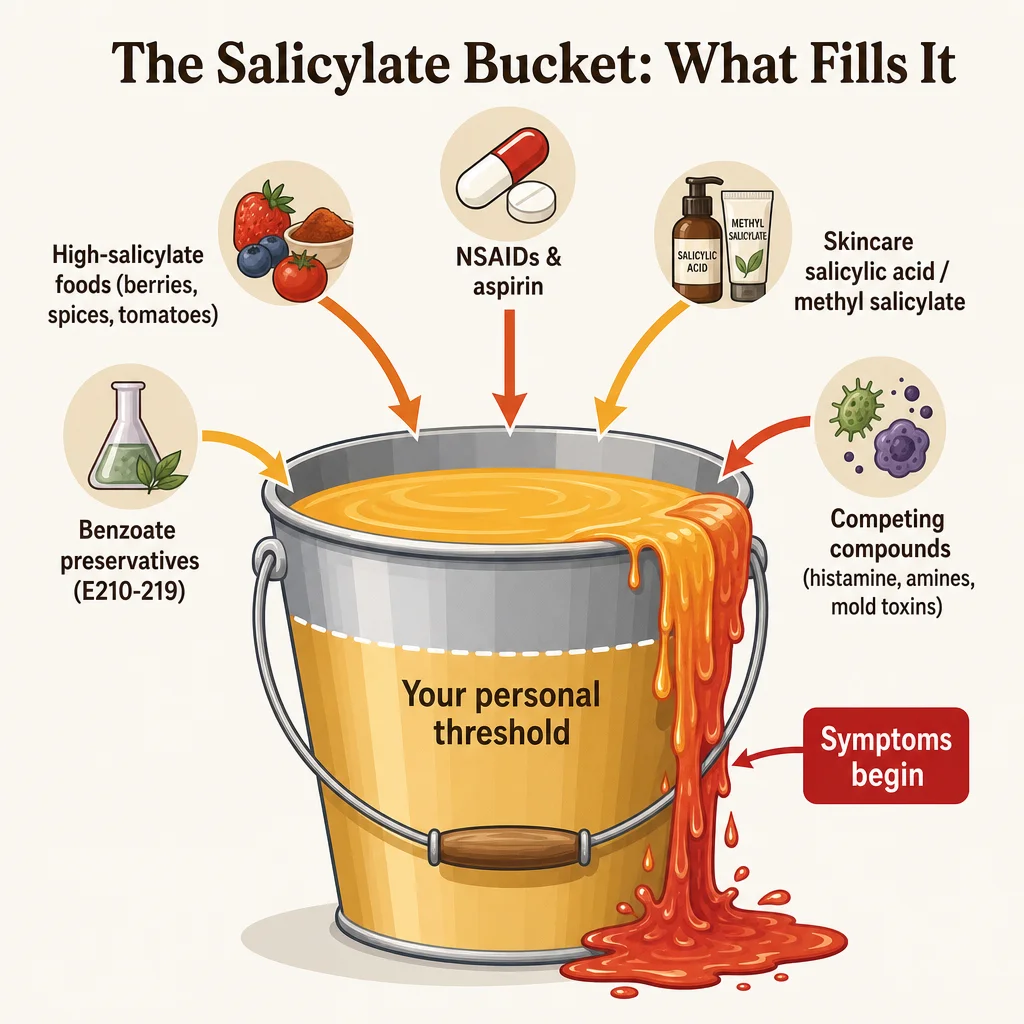
Salicylate sensitivity operates on a threshold model that practitioners often describe as a "bucket."

Your sulfation pathway has a maximum throughput capacity, determined partly by genetics (SULT1A1 genotype, SUOX function) and partly by current conditions (gut dysbiosis, leaky gut, sulphate availability). When the total load of salicylates entering your system exceeds that capacity, symptoms emerge.

The sulfation pathway handles other compounds alongside salicylates. Dietary amines such as tyramine, histamine, and phenylethylamine from aged cheese, fermented foods, and wine all compete for the same SULT enzyme capacity. Mold toxins, chlorine metabolites, and various food additives use the same pathway. A day with high histamine intake can reduce your remaining capacity for salicylates, tipping you over your personal threshold even if your salicylate intake was identical to a symptom-free day.

This explains why salicylate sensitivity seems to come and go, why a food that caused no problems for years suddenly triggers reactions, and why eliminating just one category of trigger often brings only partial relief.

Who Is Most at Risk?

Certain populations have higher rates of salicylate sensitivity than general estimates suggest:

People with Asthma and Respiratory Conditions

As noted above, roughly 21% of adults with asthma react on formal challenge testing, far more than the 3% who self-report. For those with both asthma and nasal polyps, the rate climbs further.

People with Chronic Inflammatory Conditions

Clinical series report elevated rates of salicylate sensitivity among individuals with chronic urticaria, irritable bowel syndrome, and inflammatory bowel disease. These conditions share gut barrier compromise with salicylate intolerance, suggesting bidirectional amplification.

Children with Behavioral Diagnoses

Observational research dating back to Dr. Benjamin Feingold's work in the 1970s linked salicylates and artificial food additives to ADHD-pattern presentations in children. Subsequent research on phenolsulfotransferase-P deficiency in autism spectrum conditions has kept this connection alive in the literature, though causality is debated.

People with Multiple Food Sensitivities

Overlapping sensitivities to salicylates, histamine, and amines frequently cluster together in clinical practice. This makes biological sense: all three compound classes are processed through the same sulfation pathway, meaning a system under stress from one is likely compromised for the others.

What Foods Carry the Highest Loads?

Salicylate content varies by ripeness, processing, and part of plant used. Spices dominate the highest tier:

Very high (above 100 mg/kg): Curry powder, paprika, cayenne, oregano, cinnamon, cloves, cumin, rosemary, mixed dried herbs

High (10–100 mg/kg): Dried fruits (raisins, currants, apricots), raspberries, blackberries, blueberries, oranges, avocado, champignon mushrooms, olives, tomato paste, wine

Moderate: Fresh tomatoes, capsicum/peppers, apples, pineapple, almonds, olive oil, honey

Negligible (safe baseline foods): Peeled white potato, cabbage, iceberg lettuce, banana, peeled pear, plain meats, fish, eggs, milk, rice, millet

Two practical points: peeling fruits and vegetables reduces content meaningfully, since salicylates concentrate in skins and outer leaves. Unripe produce is higher in salicylates than ripe. Concentrating plant foods increases load significantly — tomato paste carries far more per gram than fresh tomato; dried spices far more than their fresh herb equivalents.

What This Means for Reading Food Labels

Current food labeling law in both the US and EU does not require salicylates to be declared on food labels. Salicylates are natural plant components, not regulated food additives, and fall outside mandatory disclosure frameworks. Consumers with salicylate sensitivity must check ingredient lists directly rather than relying on any labeled threshold or warning.

What can be identified on labels:

Benzoate preservatives (E210–E219) must be declared if present. These are structurally related to salicylate, share metabolic pathways, and are relevant to the same enzyme bottleneck. "Natural flavors," "spices," or "herbs" listed without further specification can conceal high-salicylate herbs and seasonings such as paprika, oregano, mint, and cinnamon, with no additional disclosure obligation. Mint, menthol, methyl salicylate, and wintergreen in ingredient lists of foods or personal care products are high-salicylate compounds that can contribute meaningfully to total load. Bismuth subsalicylate, found in certain antacids, is a direct salicylate source worth flagging when managing cumulative exposure carefully.

Processed and concentrated forms deserve more attention than fresh equivalents. A tomato-based pasta sauce may contain tomato paste as its primary ingredient, making the per-serving salicylate load substantially higher than the fresh tomato would suggest.

If you or someone you know also reacts to aspirin or ibuprofen, the connection between food salicylates and NSAID sensitivity is worth understanding in detail.

Using IngrediCheck, you can scan packaged food labels and immediately flag benzoate preservatives, spice blend entries, concentrated tomato ingredients, and other potential salicylate contributors, helping you track the cumulative load across the products you eat most often when your own bucket is already partially full.

Next Label Check

Follow the scanner, hub, and ingredient paths connected to this guide

Get the app for clearer label decisions.

Scan labels, see what fits your food notes, and read the why in plain English.

IngrediCheck app