Dietary Guides

Wheat Allergy Dietary Guide: Gluten, Wheat Starch, and the FALCPA Loophole

Wheat is one of the nine major allergens under FALCPA, but the law creates a unique loophole for highly processed wheat derivatives. Wheat allergy is distinct from celiac disease and gluten sensitivity, yet all three conditions require careful label reading.

Jun 7, 2026|11 min read
By Sanket Patel|Updated 2026-06-07|6 sources|Editorial standards
Wheat Allergy Dietary Guide: Gluten, Wheat Starch, and the FALCPA Loophole

Wheat is one of the most complex major allergens to navigate on food labels. It is the only allergen that is also a staple grain, a source of gluten, and a subject of separate regulatory frameworks for gluten-free labeling. For individuals with wheat allergy, the challenge is distinct from celiac disease and non-celiac gluten sensitivity, yet all three conditions require careful label reading.

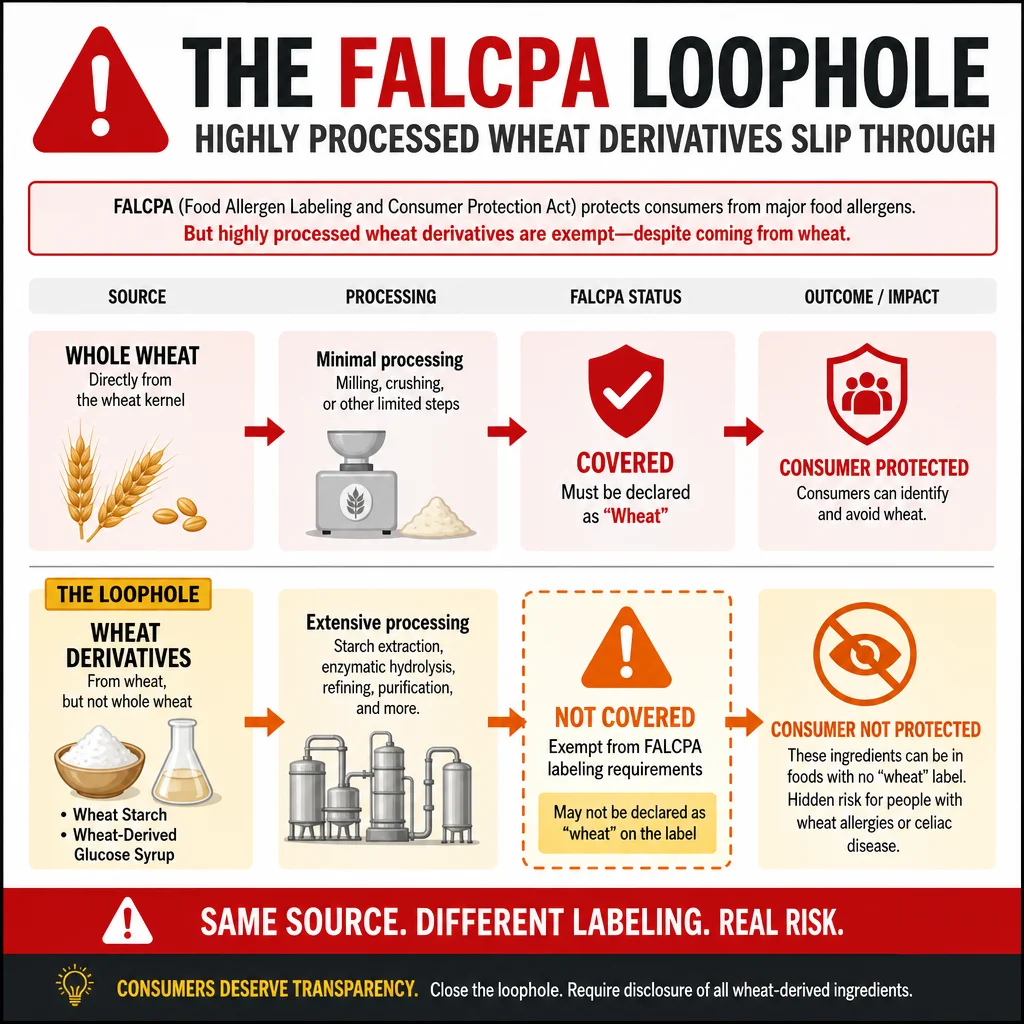
In the United States, wheat is one of the nine major allergens under FALCPA. However, the law creates a unique loophole for highly processed wheat derivatives. Wheat that has been processed to remove gluten, such as wheat starch or wheat-derived glucose syrup, may be exempt from the allergen declaration in certain cases. This creates confusion for consumers who need to avoid all wheat-derived ingredients.

This guide covers everything you need to know about reading labels for wheat allergy: the FDA's requirements, the FALCPA loophole, the complete list of wheat-derived ingredients, the difference between wheat allergy and celiac disease, and the practical steps you can take to identify wheat in packaged food.

What the FDA's Labeling Law Actually Requires

The Food Allergen Labeling and Consumer Protection Act of 2004 (FALCPA) requires that any FDA-regulated packaged food that contains a major food allergen must declare it on the label. Wheat is one of the nine major allergens covered under FALCPA, alongside milk, eggs, fish, crustacean shellfish, tree nuts, peanuts, soy, and sesame.

In practice, this means that when a manufacturer uses a wheat-derived ingredient, one of two things must appear on the label:

The ingredient list must use the common or usual name of the food source (e.g., "flour (wheat)" or "wheat gluten"), or A "Contains: Wheat" statement must appear immediately following or adjacent to the ingredient list.

Both approaches are compliant. Either gives you notice that the product contains a wheat-derived ingredient.

The FALCPA Loophole for Highly Processed Wheat Derivatives

FALCPA contains a specific exemption for highly processed wheat derivatives. The law states that wheat that has been processed to remove gluten, such as wheat starch or wheat-derived glucose syrup, may be exempt from the allergen declaration if the FDA determines that the ingredient no longer contains allergenic protein.

In practice, this means that some products may contain wheat-derived ingredients without declaring wheat on the label. This is a significant loophole for individuals with wheat allergy. The FDA has issued guidance on this exemption, but the rules are complex and not always clear to consumers.

The 2025 FDA Guidance Update

In January 2025, the FDA published the 5th edition of its Food Allergen Labeling Guidance. The update clarified that the wheat allergen declaration applies to all wheat-derived ingredients, including those that have been highly processed. However, the exemption for certain wheat derivatives remains in place, creating ongoing confusion.

For individuals with wheat allergy, the safest approach is to avoid all wheat-derived ingredients, even those that may be exempt from the allergen declaration. This includes wheat starch, wheat-derived glucose syrup, and other highly processed wheat derivatives.

Where FALCPA Does Not Apply

FALCPA applies to packaged foods regulated by the FDA. It does not apply to:

Restaurant food and foodservice. No federal law requires restaurants to label allergens. Some states have their own requirements, but at the federal level, you must ask directly. USDA-regulated products. Most meat, poultry, and egg products fall under USDA jurisdiction rather than FDA. These are not covered by FALCPA, though USDA has its own allergen labeling guidance. Alcohol. Beverages regulated by the TTB have separate labeling rules. Some beers and malt beverages contain wheat. Non-packaged foods. Foods sold loose, in bulk, or without standard packaging may not carry ingredient labels at all.
Wheat Allergy vs. Celiac Disease vs. Gluten Sensitivity

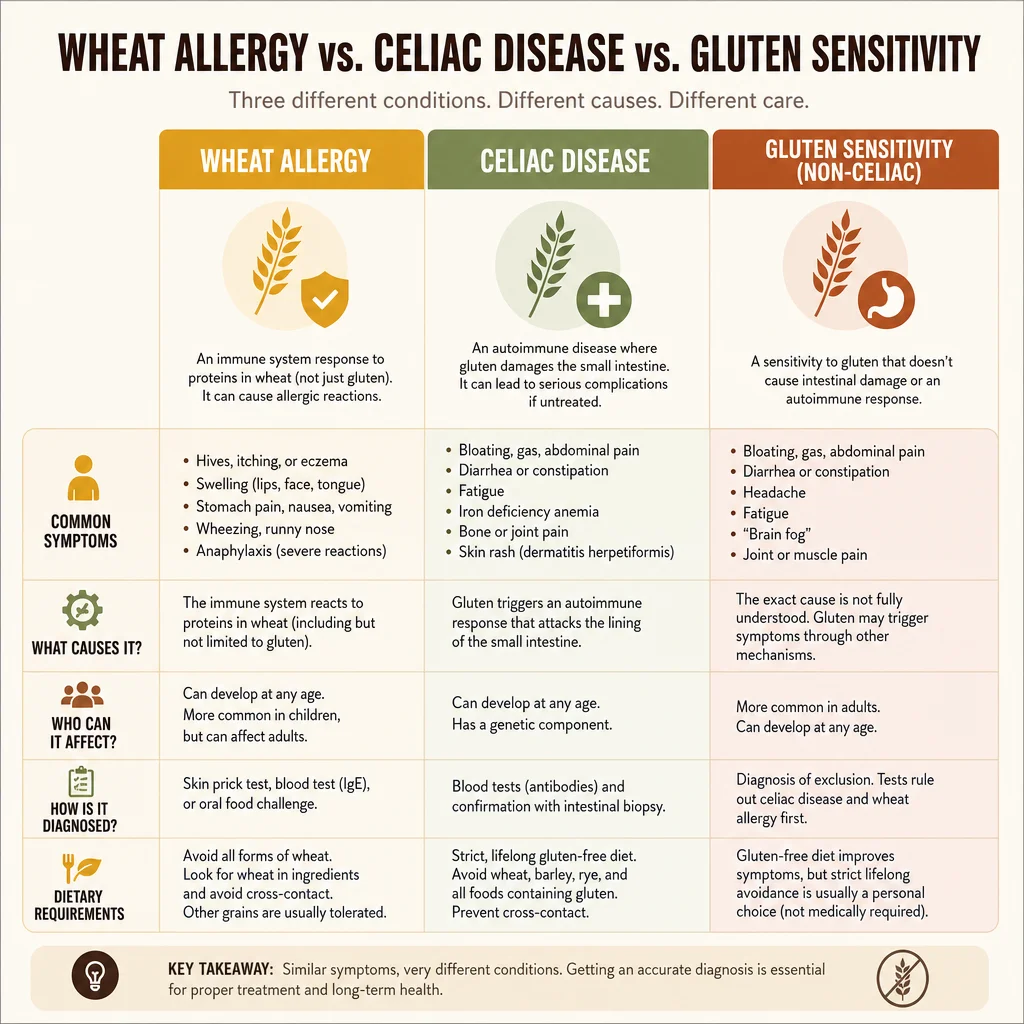
These three conditions are often confused, but they are distinct:

Wheat Allergy

Wheat allergy is an immune system reaction to proteins in wheat. It is an IgE-mediated allergy, similar to peanut or shellfish allergy. Symptoms can range from mild (hives, itching) to severe (anaphylaxis). Wheat allergy is most common in children and is often outgrown by adulthood.

Celiac Disease

Celiac disease is an autoimmune disorder triggered by gluten, a protein found in wheat, barley, and rye. It is not an allergy. When individuals with celiac disease consume gluten, their immune system attacks the small intestine. Celiac disease requires a strict gluten-free diet for life.

Non-Celiac Gluten Sensitivity

Non-celiac gluten sensitivity is a condition in which individuals experience symptoms similar to celiac disease when they consume gluten, but they do not have the autoimmune response or intestinal damage seen in celiac disease. The mechanisms are not well understood, but the treatment is the same: a gluten-free diet.

Why the Distinction Matters for Label Reading

For individuals with wheat allergy, the concern is wheat-derived ingredients. For individuals with celiac disease or gluten sensitivity, the concern is gluten-containing ingredients (wheat, barley, rye, and sometimes oats). This means that:

A product labeled "gluten-free" is safe for celiac disease but may not be safe for wheat allergy if it contains wheat-derived ingredients that are gluten-free. A product labeled "wheat-free" may still contain barley or rye, which are unsafe for celiac disease.

The Complete List of Wheat-Derived Ingredients

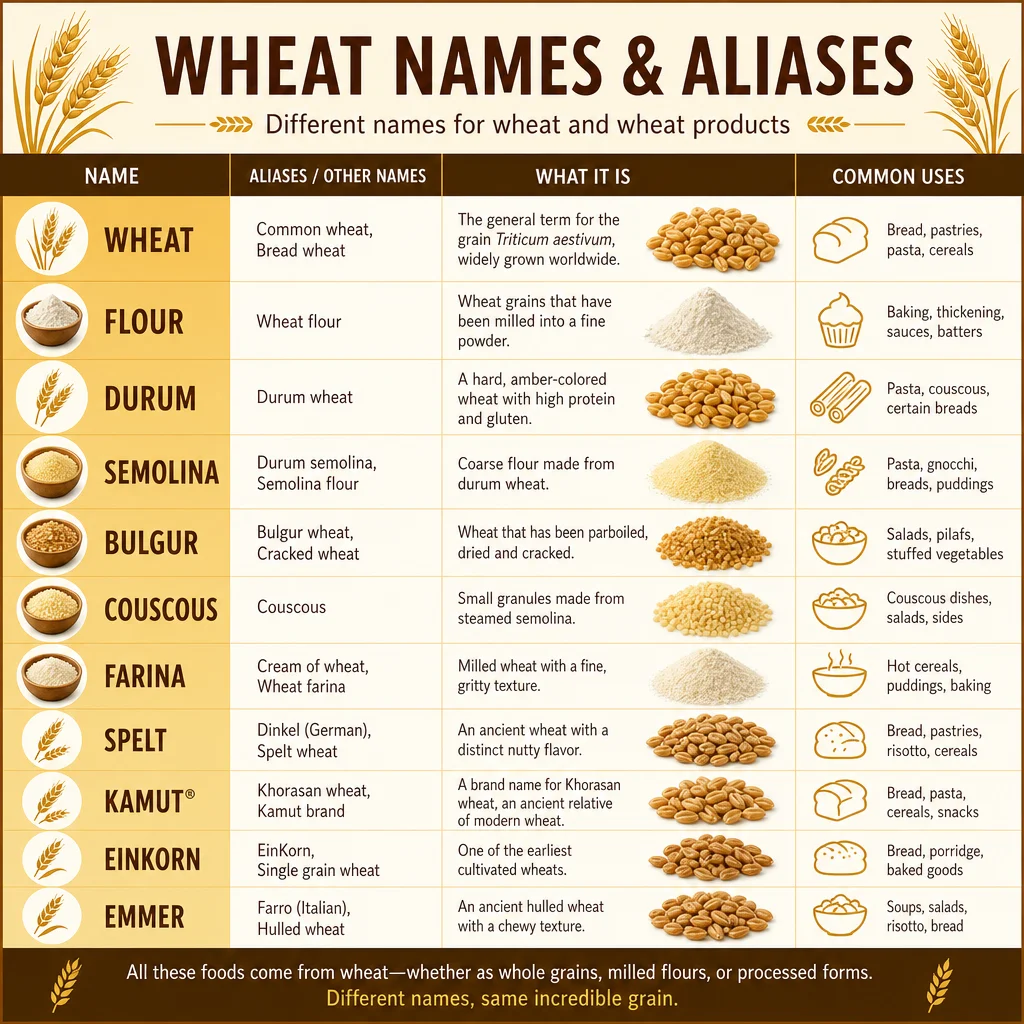
Even on FDA-regulated packaged foods, recognizing wheat requires knowing every alias. The following ingredients all indicate wheat-derived content:

Direct Wheat Forms

Wheat Whole wheat Whole wheat flour Wheat flour White wheat flour All-purpose flour Bread flour Cake flour Pastry flour Durum wheat Durum flour Semolina Bulgur Couscous Farina Farro Einkorn Emmer Spelt Kamut

Wheat-Derived Ingredients

Wheat bran Wheat germ Wheat gluten Wheat starch Wheat protein Wheat extract Wheat syrup Wheat malt Wheat malt extract Wheat-derived glucose syrup Wheat-derived dextrose Wheat-derived maltodextrin Hydrolyzed wheat protein Hydrolyzed wheat starch Modified wheat starch Pregelatinized wheat starch

Barley Barley malt Barley extract Barley flour Malt Malt extract Malt flavoring Malt syrup Rye Rye flour Triticale

Oats (Cross-Contamination Risk)

Oats Oat flour Oat bran Oat groats

Oats are naturally gluten-free, but they are often cross-contaminated with wheat during processing. Individuals with celiac disease or wheat allergy should look for certified gluten-free oats.

Where Wheat Unexpectedly Appears in Food

Even careful shoppers can be caught by wheat in products where it is not intuitive. These are the categories most likely to contain wheat-derived ingredients:

Sauces and Soups

Wheat flour is commonly used as a thickener in sauces and soups. Cream-based sauces, gravies, and soup bases often contain wheat flour.

Processed Meats

Some processed meats, including hot dogs, sausages, and deli meats, use wheat-derived ingredients as binders or fillers.

Soy Sauce

Traditional soy sauce is made from wheat and soybeans. Tamari is a wheat-free alternative, but some brands of tamari still contain wheat. Always check the label.

Imitation Seafood

Surimi (imitation crab) often contains wheat as a binder. Some brands also use wheat starch.

Beer and Malt Beverages

Beer and malt beverages are made from malted barley, which contains gluten. Some gluten-free beers are made from alternative grains, but traditional beer is not safe for wheat allergy or celiac disease.

Medications and Supplements

Some medications and supplements use wheat starch as a filler or binder. This is not a food labeling issue but is worth noting for individuals with severe wheat allergy.

Cosmetics and Personal Care Products

Some cosmetics and personal care products contain wheat-derived ingredients, such as wheat germ oil or hydrolyzed wheat protein.

Reading EU Labels for Wheat

If you consume imported European products or travel within the EU, the labeling rules are different. Under EU Regulation 1169/2011, cereals containing gluten (listed as "cereals containing gluten and products thereof") are one of 14 allergens that must be declared and must be visually distinct from the rest of the ingredient list.

The EU lists "cereals containing gluten" as a single category, which includes wheat, rye, barley, oats, spelt, kamut, and their hybridized strains. This means that on a European product, all gluten-containing cereals are grouped together under one allergen declaration.

The Gluten-Free Labeling Rule

The FDA has a separate rule for gluten-free labeling. A product labeled "gluten-free" must contain less than 20 parts per million (ppm) of gluten. However, this rule does not address wheat allergy. A product labeled "gluten-free" may still contain wheat-derived ingredients that are gluten-free, such as wheat starch that has been processed to remove gluten. For individuals with wheat allergy, a "gluten-free" label does not guarantee safety.

A Practical Label-Reading Strategy

Wheat is one of the nine major food allergens under FALCPA. Any FDA-regulated packaged food that contains wheat must declare it either in a "Contains" statement or by using the word "wheat" in the ingredient list.

When scanning a product for wheat content:

Check the "Contains" statement first. It is the fastest single-line summary. If it says "Contains: Wheat," the product is not safe. Scan the ingredient list for every known wheat alias. The word "wheat" is the most common declaration. But wheat also appears under these names: flour, whole wheat, durum, semolina, bulgur, couscous, farina, farro, spelt, kamut, einkorn, emmer, wheat bran, wheat germ, wheat gluten, wheat starch, wheat protein, wheat extract, wheat syrup, wheat malt, hydrolyzed wheat protein, modified wheat starch, and wheat-derived glucose syrup. Check for gluten-containing ingredients. Barley, rye, malt, malt extract, and triticale all contain gluten and are derived from wheat-related grains. For individuals with wheat allergy, these may also be problematic. Check for "gluten-free" labels. A product labeled "gluten-free" may still contain wheat-derived ingredients that are gluten-free. For wheat allergy, "gluten-free" does not guarantee safety. Check Asian sauces. Traditional soy sauce contains wheat. Look for tamari or coconut aminos as alternatives, but always check the label. Check processed meats. Some hot dogs, sausages, and deli meats use wheat as a binder or filler. Check imitation seafood. Surimi (imitation crab) often contains wheat starch. Check beer and malt beverages. Traditional beer is made from malted barley and is not safe for wheat allergy. Look for precautionary statements. "May contain wheat" or "Made in a facility that also processes wheat" appear after the ingredient list or in a separate advisory box. For highly sensitive individuals, these statements warrant avoidance. On imported products, look for bold or contrasting allergen text. European products use boldface for major allergens including cereals containing gluten.

Using IngrediCheck, you can scan any packaged food and immediately flag every known wheat-derived ingredient, regardless of which alias the manufacturer used, including hidden names like farro, kamut, and spelt that do not appear on most consumer allergen reference lists.

For more information on reading labels for other major allergens, see our Peanut Dietary Guide.

Next Label Check

Follow the scanner, hub, and ingredient paths connected to this guide

Get the app for clearer label decisions.

Scan labels, see what fits your food notes, and read the why in plain English.

IngrediCheck app