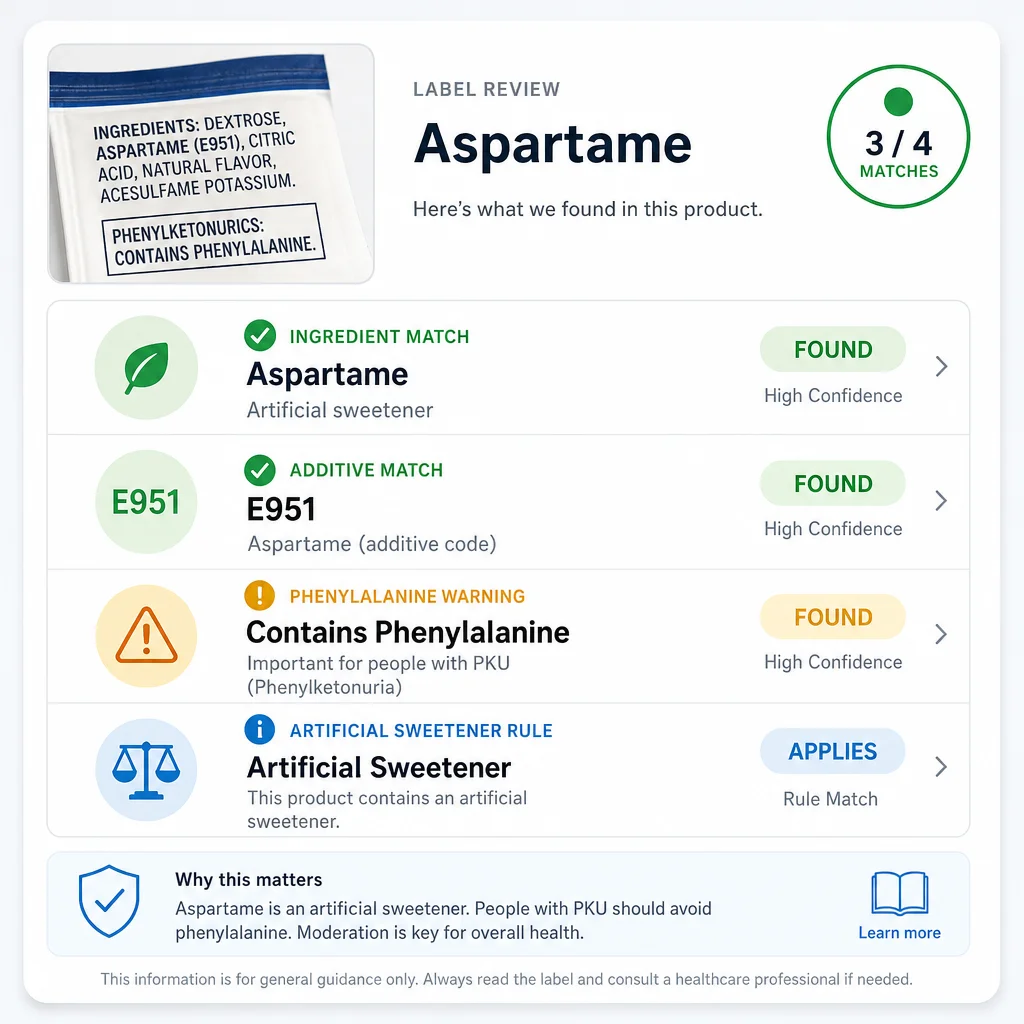
Aspartame became a headline ingredient again in 2023 because two expert groups reached conclusions that sounded contradictory at first glance. The International Agency for Research on Cancer classified aspartame as "possibly carcinogenic to humans." At the same time, the Joint FAO/WHO Expert Committee on Food Additives reaffirmed the existing acceptable daily intake.
That is not a simple "safe" or "unsafe" story. It is a hazard-versus-risk story, and that distinction matters when you are reading a food label.
Aspartame is still permitted in the United States, Europe, Canada, and many other markets. The FDA says its scientists do not have safety concerns when aspartame is used under approved conditions. The WHO release says the IARC classification was based on limited evidence, while JECFA did not change the acceptable daily intake of 40 mg per kilogram of body weight.
For shoppers, the practical question is narrower: do you want to flag aspartame when it appears on a label, and what should you do with that information?
For a product-level comparison, see our gum without aspartame guide, which separates sugar-containing and sugar-free options.
What Aspartame Is
Aspartame is a high-intensity non-sugar sweetener. It is much sweeter than table sugar, so manufacturers can use small amounts to sweeten drinks and foods without adding much sugar or many calories.
You are most likely to see it in:
- diet soft drinks
- powdered drink mixes
- sugar-free gum
- tabletop sweetener packets
- light yogurts
- sugar-free gelatin
- reduced-sugar desserts
- cough drops and chewable vitamins
It may appear simply as aspartame. In the European additive-number system it is E951. In the United States, products containing aspartame must also carry a phenylalanine warning for people with phenylketonuria, often written as phenylketonurics: contains phenylalanine.
That warning is not a general cancer warning. It is for people with PKU, a rare inherited disorder that affects the body's ability to process phenylalanine.
Why the 2023 Classification Was Confusing
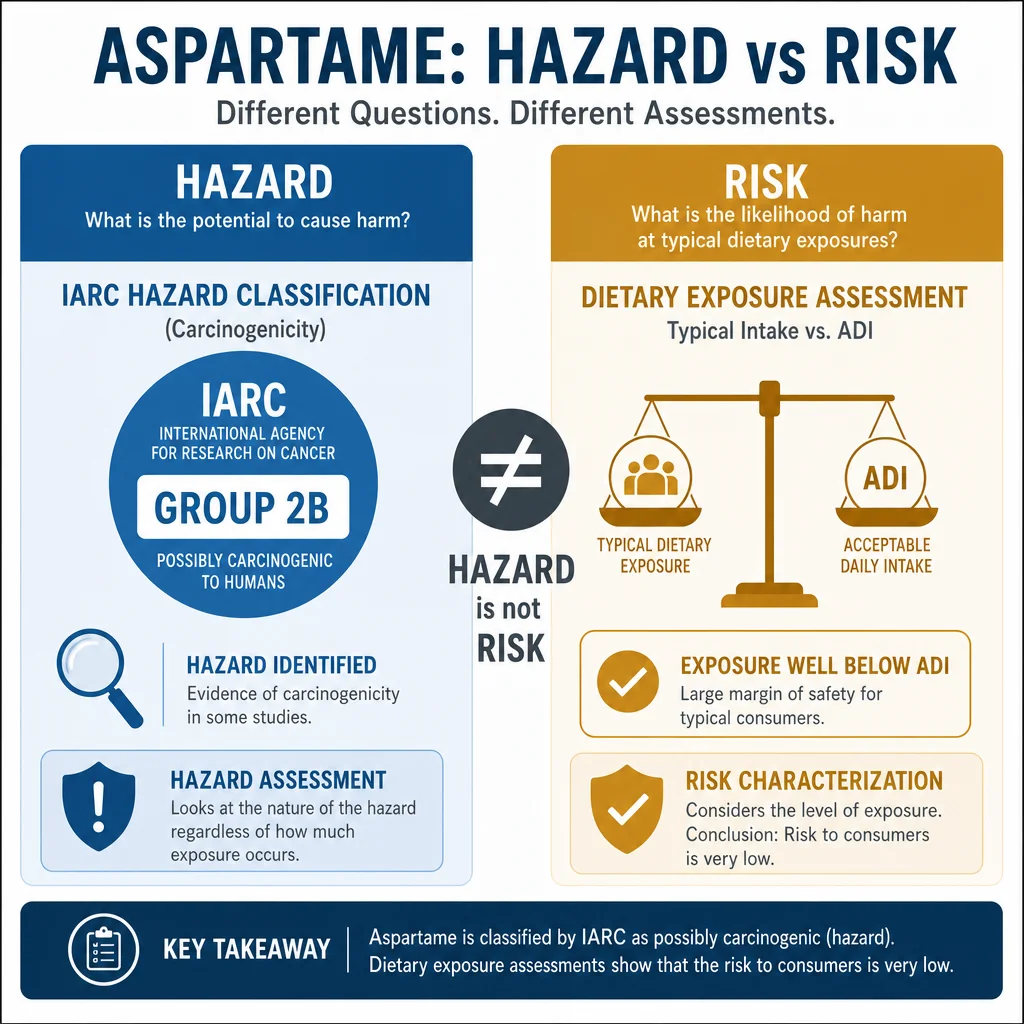
The 2023 announcement involved two different kinds of scientific review.
IARC does hazard identification. It asks whether an agent can cause cancer under some conditions. It does not decide how likely a person is to develop cancer at normal exposure levels.
JECFA does dietary risk assessment. It looks at food-additive exposure, dose, and whether the existing intake limit remains protective.
That is why the same announcement can say two things at once:
- IARC classified aspartame as Group 2B, possibly carcinogenic to humans.
- JECFA reaffirmed the acceptable daily intake of 40 mg per kilogram of body weight.
The IARC summary says the human evidence was limited, specifically for hepatocellular carcinoma, a type of liver cancer. It also notes that chance, bias, or confounding could not be ruled out in the human studies.
That wording is important. It is not the same as saying aspartame has been proven to cause cancer in people at ordinary food-use levels.
What FDA Says
The FDA response is unusually direct. The agency says it disagrees with IARC's conclusion that the reviewed studies support classifying aspartame as a possible human carcinogen. FDA also notes that JECFA did not raise safety concerns under current levels of use and did not change the ADI.
In plain English, FDA's position is:
- aspartame remains approved
- the agency considers it safe under approved conditions of use
- the IARC classification does not mean aspartame has been shown to cause cancer
- people with PKU still need the phenylalanine warning
This is where label reading gets personal. A regulator can say an ingredient is permitted at current exposure levels, while a shopper may still choose to flag it because they avoid artificial sweeteners, are managing migraines, are trying to reduce ultra-processed foods, or simply prefer products sweetened another way.
IngrediCheck should support that distinction. The app should not claim aspartame is universally bad. It should help you find it when your saved rule says it matters.
The ADI Is Not a Serving Recommendation
The acceptable daily intake is often misunderstood. It is not a recommended target and not a serving suggestion. It is a conservative intake level that regulators consider acceptable to consume daily over a lifetime.
The American Cancer Society summarizes the numbers this way: FDA's ADI for aspartame is 50 mg per kilogram of body weight per day, while JECFA and EFSA use 40 mg per kilogram per day. ACS also notes that a 70 kg adult would need roughly 9 to 14 cans of diet soda per day, depending on aspartame level, to exceed the 40 mg per kilogram level.
That perspective helps avoid panic. It also does not make the ingredient irrelevant. Most people are not doing ADI math in a grocery aisle. They are deciding whether a product fits their household's rules.
It also helps separate occasional exposure from routine exposure. A person who drinks one diet soda at a restaurant is making a different decision from someone buying several aspartame-sweetened drinks, gum, powders, and desserts every week. The label question is still specific: how often does this ingredient show up across your real shopping pattern, and do you want the app to flag it each time?
How Aspartame Differs From Other Sweeteners
Aspartame is not the same as sucralose, saccharin, acesulfame potassium, stevia, or neotame.
It has a few practical label differences:
- it breaks down with prolonged high heat, so it is less useful in baking than some other sweeteners
- it contains phenylalanine, which matters for PKU
- it often appears with acesulfame potassium in drinks and desserts
- it has decades of public safety debate, which makes it more recognizable than newer sweeteners
If you are reading labels for sugar reduction, aspartame may be part of a useful tradeoff. If you are reading labels for clean-label or minimal-additive preferences, it may be a term you flag automatically.
That is why artificial sweetener is often too broad as a single rule. Some shoppers treat aspartame differently from stevia or monk fruit. Others want every high-intensity sweetener flagged, including blends that combine aspartame with acesulfame potassium. A good scanner should preserve that detail instead of collapsing every sweetener into one generic warning.
For adjacent sweetener background, compare this post with Neotame: The Ultra-Potent Sweetener Most Shoppers Never Notice, Acesulfame K: The Artificial Sweetener Aldi No Longer Wants, and Sucralose in Baking: What EFSA's 2026 Assessment Means for You.
Where Label Context Matters Most
Aspartame is easy to spot when the label is short. It becomes harder when it is part of a broader sweetener system.
Watch for it in products that stack several sweetening tools:
- diet soda with aspartame and acesulfame potassium
- sugar-free gum with aspartame and polyols
- light yogurt with aspartame, fruit flavor, and stabilizers
- powdered drink mix with aspartame, maltodextrin, and color additives
- cough drops with aspartame and sugar alcohols
The ingredient itself is one question. The product pattern is another. A label with aspartame, acesulfame K, artificial colors, preservatives, and multiple gums is telling you something about the formulation even if each ingredient is individually permitted.