Azodicarbonamide: The 'Yoga Mat Chemical' US Bakers Are Removing

The dough conditioner nicknamed the 'yoga mat chemical' is being voluntarily phased out by the US baking industry in 2026. Here's what it is, why it was controversial, and how to avoid it.

May 28, 2026|9 min read
By Sanket Patel|Updated 2026-05-28|3 sources|Editorial standards
Azodicarbonamide: The 'Yoga Mat Chemical' US Bakers Are Removing

In February 2026, the American Bakers Association (ABA) announced something quietly significant: nearly 95% of its member companies had already stopped using azodicarbonamide in their baked goods, with the remaining holdouts committed to a full phase-out by December 31, 2026. The voluntary commitment, called the "Baked Goods Ingredient Pledge," marks the end of a long relationship between the US baking industry and a chemical that has been banned in most of the developed world for over two decades.

Most Americans have never heard of azodicarbonamide. But many of them have eaten it. And many more learned its nickname in 2014, when a viral campaign forced Subway to remove it from its bread. The nickname stuck: the yoga mat chemical.
What Is Azodicarbonamide?

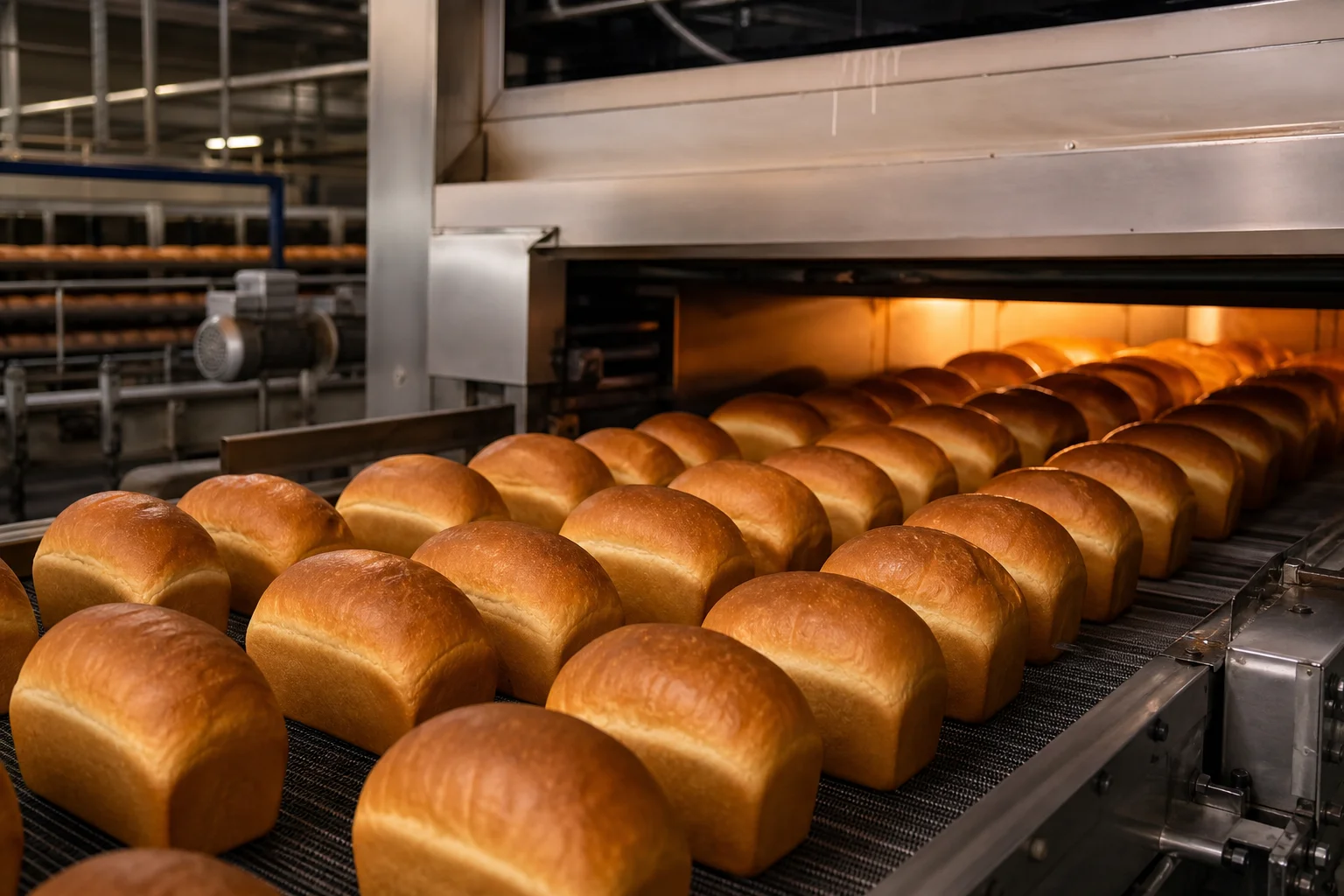
Azodicarbonamide (ADA) is a synthetic chemical used as both a flour bleaching agent and a dough conditioner in industrial bread-making. When added to flour, it strengthens the gluten network so dough rises more predictably, handles better on high-speed machinery, and produces a more consistent crumb. For large commercial bakeries churning out thousands of loaves per hour, that consistency translates directly to production efficiency.

The US Food and Drug Administration approved ADA as a food additive in 1962, designating it generally recognized as safe (GRAS) at up to 45 parts per million in flour. That approval has never been formally revisited.

ADA has a parallel industrial life: it is used as a blowing agent in the manufacture of foam rubber and plastic products, including yoga mats. The compound that puffs up bread dough also inflates athletic equipment. When that connection surfaced publicly in 2014, it proved impossible to unsee.

The Breakdown Products That Raised Alarms

The Breakdown Products That Raised Alarms

ADA itself does not remain in finished bread. The heat of baking causes it to decompose. The problem is what it breaks down into.

The two compounds that have drawn regulatory attention are semicarbazide and urethane.

Semicarbazide forms during baking when ADA passes through an intermediate compound called biurea. Research published in the Journal of Agricultural and Food Chemistry traced this pathway in detail, finding semicarbazide in the crusts of breads baked from ADA-treated flour at measurable levels. In animal studies at high doses, semicarbazide increased tumor incidence in female mice — though not in male mice or in rats of either sex. The International Agency for Research on Cancer classifies semicarbazide as Group 3 (not classifiable as to carcinogenicity in humans), reflecting limited and inconsistent evidence.

Urethane (ethyl carbamate) is the more concerning of the two. IARC classifies urethane as Group 2A, meaning it is probably carcinogenic to humans, based on sufficient animal evidence. As the Environmental Working Group notes, urethane also damages the reproductive system in animal models.

The FDA's position has been that human exposure to these breakdown products from ADA-treated bread falls well below levels shown to cause harm in animal studies. The agency has not recommended that consumers change their diets. Regulators in other jurisdictions weighed the evidence differently.

Where ADA Is Banned

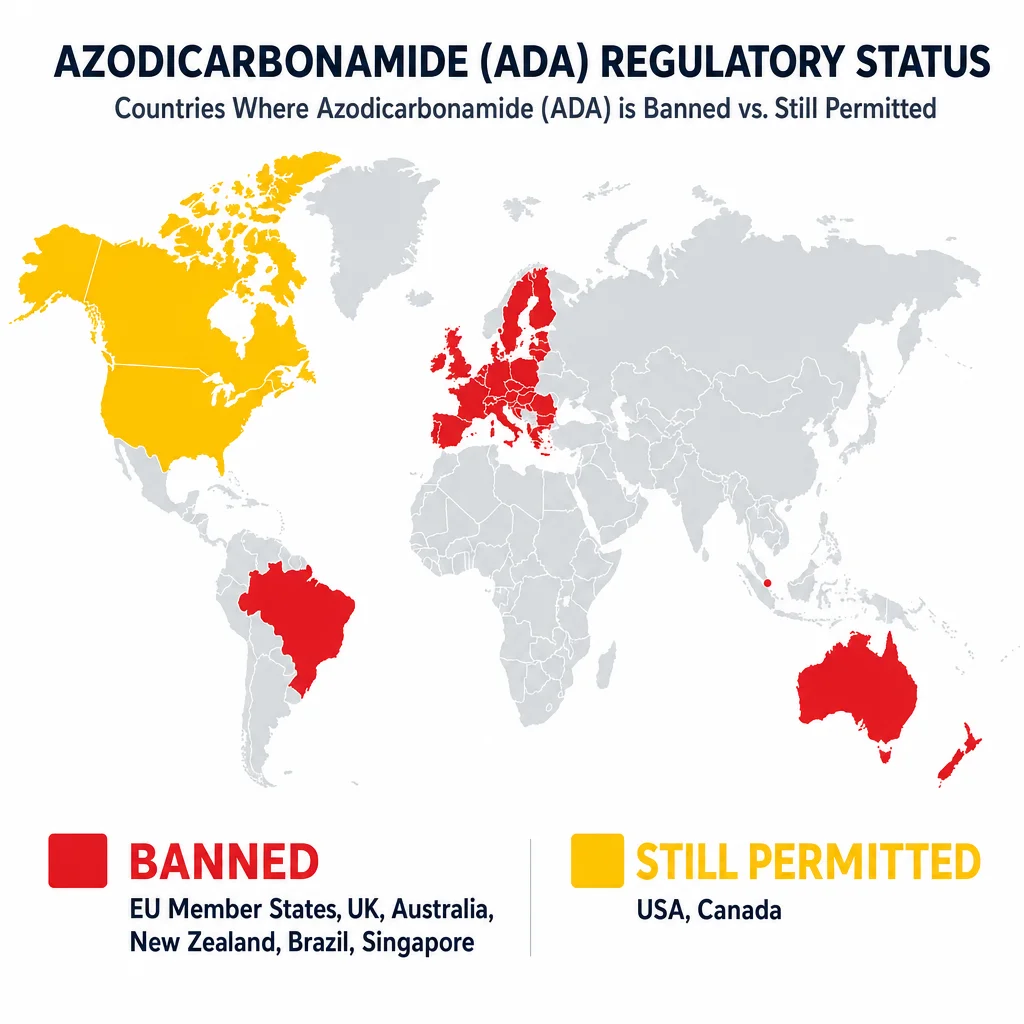
The European Union banned ADA as a food additive in 2005, following the European Food Safety Authority's concerns about semicarbazide migration from food contact materials. The UK retained that prohibition after Brexit. Australia and New Zealand prohibit it under the FSANZ regulatory framework. Brazil and Singapore have also banned it.

Canada remains the only other major Western jurisdiction still permitting ADA at the same 45 ppm limit as the US. That makes the US-Canada pair an outlier in a field that includes most of North America's peer economies.

According to a comprehensive 2026 regulatory analysis by PolicyCanary, the UK's Health and Safety Executive has additionally classified ADA as a respiratory sensitizer in occupational contexts. The WHO has documented that workers who handle ADA powder in industrial settings report respiratory symptoms, allergic reactions, and asthma — a profile that has contributed to regulatory discomfort with the ingredient even at the low levels found in baked goods.

The Viral Moment That Changed Industry Behavior

The public reckoning with ADA began in early 2014, when food blogger Vani Hari, known as the "Food Babe," published a petition calling out Subway for using ADA in its bread recipe. The petition highlighted the yoga mat connection and gathered hundreds of thousands of signatures within days. National media picked it up. The story spread across social platforms in a way that food additive controversies rarely do.

Subway announced within weeks that it would remove ADA from its bread. The speed of that response signaled how seriously the company took reputational risk from the campaign.

That episode set off a sustained, quiet reformulation movement across the baking industry. Consumers had learned to read ingredient labels for ADA, and brands that wanted clean-label positioning had a new reason to reformulate. The trend continued gradually through the late 2010s and accelerated in the early 2020s.

By the time the ABA surveyed its members in 2025, 95% had already completed the switch.

2026: The Formal Wind-Down

2026: The Formal Wind-Down

The ABA's February 2026 announcement made the industry's position official. The Baked Goods Ingredient Pledge commits the remaining 5% of ABA member companies to complete their phase-out by December 31, 2026. ABA president Eric Dell described the move as the industry "meeting evolving consumer expectations" while continuing to deliver on nutrition and quality.

The pledge follows two earlier ABA voluntary commitments: the Baked Goods in Schools Pledge and the Baked Goods FD&C Colors Pledge, which committed to removing synthetic dyes from school-served products. Together they reflect an industry strategy of getting ahead of regulatory requirements rather than waiting to be mandated.

ADA is not federally banned in the US. The FDA has not moved to revoke its GRAS status. Under the MAHA (Make America Healthy Again) initiative, HHS has signaled broader intentions to revisit the safety of long-approved additives, and a 2026 congressional bill would require the FDA to reassess at least ten food substances annually — a category ADA would likely fall into. At the state level, New York's pending bill A1556/S1239 would ban ADA outright alongside six other food additives. Texas SB 25 would require warning labels for ADA and 43 other ingredients, though enforcement remains enjoined under a federal court finding that the warning requirement likely compels speech in violation of the First Amendment.

Until a federal ban arrives, ADA remains technically permitted. Smaller bakeries not affiliated with the ABA, some food service suppliers, and certain imported products may still use it. The broader picture of which additives are currently banned or under review at the state level is covered in our state food ingredient bans overview for 2026.

What Bakers Are Using Instead

The commercial alternatives to ADA are well established and widely used in countries where it has long been banned.

Ascorbic acid (vitamin C) is the most common replacement. It conditions dough, strengthens gluten, and improves rise in a manner functionally similar to ADA. It is permitted everywhere ADA is banned and carries no meaningful safety concerns at food-use levels.

DATEM (diacetyl tartaric acid ester of mono- and diglycerides) is another dough conditioner that many large bakeries already use alongside or in place of ADA.

Enzyme-based systems using lipases, amylases, and hemicellulases achieve similar structural effects through biological rather than chemical action. These have grown in use as bakeries seek cleaner label ingredient lists.

The industry transition away from ADA has not required meaningful compromises on bread quality or shelf life. European consumers have long had access to breads made without ADA, and no evidence suggests the final product differs in ways consumers notice.

How to Check Your Bread

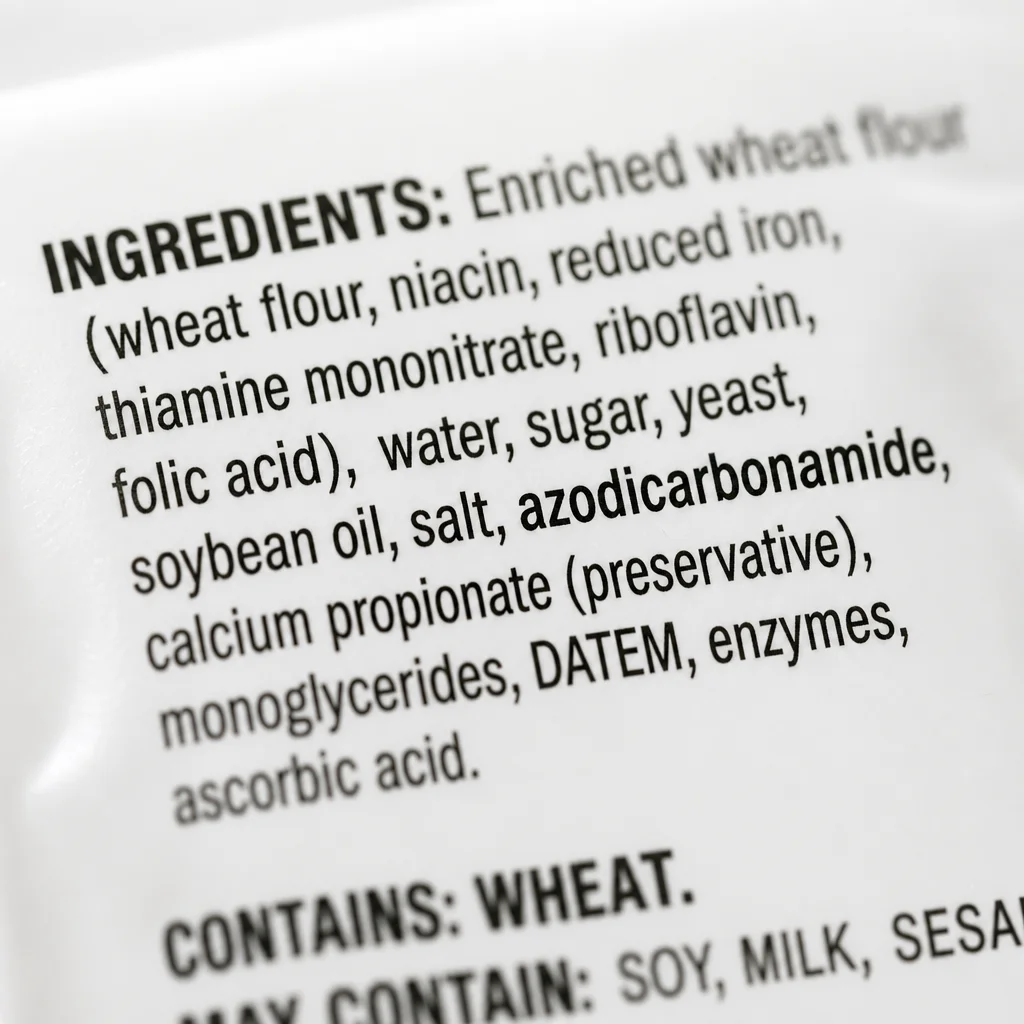
Under US labeling law, all intentional food additives must be declared on the ingredient label. Azodicarbonamide must appear by its full name. There are no aliases or E-numbers that substitute for it on US labels.

Products most likely to still contain it include commercial white and wheat sandwich bread, hamburger and hot dog buns, flour tortillas, and frozen bread doughs. Bread labeled "no artificial additives," certified organic, or positioned as clean-label will not contain ADA. Artisan sourdough and most fresh-baked bakery bread also avoid it by their nature.

By the end of 2026, ADA should be essentially absent from major branded bread in US supermarkets. Until that point — and for any product outside the ABA membership — the ingredient label is the only reliable guide.

Using IngrediCheck, you can scan any packaged bread, tortilla, or baked product to instantly check whether azodicarbonamide appears in the ingredient list, helping you make ADA-free choices without spending minutes squinting at fine print at the store.

Next Label Check

Follow the scanner, hub, and ingredient paths connected to this guide

Get the app for clearer label decisions.

Scan labels, see what fits your food notes, and read the why in plain English.

IngrediCheck app