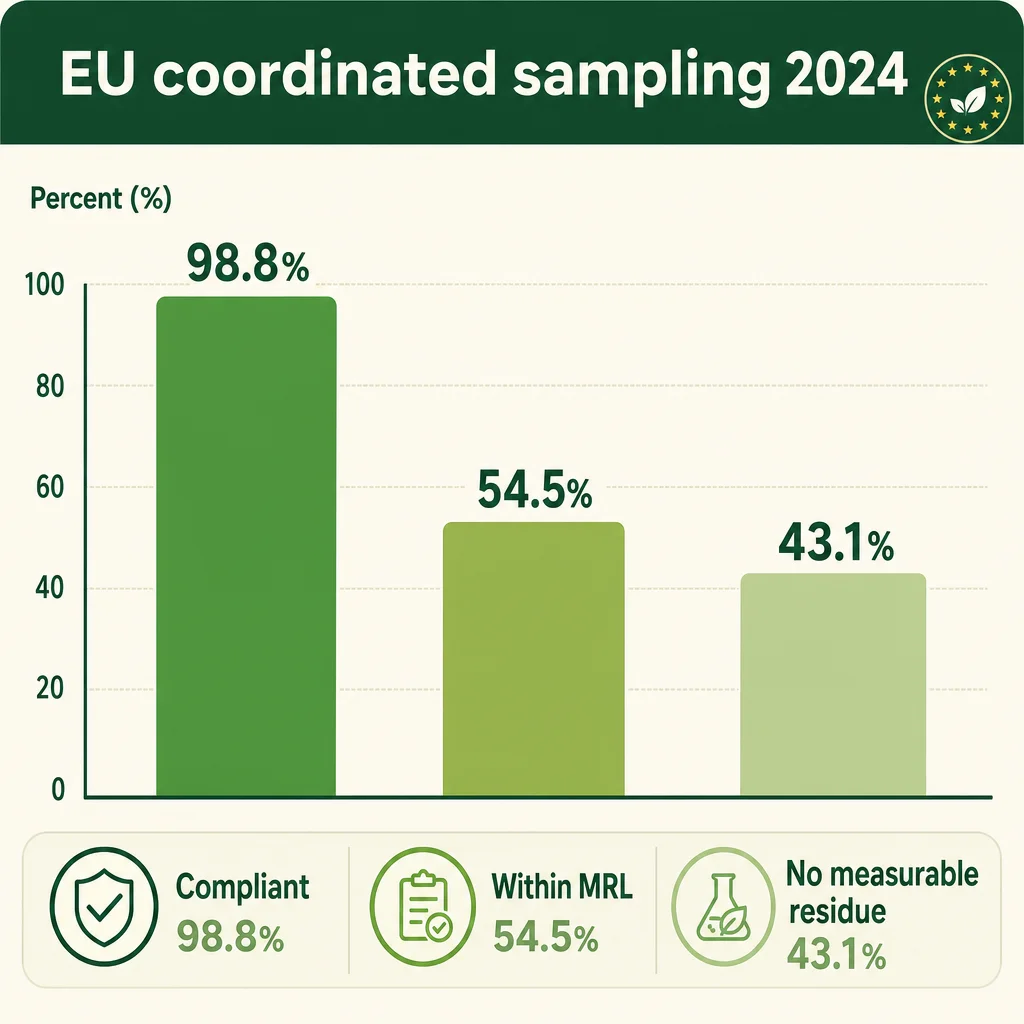
EFSA's publication reflects three complementary programmes:
- EU-coordinated multiannual sampling, where Member States (plus Norway and Iceland under the relevant agreements) target the same basket of foods on a repeating schedule so trends stay comparable across years.
- National Multiannual Control Programmes (MANCP), where countries prioritise domestic risks, trade patterns, and historically problematic commodities.
- Sampling linked to increased import controls, where certain hazards, products, or origins trigger closer border surveillance under EU rules.
Together, those streams produced more than 125,000 analytical results for the report cycle discussed in EFSA's May 2026 summary.
EU-coordinated samples: stability at retail
For the 2024 EU-coordinated basket, authorities collected 9,842 samples covering foods such as aubergines, bananas, broccoli, cultivated fungi, grapefruits, melons, sweet peppers, table grapes, virgin olive oil, wheat grain, bovine fat, and chicken eggs. These are everyday staples for millions of households.
According to EFSA's published figures for that coordinated slice:
- 98.8% of samples met legal limits.
- 43.1% contained no measurable pesticide residues.
- 54.5% contained one or more residues within maximum residue levels (MRLs).
- 2.4% exceeded MRLs in initial testing, with 1.2% ultimately classified as non-compliant after confirmatory steps described in official methodology.
Those coordinated numbers are broadly in line with the previous comparable cycle in 2021, when 98.7% of samples from the same commodity rotation met legal limits. Stability matters because it suggests that major shifts in agricultural practices or enforcement are not showing up as a sudden breakdown in retail compliance at EU level.
National programmes: most samples, similar compliance picture
MANCP work accounted for 86,449 samples in the same reporting window. Here EFSA reports 98.2% compliant results, compared with 98.0% in 2023 and 97.8% in 2022.
Roughly 58.4% of MANCP samples showed no quantifiable residues, while 38.3% contained residues within MRLs. Exceedances occurred in 3.3% of samples, with 1.8% deemed non-compliant after follow-up.
Because MANCP sampling follows national priorities, it often captures foods that carry higher intrinsic variability: regional specialties, smaller producers, or categories that historically drove alerts. Yet the overall compliance band stays narrow year to year, which is what risk managers want to see before they refine enforcement priorities.
Import controls: a different risk profile
For the first time in this reporting format, EFSA separates samples taken under increased import controls from the MANCP totals that previously swallowed those figures. That matters at the dinner table because border programmes focus on consignments where geography, past non-compliance, or known hazards justify tighter scrutiny.
From 39,433 import samples:
- 38.3% had no quantifiable residues.
- 56.2% had residues within legal limits.
- 5.5% exceeded MRLs, with 3.6% classified as non-compliant.
Those percentages are not directly comparable to a random grocery shelf in Berlin or Lisbon. They describe a risk-targeted slice of global trade. Still, they explain why shoppers sometimes hear about rejected shipments or border rejections even when domestic retail sampling looks comparatively calm.